IMF’s Georgieva warns more AI correction to come
The head of the IMF said she expects “perhaps a little bit more” of a correction in financial markets related to artificial intelligence (AI), amid concerns the boom has been overdone and as the US seeks to crack down on the smuggling of high-end chips to China.
The Washington-based lender had anticipated an adjustment because enthusiasm was “way too high” and expects more to come, IMF managing director Kristalina Georgieva said in a Bloomberg Television interview with Stephen Engle in Shenzhen, China, yesterday.
“At this point we don’t see a major correction, but we do expect perhaps a little bit more,” Georgieva said, adding that it would “bring us to a more sustainable place.”
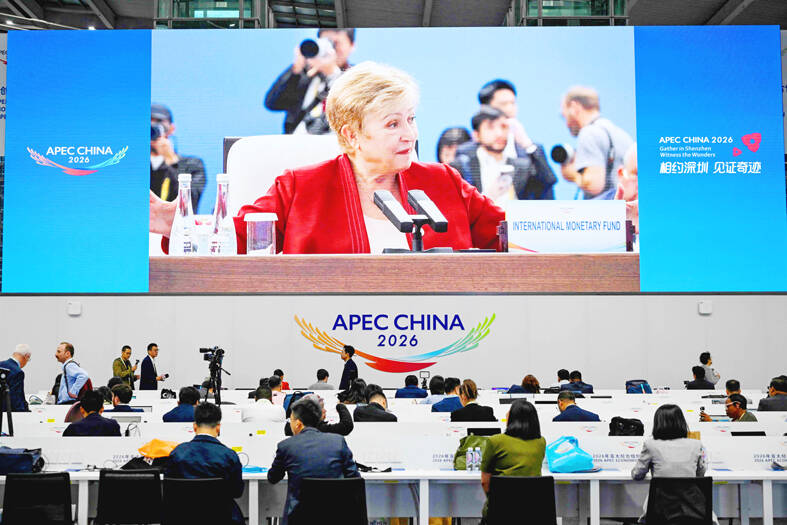
IMF managing director Kristalina Georgieva is pictured on a screen at the APEC Economic Leaders’ Meeting during the APEC summit in Shenzhen, China, yesterday.
Photo: AFP
Jitters around the payoff from hefty investments into AI have fueled volatility in global markets. The NASDAQ 100 has dropped more than 4 percent this month, tracking its worst November performance since 2008.
Georgieva said that so-called circular financing, in which chipmakers such as Nvidia Corp provide funds for a buyer to purchase their gear, totals about US$1 trillion, with about two-thirds of that in debt.
While that is “not huge,” she said “what is concerning is the speed with which it grows,” along with the gradual shift away from equity toward more debt.
“This creates a potential financial stability risk,” she said.
However, it can be tempered “by being transparent around what is going on” and for companies to “be on the alert that maybe you’re stepping into a more dangerous territory,” she said.
Asked about the economic impact of new US rules on chips for Southeast Asian nations, she said that was “not yet much” of a threat.
However, the bigger risk is “if there is genuine separation of technological paths and countries are forced to choose, then that is going to be more dramatic,” she added.
KioskNews shows a cleaned-up reading view extracted from the publisher’s page — the original always lives on their site, not ours.