Cop31 live: ‘I will never give up’ UN chief tells climate summit ahead of last address
Good morning. Nearly all of the more than 90 world leaders who descended on Antalya in the past three days have now packed up their suitcases and lit out, some of them for the EU’s AI summit in Dublin. Anthony Albanese and the UN secretary-general are among the few to linger but will also head off later today.
With the departure of the circus, the real negotiations can begin, and a first draft of the cover decision for this Cop could come as soon as today, though over the weekend or Monday are still more likely. Look out for wording on the “overshoot” of 1.5C, climate science, the all-important transition away from fossil fuels, the electrification target and finance. The current “wishlist” can be perused here.
As double-hosted Cop31 gathers steam, the quest is also on for a venue for Cop33. Next year’s event will be in Ethiopia, and according to the complex systems of the 1992 UN Framework Convention on Climate Change, the meeting after that should be in Asia. But who will host?
As the Guardian revealed last night, it will not be China – a shame, according to many experts, who had been hoping that the world’s biggest emitter of greenhouse gases and second biggest economy would step up. China is undergoing a massive economic transformation, swapping reliance on coal and oil for electricity generated from renewable sources. This has proved a boost to the country’s economy, as the clean and low-carbon sectors now make up more than a tenth of its GDP.
India also considered hosting Cop33, but dropped its early-stage proposal months ago. That leaves the field open, with Uzbekistan, Thailand, Korea and Indonesia also cited as potential bidders. No decision on the hosting is likely to be made at this Cop, as countries are likely to need more time to develop their bids.
Key events
Norway's top court rules three oil and gas permits invalid on climate grounds
Ignoring fossil fuel industry denial 'like telling the story of Little Red Riding Hood and leaving out the wolf' - US Senator
The world is now in the "age of electricity", energy agency boss says
Real negotiations can begin as world leaders depart
Activists from civil society – representing Indigenous peoples, women, trade unions, young people and others – are in the plenary room celebrating the work of António Guterres, the outgoing secretary-general of the United Nations, who is attending his last Cop (at least in this role) this year. Guterres has championed climate action in often fiery speeches over the years, and highlighted the injustices faced by the most vulnerable people in society.
“You pushed me to go further, to do more, and I am grateful for that,” he told the assembled civil society representatives.
“Dear friends, even in a divided world cooperation is possible,” he added. “You prove that every day.”
Far away from the conference centre, Norway’s supreme court has declared the state’s decision to award three permits for oil and gasfields in the North Sea invalid, as it had not accounted for the harm caused by burning the fuels.
The decision, hailed as a win by climate campaigners, does not automatically revoke the permits or demand an immediate shutdown of the fields, but will force the government to consider the global impacts of pollution before awarding licenses. It comes two days after the Norwegian prime minister, Jonas Gahr Stør, told fellow leaders at Cop31 that “Norway will do its part” in a speech that did not mention the country’s ongoing expansion of oil and gas infrastructure.
Tessa Khan, executive director of Uplift, which led legal challenges against the UK’s Jackdaw and Rosebank oilfields, called it a “historical ruling” that would be noted by decision-makers around the world.
“Today’s decision affirms what scientists and campaigners have been saying for years: burning more oil and gas is incompatible with a healthy and secure planet,” she said. “As Europe’s largest petrostate is forced to account for its climate harms, and with El Niño looming large, it is a timely reminder to all governments that their obligation to protect the public from climate harms is not up for political discussion. It is a legal requirement.”
Norway has argued that its oil and gas is produced more cleanly than many other major fossil fuel exporters, and that limits to its production would lead to more European dependence on countries with dirtier fuel and worse human rights. Studies estimate that for every 10 barrels of oil Norway stops producing, other suppliers will make six to nine more.
Climate campaigners have dismissed this argument as “the drug dealer’s defence”, arguing that almost every fossil fuel exporter is trying to be the last one to keep extracting dirty fuels, with justifications that range from the relative cleanliness of extraction processes to the right for poorer countries to exploit their natural resources.
My colleagues Fiona Harvey and Oliver Milman spoke today with Al Gore, the former US vice-president who championed global climate action with his documentary An Inconvenient Truth twenty years ago.
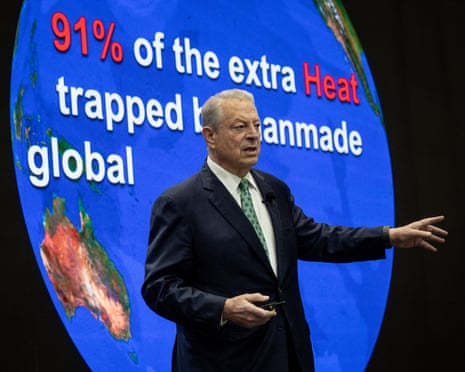
If the world were to meet 35% of final energy demand with electricity by 2035 – one of the key goals proposed at this Cop – it would represent one of the cheapest ways of getting to net zero greenhouse gas emissions, new data has shown.
The findings are from Climate Trace, a non-profit supported by former US vice-president Al Gore, which examines global emissions data. The analysis found that achieving the goal would result in emissions cuts of about 4bn tonnes of carbon dioxide equivalent per year, or about 7% of global emissions, even if the electricity were not generated entirely from renewable sources. If clean energy was used, the potential emissions cuts would be about 8bn tonnes a year, or 14% of global emissions.
As electricity is much more efficient than fossil fuels, and fossil fuel prices remain high, this would also represent a lower cost per tonne of removing carbon dioxide than other methods.
Gore told the Guardian in an interview: “You could double the emissions reductions at a fraction of the cost, if they simply do it in the right way.”
Electric cars are key to meeting the electrification goal, but Gore said there should also be more emphasis on buildings and homes. “If we electrify cooking and heating and use heat pumps, we can have a very large reduction in emissions,” he said.
Capping landfill sites that are leaking methane, which is a particular problem in Turkey as the Guardian has revealed, would also be a quick and cost-effective solution, he added.
Halving emissions of methane, a greenhouse gas about 80 times more powerful than carbon dioxide, which comes from oil and gas production, from animal husbandry, and from waste, could reduce global temperature increases by about 0.3C. The Turkish co-presidency has included in its voluntary “action agenda” a goal for halving the increase in the amount of solid waste produced globally by 2035. But Gore said there was room to do much more.
“The solid waste goal is an excellent goal but if we add to that the better management of existing landfills [we could achieve more],” he said. “The emissions from uncovered landfills are greater than all of the datacentres, AI and others, in the world. And it’s not a hi-tech challenge to manage these landfills. It’s shovel-ready – you just need sand or clay, to stop the methane.”
‘I want governments to put human rights at the centre of decisions’
During this first week of Cop31 I’ve been speaking to young climate activists at the UN summit. Today I spoke to Selma Bichbich, 25, from Algeria, who campaigns for climate education and greater youth participation in climate policymaking.

“In my region, we’ve seen water become scarcer, and heatwaves become more intense. When wildfires hit my family’s region in 2021, people lost crops and livestock. We don’t have enough resources to deal with these impacts, while many of the countries that contributed most to climate change have more capacity to respond.
“I worry about whether people in my region will be able to keep farming and stay in the places they call home. If governments won’t even recognise climate displacement, how are we supposed to support the people facing it? That’s why I’m at Cop31. We’re still debating adaptation and loss-and-damage finance while communities wait for support. I want to see more funding reach the people who have already suffered losses and more investment in water and agriculture.
“If I could change one thing about Cop, I’d give young people a real say in shaping the policies that will affect our future. That means speaking in our own words and helping to write the decisions. At this Cop, I feel young people from war zones have been completely overlooked, so I call on everyone to pay attention to the young people who couldn’t be here because of war, genocide, or occupation.
“Young people should be there for one another. I hope we make room for communities affected by climate change and conflict to shape these decisions with us. I want governments to put human rights at the centre of the decisions they make here.”
Given Sheldon Whitehouse’s often lonely climate advocacy in American politics, it is grimly suitable that he is the only US senator here at Cop31.
The Rhode Island lawmaker is with a group of other Democrats who are, in a sort of unofficial way, representing the US. Donald Trump has, for the second year in a row, not sent a delegation to Cop and has recently spent time talking about solar panels frying animals to death and how he won’t allow any “loser” wind turbines.
Whitehouse is attempting to bypass this stance with contentious new legislation to speed up approvals of energy projects that is currently being fiercely debated in the US over whether it will be a win for the environment or not.
Speaking to the Guardian, Whitehouse said that he has three priorities here at Cop: pushing for a price on carbon pollution to “end the free to pollute business model”, to highlight the economic havoc caused by the climate crisis including the “full meltdown” of real estate and insurance markets and finally to explicitly denounce the fossil fuel industry.
“If we’re going to win this fight, we’ve got to go at the villains in the fight,” Whitehouse said. “They are the climate denial fraud operation of the fossil fuel industry and the dark money corruption operation of the fossil fuel industry, which we’ve allowed to work semi-covertly for far too long.
“We should put a bright spotlight on those operations so that everybody sees what’s going on. This wasn’t something that happened. This was something that was done.”
Not making this clear is, Whitehouse added, “like telling the story of Little Red Riding Hood, but leaving out the wolf. It misstates the story, it makes it boring, and it’s wrong.”

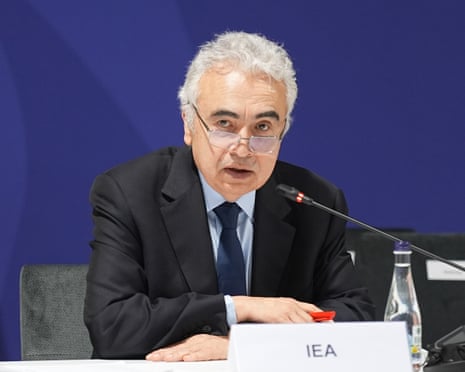
The race to electrification has emerged as a key theme of this year’s Cop. Fatih Birol, the executive director of the International Energy Agency (IEA), told the Guardian yesterday that the world is now in an “age of electricity”.
But what does life look like in some of the world’s most highly electrified countries? We spoke to people in Norway, Rwanda and China to find out.
The world has left behind the age of coal, oil and gas and is now firmly in “the age of electricity”, the world’s leading energy economist has said.
Fatih Birol, the executive director of the International Energy Agency (IEA), said more than twice as much electricity generation would be added to the global economy in the next decade than in the last, as countries scramble to secure their energy supplies against fossil fuel price volatility and supply shocks, such as the Iran war.
Transport is being electrified at an unprecedented rate: outside China, sales of electric cars have risen by 60% in the last nine months, the IEA has found. The growth of AI datacentres is also spurring electricity generation, as is the rapid growth in air conditioning, according to Birol, as heatwaves grow more intense and more frequent under rising global temperatures.
“We will still use oil and gas, but the dominant source of energy is becoming electricity,” Birol told the Guardian in an interview at the Cop31 UN climate summit in Turkey. “One staggering number [is that] in the last 10 years, the world has added about 5,000 gigawatts of electricity. And we expect, in a very conservative way, in the next 10 years, about 12,000 gigawatts, more than two times more than what we had in the last 10 years.”
Governments from 185 countries are meeting this week and next in Antalya for the annual talks, where the turn to electrification in place of fossil fuels is one of the key topics. A resolution to derive 35% of final energy worldwide from electricity by 2035 is on the table, which if it succeeds, could be one of the most important ways of achieving the needed decarbonisation of economies by mid-century.
Electricity now fulfils about a quarter of most energy needs while three-quarters of final energy worldwide is supplied by fossil fuels, mostly for transport, heating and industrial uses. Global electricity was increasingly generated by renewable sources and that process would speed up even faster over the next decades, Birol said.
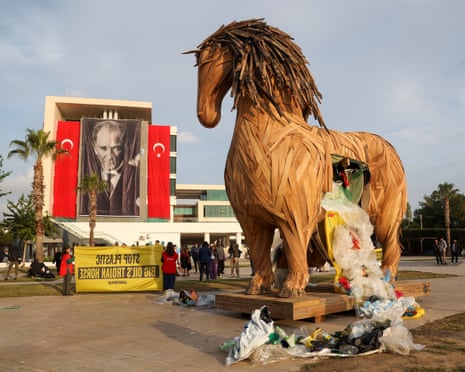
Greenpeace has unveiled a 6-metre tall Trojan horse next to a town hall in Antalya to draw attention to the fossil fuel industry’s expansion through plastic.
The installation, by Danish artist Thomas Dambo, has bags of plastic rubbish spilling out of the horse’s stomach, and a sign that reads: “Stop Plastic. Big Oil’s Trojan horse.”
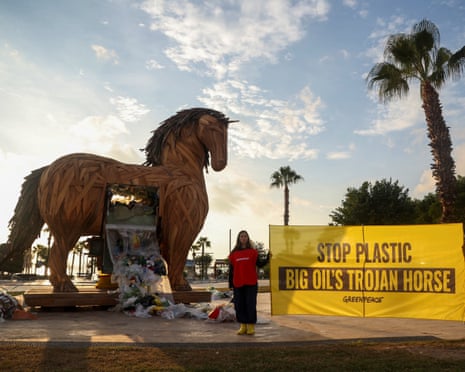
Petrochemicals are an attractive opportunity for oil companies anxious that their core business – selling fuels to burn – will be destroyed by the green transition.
Plastic production worsens the climate crisis through the extraction of hydrocarbons, during which planet-heating methane often leaks into the atmosphere, and the energy-intensive process of turning fossil fuels into consumer products. Large volumes of plastic are then burned as waste, pumping even more CO2 and other lung-scarring chemicals into the air.
The UK government still has no plans to publish an explosive report showing the national security risk from the collapse of ecosystems around the world – even after handing the key official behind the report a new advisory role.
Andy Burnham addressed the Cop31 climate summit in Turkey on Thursday and said the UK was determined to reach net zero by 2050 and work with its partners to build a clean energy future.
The prime minister also announced the appointment of Madeleine Alessandri, a long-serving civil servant and the former head of the UK’s joint intelligence committee, to be adviser on climate security. The JIC is the committee of the UK’s spy chiefs, which oversees the work of MI5 and MI6.
Alessandri spearheaded the publication of the climate report, which found that food shortages, food price rises, mass migration and nuclear conflict overseas could result from the failure to prevent the collapse of key ecosystems, including the Amazon rainforest.
The report was supposed to be launched at last year’s Cop, but was suppressed by Keir Starmer’s government. The Guardian revealed – through a leak – the key contents of the report ahead of its intended launch last year, and early this year a redacted version was put out. Ed Miliband, the foreign secretary, has briefed foreign governments on the findings and the report clearly influenced Burnham’s decision to appoint Alessandri, but the report itself remains under wraps.
China has ruled out hosting the Cop33 UN climate summit in 2028 after months of deliberations, leaving the field open for other Asian countries to hold it, the Guardian understands.
The decision will disappoint many countries and climate experts, who had hoped the world’s biggest emitter would take the lead on the global stage, as the US under Donald Trump has vacated all forms of international cooperation on the climate.
Al Gore, the former US vice-president, was among those left disheartened by the decision. “I would be very much in favour of that idea [of China hosting the summit],” he told the Guardian. “It’s too bad.”
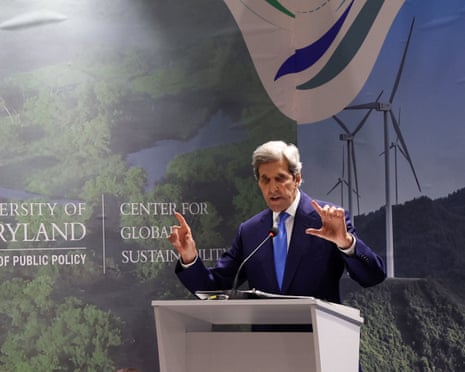
China is in the midst of an economic transformation, from being heavily dependent on coal to becoming an “electro state”. John Kerry, the former US secretary of state, told the Guardian that China was leaving the rest of the world behind in forging and using the low-carbon technologies of the future.
Renewable energy generation capacity has now outstripped coal in China, and its greenhouse gas emissions appear to have declined slightly this year.
Sales of electric vehicles in the country have also taken off, making up nearly two-thirds of the market last month, and China’s clean energy industries drove more than 90% of the country’s investment growth last year.
The rules of the UN Framework Convention on Climate Change (UNFCCC) mean an Asian country should host in 2028.
Gareth Redmond-King, the international lead at the Energy and Climate Intelligence Unit thinktank, said China’s position as an industrial powerhouse would have made it a formidable contender to hold the summit.
“It would undoubtedly be significant for the world’s biggest emitter and second-biggest economy to host a climate Cop,” he said.
“They’re leading the world on investment, manufacture and deployment of clean energy tech, and their emissions have started to tick down. As a leadership story, China hosting Cop33 would be a big deal.”
Good morning. Nearly all of the more than 90 world leaders who descended on Antalya in the past three days have now packed up their suitcases and lit out, some of them for the EU’s AI summit in Dublin. Anthony Albanese and the UN secretary-general are among the few to linger but will also head off later today.
With the departure of the circus, the real negotiations can begin, and a first draft of the cover decision for this Cop could come as soon as today, though over the weekend or Monday are still more likely. Look out for wording on the “overshoot” of 1.5C, climate science, the all-important transition away from fossil fuels, the electrification target and finance. The current “wishlist” can be perused here.
As double-hosted Cop31 gathers steam, the quest is also on for a venue for Cop33. Next year’s event will be in Ethiopia, and according to the complex systems of the 1992 UN Framework Convention on Climate Change, the meeting after that should be in Asia. But who will host?
As the Guardian revealed last night, it will not be China – a shame, according to many experts, who had been hoping that the world’s biggest emitter of greenhouse gases and second biggest economy would step up. China is undergoing a massive economic transformation, swapping reliance on coal and oil for electricity generated from renewable sources. This has proved a boost to the country’s economy, as the clean and low-carbon sectors now make up more than a tenth of its GDP.
India also considered hosting Cop33, but dropped its early-stage proposal months ago. That leaves the field open, with Uzbekistan, Thailand, Korea and Indonesia also cited as potential bidders. No decision on the hosting is likely to be made at this Cop, as countries are likely to need more time to develop their bids.
KioskNews shows a cleaned-up reading view extracted from the publisher’s page — the original always lives on their site, not ours.