NSF expansion a possibility: premier
REVIEW AND RETHINK: The government is open to a review of the NSF with an eye toward expanding it to reflect market conditions, the premier said during a meeting
By William Hetherington / Staff writer, with CNA


The government has sufficient resources to stabilize the stock market through the National Stabilization Fund (NSF), Premier Cho Jung-tai (卓榮泰) said yesterday, adding that the Cabinet is open to reviewing the fund’s size.
Financial authorities had introduced several measures and the fund was already intervening in the market, Cho said.
The premier made the remarks during a meeting with representatives of the National Association of Industry and Commerce, the Taiwan Electrical and Electronic Manufacturers’ Association, state-owned and private banks, securities firms and the semiconductor industry.
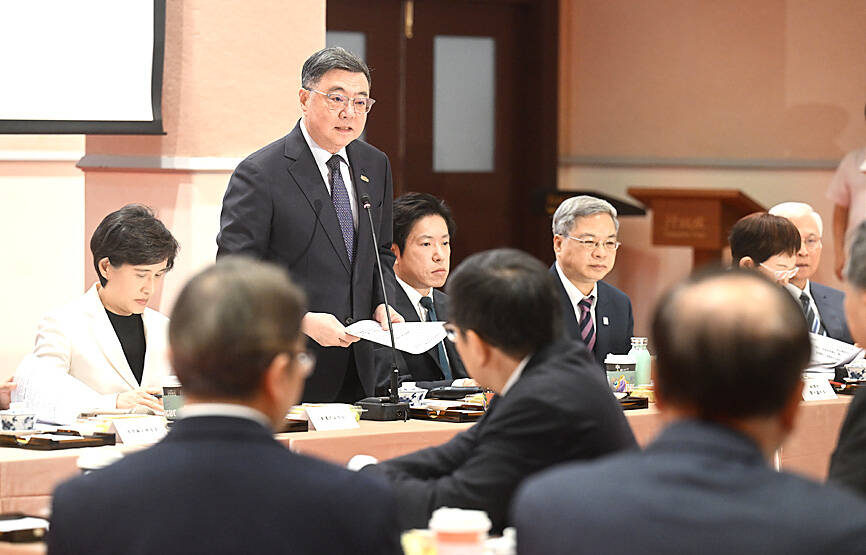
Premier Cho Jung-tai, second left, meets with industry and financial sector representatives in Taipei yesterday.
Photo: Lin Cheng-kun, Taipei Times
He said he hoped the discussions would reassure investors that the government and business community are working together to stabilize the capital market through a series of phased measures.
Cho said he had convened several meetings with senior financial officials last week and sought opinions from business groups before introducing the measures.
These included activating the NSF, banning short selling below the previous day’s closing price and raising margin requirements for securities financing.
The measures were intended to prevent investor panic, he said.
The Taiwan Stock Exchange has talked with the securities industry and is to lower the minimum maintenance margin ratio for margin trading to 120 percent, Cho said.
The NSF has sufficient financial depth for its mission, he said.
However, the government has heard concerns raised by lawmakers and members of the public about whether the fund’s size should be adjusted to reflect the expansion of Taiwan’s stock market.
The government is open to conducting a review of the fund, he said, adding that any changes would have to take into account the nation’s fiscal structure and be clear to the public to avoid anxiety during periods of market volatility.
Cho highlighted Taiwan’s strong economic and industrial fundamentals, saying the nation’s economic monitoring indicator had sat at “red” status for 10 consecutive months, the longest such period since 1984.
The indicator scored 41 points last month, showing the economy’s positive outlook, he added.
The government has a responsibility to support industries amid challenges from the global situation and provide the best assistance to industrial development, Cho said.
Taiwan’s economic growth this year is expected to reach its highest level in almost 40 years, Minister of Economic Affairs Kung Ming-hsin (龔明鑫) said.
Economic growth reached 14.22 percent in the first three quarters, while figures last month suggest fourth-quarter growth could exceed 12 percent, he said.
Export orders were more than US$940 billion in the first 10 months of the year and are expected to exceed US$1.1 trillion for the full year, Kung said, adding that companies had substantially increased equipment imports.
The TAIEX closed up about 780 points yesterday, Kung said, suggesting that the measures to address market volatility were having some effect.
Taiwan’s underlying economic fundamentals remain strong, he said, adding that the government hopes to work with businesses to maintain confidence and stability.
KioskNews shows a cleaned-up reading view extracted from the publisher’s page — the original always lives on their site, not ours.