They’re potential kingmakers, but may be excluded from Israel’s government. Here’s why
Tel Aviv: Every Israeli election ballot has now been counted, and the final tally confirms one of the major stories of the contest is the remarkably strong performance of the so-called Arab parties.
These parties attract most of their support from Arab citizens of Israel, many of whom identify as Palestinian citizens of Israel, and make up about 20 per cent of the population.
The Arab parties won 19 seats, a major improvement on the 10 they claimed at the last election. This reflects a massive increase in voter turnout in Israel’s Arab sector; around 80 per cent of Arab-Israelis are believed to have voted this year, up from 53 per cent in the last election.
A surge of violent crime, unsolved murders and home demolitions under far-right National Security Minister Itamar Ben-Gvir convinced Arab-Israelis to vote in record numbers.
Supreme Court Justice Noam Sohlberg has asked the country’s internal security agency, Shin Bet, to investigate claims that Qatar used foreign interference to drive up the Arab vote, leading to accusations from Prime Minister Benjamin Netanyahu’s Likud party that the elections had been stolen. Opposition parties have backed the investigation, while condemning Likud’s alarmist rhetoric before the full facts are known. Qatar has called the allegations “ridiculous and dangerous”.
The opposition bloc of Zionist parties led by former military chief Gadi Eisenkot and the Arab parties won 67 seats in total, more than Netanyahu’s conservative coalition (53 seats) and easily enough to form a new government. Many Israelis who want to see Netanyahu removed from power are clamouring for this to happen one way or the other, but it currently looks to be a remote prospect because of imposing political and practical problems.
To see why, it is first important to understand the differences between the two main Arab party groupings.
The Joint List is a coalition of three mostly Arab parties – Hadash, Ta’al and Balad – that won 11 seats at this election. Hadash represents the remnants of the Communist Party of Israel and other far-left groups. It has favoured the creation of a Palestinian state alongside Israel and the recognition of Israel’s Arab community as an official minority. Ta’al is an Arab nationalist, largely secular, party. Balad is a more radical Palestinian nationalist party that favours a one-state solution, with Jews and Arabs sharing the same country from the Mediterranean Sea to the Jordan River. Its opposition to Israel as a Jewish state has repeatedly seen it banned from participating in elections. The Central Elections Committee disqualified Balad’s leader, Sami Abu Shehadeh, from running in this year’s elections for an article he wrote on October 8, 2023, describing the October 7 attacks as an “important historical event”. Critics said it displayed “support for armed struggle against Israel” and Shehadeh eventually withdrew from the elections.
The Joint List is an ideologically committed grouping that puts great emphasis on the need to reach a political settlement with the Palestinians. Its members display ambivalence to, or outright hostility towards, Israel’s status as a Jewish majority state. This leads to a complicated relationship between the parties and government. The Joint List parties have not traditionally sought to join Israeli governing coalitions on the grounds that it would be wrong to provide legitimacy to the Israeli government until the occupation of the Palestinian territories in the West Bank and Gaza ends. This is why the prospect of the Joint List agreeing to the equivalent of a supply-and-confidence agreement with Eisenkot has been floated as a way to remove Netanyahu from power and install a new minority government.
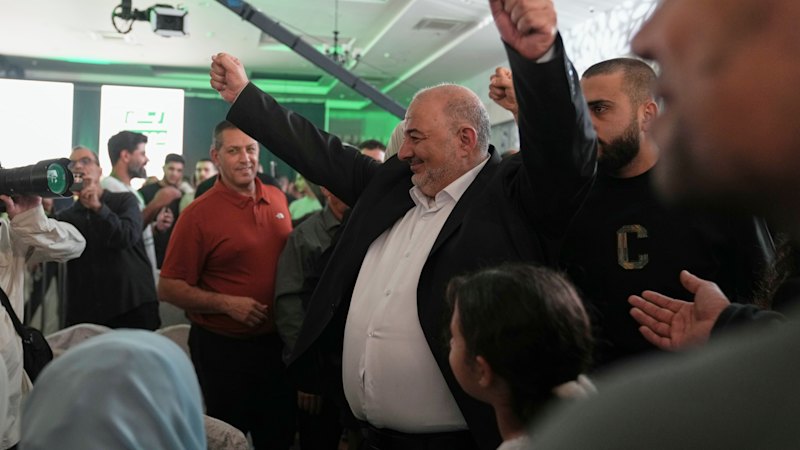
Ra’am, or the United Arab List, is a more religious party but also a more pragmatic one. The party began as an offshoot of the Islamic Movement in Israel, which has close ties to the Muslim Brotherhood. The party performs extremely well in the Negev Desert, including among Israel’s Bedouin communities. Led by former dentist Mansour Abbas, Ra’am is increasingly willing to work within the Israeli system to achieve practical improvements for Arab Israeli citizens on issues such as crime. Ra’am joined a short-lived coalition government led by former prime minister Naftali Bennett and Yair Lapid in 2021-22 – the first time in Israeli history an Arab party had been part of a governing coalition. Abbas used the position to gain extra resources for Arab communities and would like to do so again.
Why not kingmakers?
Which raises the question of why the Arab parties are not being treated as the kingmakers their parliamentary numbers suggest they should be. The short answer is that October 7 changed the dynamics in Israel, making it harder for many Jewish Israelis to stomach co-operation with Arab parties.
This is especially so in light of Shehadeh’s controversial comments on October 8. As for Abbas, he has forcefully condemned the October 7 attacks, but has declined to say whether he regards Hamas as a terrorist organisation that needs to be eliminated. This was a key condition that Eisenkot issued for parties to join a coalition led by him. His conditions also include mandatory military service for all Israelis, another complication given the vast majority of Arab-Israelis do not serve in the Israel Defence Forces and several parties do not support universal conscription.
Right-wing secular leader Avigdor Lieberman, a member of Eisenkot’s bloc, has repeated since the elections that his party will not go into a coalition with the support of the Arab parties (or Netanyahu). This means Eisenkot would lose at least eight of Lieberman’s seats from his bloc. Bennett has also been firm on not relying on the support of Arab parties.
Eylon Levy, a former Israeli government spokesperson who favoured a change from Netanyahu, says it would be political suicide for Eisenkot to pursue a minority government dependent on the support of “Islamists and communists”.
“If this happened, it would be massively unpopular, extremely unstable and drag the country back to another round of elections in which Netanyahu would win an even bigger majority,” he argues. “If they are even flirting with the idea, they are putting themselves in a very dangerous position.”
Israel’s ambassador to Australia, Hillel Newman, argued in a pre-election briefing that any minority government dependent on the Arab parties would be short-lived, probably collapsing within a year over disagreements about military funding. Israel would then return to another round of elections.
Even if forming a government proves too ambitious, the change bloc and Arab parties could use their majority in parliament to appoint a new speaker, quickly create a commission of inquiry into the October 7 attacks, and pass legislation to entrench the power of the judiciary. While they may not be able to govern, they can legislate.
Read more on Israel’s election:
- Negotiations begin: The election produced a deadlock. Here’s what happens now
- Analysis: Netanyahu wrestled his opponents to a draw. For now, that’s a victory
- Results: Netanyahu claims mandate after polling error underestimated his support
- ‘They are stealing’: Netanyahu unleashes election day scare tactics
- Explainer: Six things to know about Israel’s election
Get a note directly from our foreign correspondents on what’s making headlines around the world. Sign up for our weekly What in the World newsletter.
KioskNews shows a cleaned-up reading view extracted from the publisher’s page — the original always lives on their site, not ours.