Sharks often swim across national borders. Our conservation efforts must travel with them
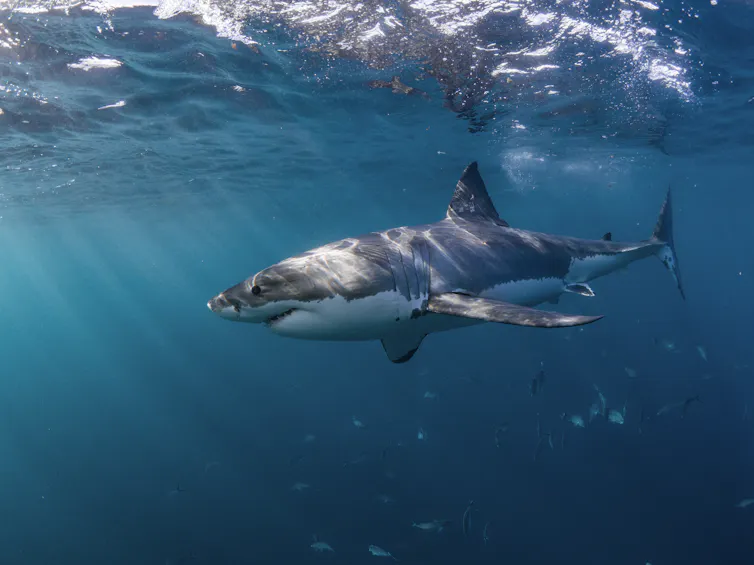
Almost 11,000 kilometres. That’s how far one white shark swam while travelling from South Africa to Western Australia, before turning around and returning home.
In the waters off southern Australia, school sharks can cover up to 3,000 kilometres while crossing the Tasman Sea to New Zealand.
Many shark and ray species embark on mammoth migrations. But to protect these species, we need to know not only how far an animal moves, but whether it crosses national borders.
Our new study analysed 30 years of shark and ray movement studies. We uncovered major gaps in our understanding of where these species go during their migrations.
Many reasons to move
Sharks and rays move for many reasons. These species may travel to find food or give birth to young. They may also migrate to waters where the temperature or salinity levels suit them better.
Body size and maturity also affect how far animals travel – older, larger animals generally travel further. Depth, ocean currents and access to suitable habitat can shape the paths taken by sharks and rays.
These factors influence each species differently. Some species are confined to particular estuaries, while others can cross entire ocean basins.
Whale sharks, for instance, gather seasonally at Ningaloo Reef in WA where they attract tourists and researchers from across the country. But they do not stay at Ningaloo. Tracking studies show some of these sharks travel thousands of kilometres beyond Australian waters, including into Indonesia.
In Australian waters, whale sharks are protected and tourism is strictly regulated under both state and federal law.
However, national protections cannot address pressures animals may encounter after leaving Australian waters, such as accidental capture and vessel strikes, where cargo vessels or other boats collide with whale sharks.

What we studied
Our new study analysed three decades of studies that used various methods to understand shark and ray movements. These included satellite and acoustic tracking as well as catching, marking and recapturing individual animals.
We identified 29 shark and ray species that are known to migrate across international borders. But only five species – namely white sharks, whale sharks, shortfin makos, blue sharks and school sharks – had studies showing movements between Australian waters and those of other countries. These included Papua New Guinea, Indonesia, New Zealand, Micronesia, New Caledonia and South Africa.
Worryingly, we found 18 species had no published information about their movements. This lack of research means we simply don’t know if these species travel long distances or cross boundaries. What’s more, nearly two thirds of the threatened species we examined had no published studies about their movement patterns.
Conservation across borders
A United Nations treaty, the Convention on the Conservation of Migratory Species of Wild Animals, gives countries guidance on collectively conserving sharks and rays that migrate across borders.
To fulfil its commitments under the Convention, Australia should focus on three key areas.
Shared expertise
We must strengthen our conservation ties with our closest neighbours including Indonesia, Timor-Leste and Papua New Guinea to the north, and the wider Pacific to the east.
Tracking animals over long periods can be costly and difficult to maintain, particularly in remote areas. Given Australia already has a relatively well funded marine science sector, we should share our tracking technology and expertise with neighbouring countries.
Targeted research
Conducting more research into shark and ray movements is key to identifying where cooperation may be most effective and what it would look like in practice. Researchers must prioritise the 18 species whose movements we know little about.
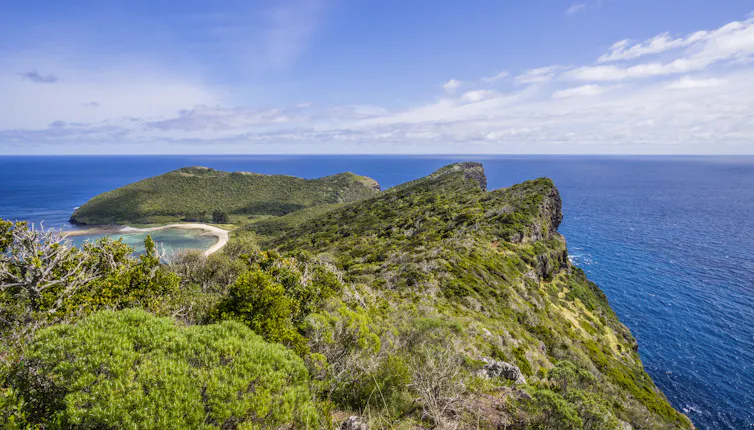
In particular, Australia and New Zealand should support coordinated research around the Lord Howe Rise in the Tasman Sea. Authorities are currently considering whether to establish this region as a protected area, under the new High Seas Biodiversity Treaty.
Australia must also rethink how it classifies shark and ray species. For example, while the UN convention lists hammerhead sharks as migratory, Australia does not. This may be to appease commercial and recreational fishers who target or incidentally catch these sharks. Australia’s species categories should be based on science.
Strategic tracking
Instead of simply tracking more sharks, we must track them strategically. By combining movement data with oceanographic information – including about ocean currents, salinity and temperature – researchers can identify likely movement pathways linking countries and important shark and ray habitats.
This will help governments decide where to invest in additional tracking technology like acoustic receivers and satellite tags. It will also allow researchers to build a more complete picture of how sharks and rays travel.
Sharks have been moving across oceans for millions of years. It’s time our research and conservation efforts caught up with them.
KioskNews shows a cleaned-up reading view extracted from the publisher’s page — the original always lives on their site, not ours.