India sets terms to advance talks on WTO plurilateral deal
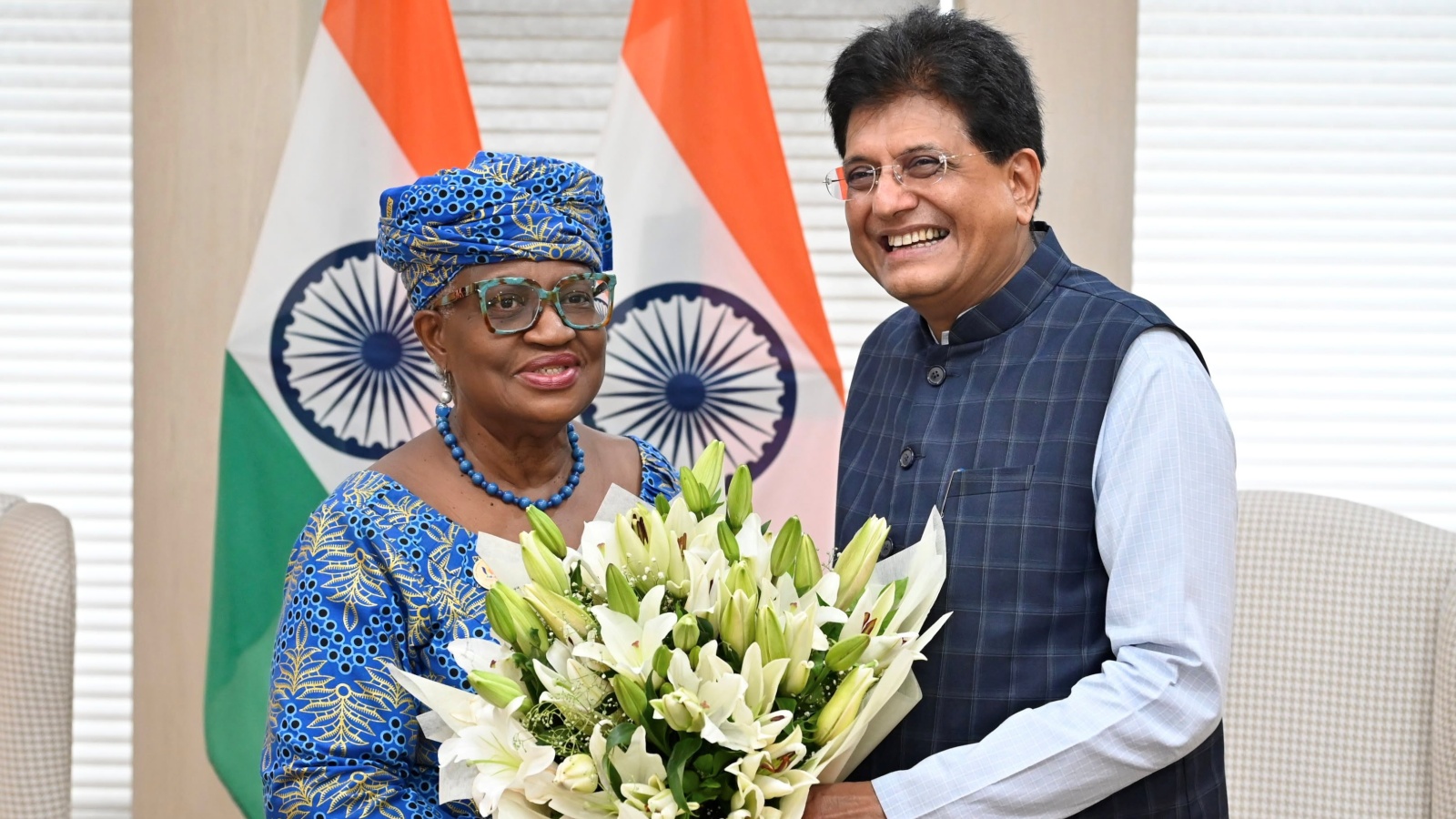
Union Commerce and Industry Minister Piyush Goyal meets Director-General of the World Trade Organisation, Ngozi Okonjo-Iweala. (Source: X/ @PiyushGoyal)
After staunch opposition to plurilateral pacts at the World Trade Organisation’s (WTO’s) 14th Ministerial Conference in Cameroon earlier this year, India offered its proposal on WTO reforms which could help insert plurilateral agreements within the WTO framework, the country’s submission to the body’s General Council on Wednesday showed.
Plurilateral trade agreements are negotiated and implemented by exclusive WTO groups rather than by all members. The country’s concern is that these pacts would act against developing nations’ interests, including India. A number of developed countries have opposed India’s public stockholding programme on grounds that they are distorting trade.
Softening its stance, India said “common understanding” of safeguards for plurilateral initiatives can serve members and provide predictability. “A common understanding on safeguards can provide greater predictability to proponents; enable non-participants to understand and protect their rights and interests; preserve attention to existing mandates; and support confidence in the WTO as a Member-driven, inclusive and development-oriented multilateral institution,” its submission said.
Emphasizing the preservation of rights, interests, and the agency of non-participants, India said in the statement: “Depending on their subject matter, design and intended institutional relationship with the WTO, plurilateral initiatives may have implications for existing rights and obligations of the members, the conduct of WTO work, the negotiating interests of members, or the operation of the multilateral trading system.”
“While non-participation should remain a legitimate exercise of a member’s rights, it should not prejudice the rights or interests of non-participating members in matters concerning the WTO framework,” New Delhi told the WTO.
The country stressed that “special and differential treatment” should be central to the rule-making, and that the pursuit of plurilateral initiatives should not lead to “marginalisation of development priorities or divert attention and negotiating resources from issues of particular interest to developing and least-developed members”.
“Without procedural safeguards, proliferation of plurilateral initiatives and agreements could put a strain on WTO resources and limited budget. Members may face challenges in authorising the allocation of WTO budget and other resources to service these initiatives and any resulting agreements. Scarce resources would be diverted from required mandated uses, including technical assistance and capacity building,” the proposal flagged.
Story continues below this ad
Change in position after BRICS; opposition to IFD
The change in India’s position came after the BRICS summit and the bilateral talks with China. The New Delhi Declaration said BRICS members recognise the importance of identifying pathways for plurilateral initiatives. “… we recognise that it is important to identify appropriate pathways for plurilateral initiatives into the WTO legal framework including on development-oriented issues, and to explore the formulation of forward-looking rules in the WTO,” the BRICS declaration said.
India had blocked the insertion of China-backed Investment Facilitation for Development (IFD) plurilateral pact into the WTO rulebook. Under itsrules, a plurilateral agreement can be included into the family of agreements “exclusively by consensus”. The IFD initiative, launched by the WTO in 2017, aims to enhance foreign direct investment (FDI) flows.
According to India, IFD risks eroding foundational principles and functional limits of the WTO. It indicated that as part of the body’s reform discussions, members are seeking guardrails and legal safeguards for plurilaterals before integration of any specific plurilateral outcome.
“Hence, India did not agree to incorporation of the IFD into the WTO framework as an Annex 4 agreement. In view of the systemic issue at hand, India showed openness to first have good faith comprehensive discussions and constructive engagement under the WTO Reform Agenda,” the Commerce and Industry Ministry said in March this year.
Story continues below this ad
Canada’s opposition to India’s stance
The Indian Express last month reported that several countries targeted India during its trade policy review last month. While Canada most prominently opposed India’s stand on plurilateral agreements, the European Union (EU) said that over the past decade, India has benefited significantly from its integration into global trade, increasing its share in world trade.
An EU representative also said the bloc “encourages India to rethink its approach to plurilateral agreements” and to “consider them as an opportunity to shape the agenda of the WTO and to modernise the organisation rather than as a threat to multilateralism — which they are not, if we build them properly”.
While Gambia and Costa Rica asked India to withdraw its opposition to the IFD agreement, several countries asked India to join negotiations for plurilateral agreements such as the fossil fuels subsidy reform initiative, dialogue on plastics pollution and environmentally sustainable plastics trade.
Nearly 129 members have supported IFD, but India remains the primary holdout, citing systemic risks and stating that investment is not a core trade issue.

Ravi Dutta Mishra is a Principal Correspondent with The Indian Express, specializing in economic policy and financial regulations. With over five years of experience in business journalism, he provides critical coverage of the frameworks that govern India's commercial landscape. Expertise & Focus Areas: Mishra’s reporting concentrates on the intersection of government policy and market operations. His core beats include: Trade & Commerce: Analysis of India's import-export trends, trade agreements, and commercial policies. Banking & Finance: Covering regulatory changes and policy decisions affecting the banking sector. Professional Experience: Prior to joining The Indian Express, Mishra built a robust portfolio working with some of India's leading financial news organizations. His background includes tenures at: Mint CNBC-TV18 This diverse experience across both print and broadcast media has equipped him with a holistic understanding of financial storytelling and news cycles. Find all stories by Ravi Dutta Mishra here ... Read More
KioskNews shows a cleaned-up reading view extracted from the publisher’s page — the original always lives on their site, not ours.