Campus gate shut, food for protesters stopped: Ambedkar University students claim ‘manhandled by guards’
The confrontation is the latest flashpoint in a protest that began with a five-point demand charter but has since widened into students voicing concerns about how the university is run.
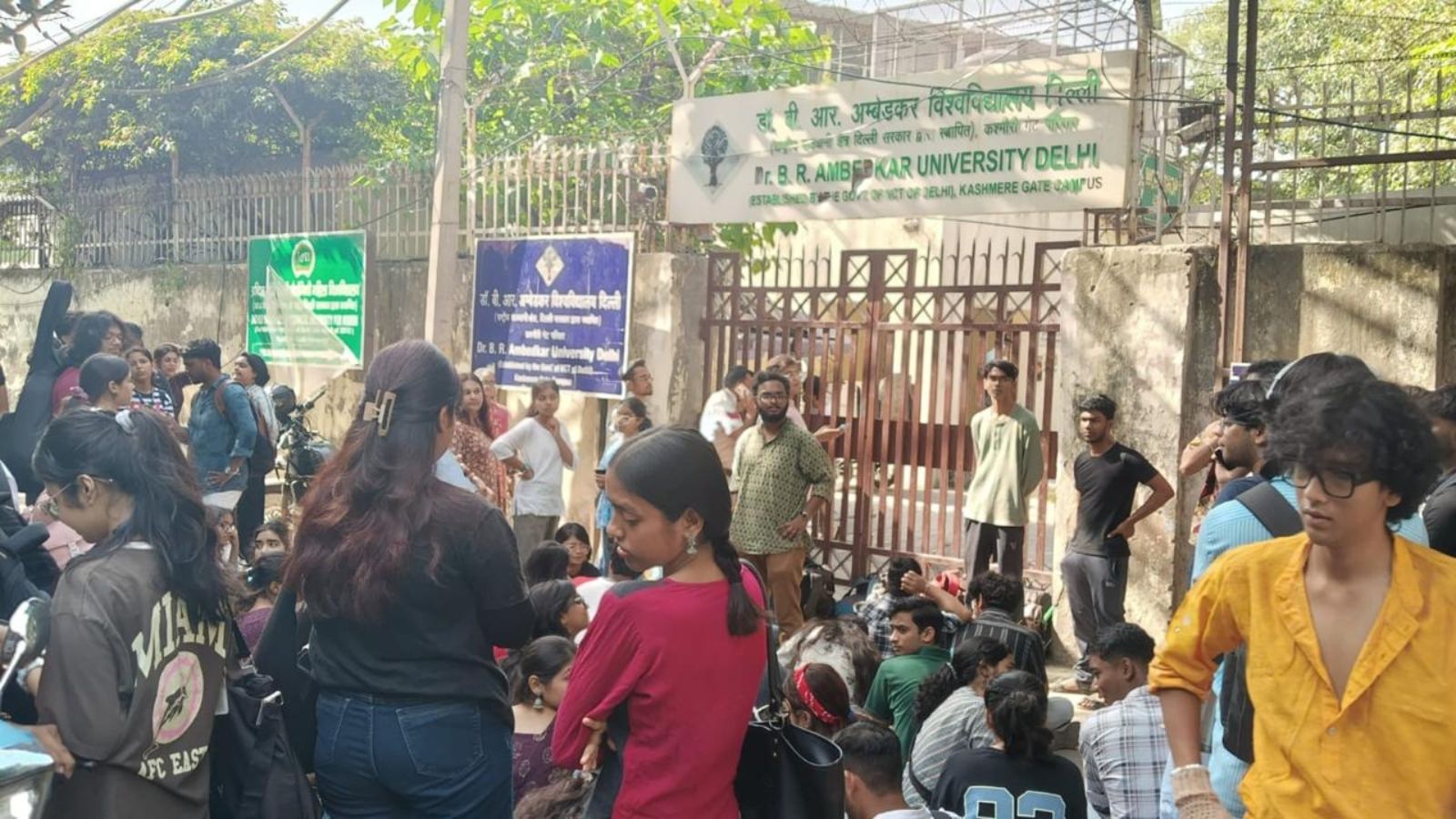
At the gates of Dr B R Ambedkar University’s Kashmere Gate campus, students gathered on Saturday with packed food in their hands. It was meant for students and PhD scholars who had been sitting in an indefinite protest for six days inside the campus with demands ranging from drinking water and classrooms to faculty shortages, student representation, and access to campus areas.
But those outside the gate alleged that security guards stopped them from entering the campus and they could not hand over food to the protesters.
Blessy, an MA student of Gender Studies, said students were stopped from entering the campus despite many having classes and exams. While alleging that the campus was closed to students on Saturday, she claimed that guards stopped students outside from passing food to the protesters and “manhandled” those trying to receive it.
The Public Relations Office of the university, however, said in a statement on Saturday that items being delivered at the gate beyond normal hours were checked by security personnel on safety grounds. It also said that its medical team was monitoring the protesting students and providing assistance.
It further said that the library, computer laboratories and some blocks had been closed for maintenance and that students had been informed in advance. “Students have manhandled security guards, and the issue is already in the cognisance of the Delhi Police. University security guards have not initiated any action on their own. Their role is limited to maintaining campus security as per standard protocol,” the PRO office said.
Further, the AUD said that while it had designated a place for peaceful protests, “students are sitting in the area close to the library and classrooms, which is also adversely affecting other students”. It said its Proctor’s office had appealed to the protesters to move to the designated area.
Maintaining that it was in continuous dialogue with the protesters, the university said it had positively responded to their “permissible and legitimate demands”.
Story continues below this ad
The confrontation is the latest flashpoint in a protest that began with a five-point demand charter but has since widened into students voicing concerns about how the university is run.
At the heart of the protest are demands to reopen the university’s main gate for students, remove iron gates separating the administration and student areas, reinstate the PhD fee waiver, withdraw a July 31 circular requiring students to inform the university four days in advance about holding public gatherings and remove compulsory attendance requirements for PhD scholars.
The Indian Express had reported on August 7 that AUD has sought “attendance-cum-whereabouts records” for PhD scholars receiving fellowships and had said that unauthorised absence from on-campus research work could affect their fellowship.
Aameen Amitoj, a PhD scholar in Urban Studies, said, “For PhD students, the fee waiver was discontinued, with the university citing the stipend received by research scholars as the reason.”
Story continues below this ad
He added that the closure of the main gate had forced students to use the back gate. “The main gate of the university has been shut off for students. Only VC, Proctor and Registrar can enter from that gate,” he said.
Vivek, Treasurer of the Karampura Campus Council and an MA Performance Studies student, pointed to another gate – installed inside the campus about one-and-a-half years ago.
“It literally divided the campus into two parts. On one side is the student community, and on the other side is the administration,” he said.
He added that students are struggling for basic facilities at AUD’s Karampura campus. “Drinking water remained unsafe for nearly six months as RO systems and water coolers were not functioning. Students were forced to buy water from the canteen,” he said.
Story continues below this ad
Vivek also flagged faculty shortages. “It has been almost two-and-a-half months since my third semester began, and we still do not have a teacher for one of our subjects.”
A master’s student from the Karampura campus said students were dealing with poor facilities, inadequate classrooms and faculty shortages. “We don’t have drinking water. We don’t have clean bathrooms. Some students don’t even have any faculty to teach them. Timetables are always clashing because there aren’t enough classrooms…,” the student said, adding that PhD scholars lacked dedicated spaces to work and hold discussions.

Sophiya Mathew is a Correspondent at The Indian Express, based in New Delhi. She joined the Delhi bureau in 2024, and has specialization in Integrated Multimedia Journalism from the Asian College of Journalism (ACJ), Chennai. Professional Background Core Beats: Her reporting is primarily focused on the Environment and Education. Specialization: She has gained recognition for her ground-level reporting on the Yamuna floodplains and the socio-economic challenges faced by those living on its banks. She also focuses on the disparities in Delhi's education system, ranging from elite private schools to government institutions and refugee education. Recent Notable Articles (December 2025) Her recent work has been heavily centered on Delhi's severe winter pollution crisis and the government's regulatory responses: 1. The Air Pollution Crisis "A tale of two cities: Delhi govt schools choke in bad air, private classrooms set up air filters" (Dec 20, 2025): A high-impact feature contrasting the "Clean Air Bubbles" in elite schools with the reality of government school students who are exposed to an equivalent of 17 cigarettes a day due to outdoor exposure. "Delhi sees season's worst air day, second worst December AQI in nearly a decade" (Dec 15, 2025): An analytical report on the meteorological patterns trapping pollutants in the NCR. "Delhi bans non-BS VI vehicles from outside: Why curbing vehicular pollution is key" (Dec 17, 2025): Explaining the science behind targeting specific vehicle vintages to lower particulate matter. 2. Enforcement & Regulations "No fuel at pumps in Delhi without valid PUC certificate from December 18" (Dec 17, 2025): Breaking the news on the environment ministry's strict "No PUC, No Fuel" policy. 3. Education Policy "Law to regulate school fee in Delhi risks becoming procedural, say parents" (Dec 13, 2025): Investigating the loopholes in the new Delhi School Education (Transparency in Fixation and Regulation of Fees) Bill, 2025. "Monsoon Session: Private school fee regulation Bill cleared after four-hour debate" (Aug 9, 2025): Covering the legislative passage of the controversial fee hike regulation. Signature Style Sophiya is known for her observational depth. Her reporting often includes vivid details from school corridors, hospital waitlists, or the banks of the Yamuna to illustrate how policy failures affect the city's most vulnerable residents. She is a frequent expert guest on the 3 Things podcast, where she explains the complexities of Delhi’s environmental laws. X (Twitter): @SophiyaMathew1 ... Read More
Stay updated with the latest - Click here to follow us on Instagram
KioskNews shows a cleaned-up reading view extracted from the publisher’s page — the original always lives on their site, not ours.