MND Local BCS: Hurricane Polo hits Baja California Sur, plus new regulations for swimming with whale sharks in La Paz
On Monday, Sept. 21, Polo was designated a tropical storm off the southwestern coast of Mexico, with wind speeds of approximately 50 miles per hour (mph). Within 24 hours, winds had increased to 160 miles per hour, and Polo was suddenly one of the most terrifying types of natural disasters: a Category 5 hurricane.
The National Hurricane Center characterized the speed of Polo’s intensification as “truly remarkable,” not to mention historic. Indeed, it was one of the most rapid storm intensifications in recorded history, second only to that of Hurricane Patricia in 2015, a monster Category 5 hurricane that reached sustained winds of over 200 miles per hour.
By Tuesday afternoon, Hurricane Polo had reached sustained winds of 180 miles per hour (285 kilometers per hour), making it the third-strongest hurricane by that measure in the history of the Eastern Pacific region.
This rapid intensification was aided by climate change — sea surface temperatures in the Pacific Ocean are the highest they’ve ever been — and an exceptionally strong El Niño weather pattern, which has raised water temperatures even further. Polo’s development, per NASA, occurred over waters with surface temperatures as high as 90 degrees Fahrenheit (32 degrees Celsius).
But despite its supercharged power, Polo remained offshore as it developed, making no landfall along the southwestern coast, but causing at least four deaths in Jalisco, and inflicting property damage across parts of Colima, Guerrero, Jalisco and Michoacán.
MND Local: Hurricane preparedness and fear of a ‘Super El Niño’ in Baja California Sur

Baja California Sur prepares for the arrival of Hurricane Polo
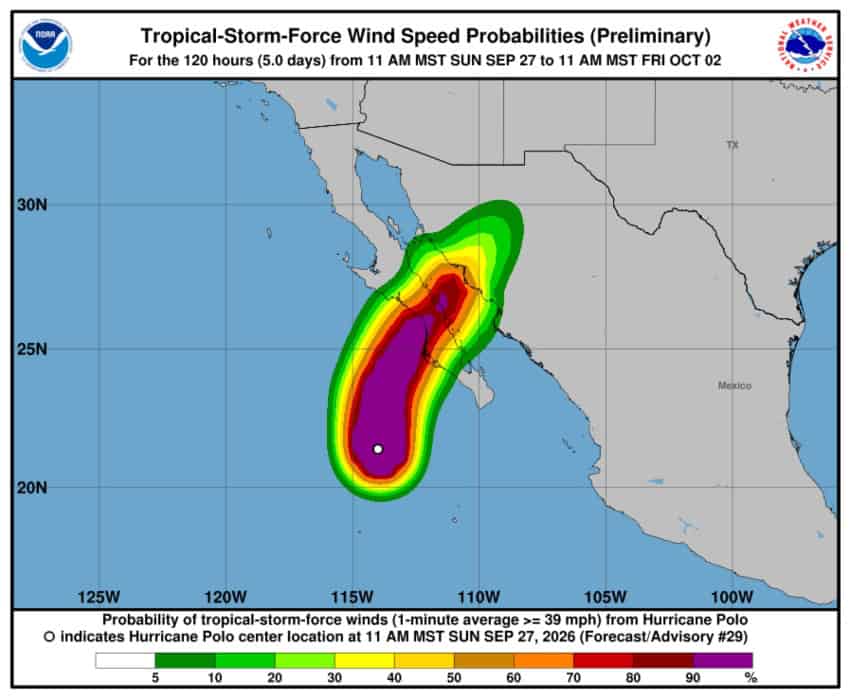
By Sunday, Hurricane Polo had been downgraded to Category 3, with wind speeds of “only” 125 miles per hour as it continued in an arcing, left hook-like path towards Comondú municipality in the center of Baja California Sur — but with effects expected to be felt statewide, since tropical force winds from Polo were extending up to 105 miles (165 kilometers) from the storm’s center.
Hurricane warnings were issued for both the west (between Punta Abreojos and Santa Fe) and east coasts (from Loreto to Santa Rosalía) of the state prior to the arrival of the hurricane on Monday, and the state readied its response efforts, with help from the federal government.
Classes were canceled statewide for schools on Monday, while 1,360 military personnel in engineering groups awaited deployment, in case of need from impacts such as destructive winds, flooding and storm surges. Port activities in Comondú and Los Cabos were closed over the weekend, as were 26 beaches in Los Cabos. Meanwhile, 169 shelters across all five of the state’s municipalities were readied for those potentially displaced or in vulnerable areas.
The aftermath
The most visibly affected as the storm neared was Puerto San Carlos, in the Bahía Magdalena area, where storm-driven waves flooded streets, prompting hundreds of residents to evacuate their homes and seek shelter.
But it was 84 miles farther north, near Las Barrancas, a small fishing community of a little more than 500 residents that also lies in the municipality of Comondú, that Hurricane Polo finally made landfall at 11 p.m. local time on Monday, Sept. 28. By then, it had been downgraded to a Category 2 hurricane, but still a dangerous one, with sustained wind speeds of 110 miles per hour (175 kilometers per hour).
Six hours later, at 5 a.m., Hurricane Polo reached the Gulf of California on its way to Sonora — downgraded to Category 1 — leaving behind power outages, wind damage and flash flooding, but with no reported deaths in Baja California Sur … at least pending official damage assessments.
New rules instituted for swimming with whale sharks tours in La Paz
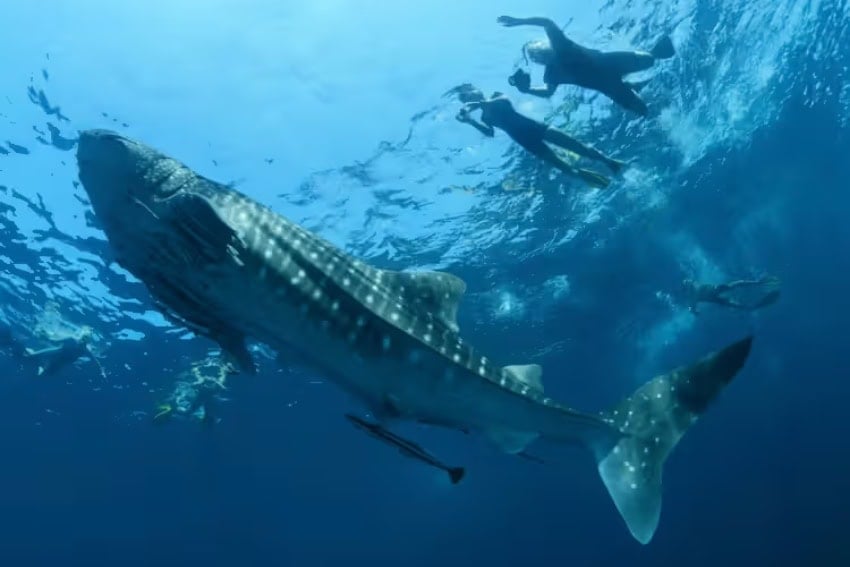
Bucket list adventures are a big draw in Baja California Sur. There’s whale watching in Los Cabos and in Pacific Coast lagoons, and swimming with whale sharks off the coast of the state’s capital city of La Paz. (Seasonal opportunities to swim with orcas at La Ventana are currently up in the air after a pilot program for 2025-2026 expired at the end of July).
In each case, however, there are regulations in place to protect not only tourists, but also the wildlife at the center of these experiences. In Los Cabos, for example, permitted boats must remain at a minimum distance from whales (60 to 80 meters, depending on the size of the vessel).
But nowhere is the need for caution more urgent than in the state capital, La Paz, where swimming with whale sharks season (Oct. 1 to April 30) has been suspended for parts of each of the last three years (2023 to 2025) due to an insufficient population of whale sharks.
A guide to whale watching season in Los Cabos, plus swimming with orcas and whale sharks
New zones unveiled for 2026
Whale sharks are listed as endangered worldwide by the International Union for Conservation of Nature (IUCN), and because La Paz is a seasonal feeding ground for juveniles, it should ideally play a key role in helping to replenish and grow the species’ population. Although whale sharks are enormous (they are the “world’s largest fish,” reaching up to 65 feet long and weighing as much as 60,000 pounds), these “gentle giants” are plankton eaters and very safe to swim with — from a human perspective.
From the wildlife perspective, very strict rules are needed to protect whale sharks from injury or undue stress due to tour activities. To this end, Mexico’s Secretariat of Environment and Natural Resources (Semarnat) has recently published new guidelines for swimming with whale shark tours in La Paz for 2026 through 2029.
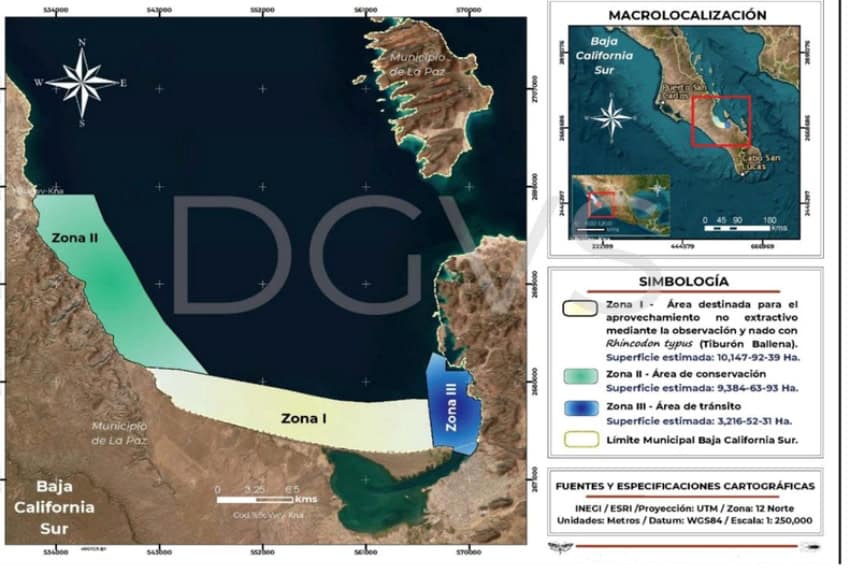
The most notable change is the creation of three zones, in only one of which — Zone I, off the northern shore of the El Mogote peninsula — swimming with whale sharks is permitted. Zone II is listed as a conservation area, with Zone III restricted to transit for tour operators, and at slow speeds (7 knots or less).
Cap on boats tied to whale shark population figures
A ceiling of 56 boats per day for swimming with whale sharks is retained from previous regulations, which will be spread across four time periods for 14 boats each. Boats can bring five swimmers only, plus a guide, with encounters limited to 30 minutes. Other boats must keep at least 50 meters’ distance from those that are engaged in whale shark swims, and tourists are prohibited from touching the whale sharks (they can get no closer than two meters from the side of the fish, or three meters from its tail).
However, since the number of boats permitted for such tours (112 this year) exceeds the daily capacity allowed by half, time slots will be eagerly sought after … but closely tied to abundance. Meaning, the number of allowable boats, per the National Commission of Protected Natural Areas (Conanp), will be scaled back if the whale shark population, or lack thereof, warrants it. For instance, no boats will be allowed if there are five or fewer observable whale sharks, with a sliding scale up to the maximum of 56 boats based on closely monitored population figures.
Chris Sands is a writer and editor for Mexico News Daily, and the former Cabo San Lucas local expert for the USA Today travel website 10 Best and writer of Fodor’s Los Cabos travel guidebook. He has also contributed to numerous other websites and publications, including The San Diego Union-Tribune, Marriott Bonvoy Traveler, Forbes Travel Guide, Porthole Cruise and Travel, and Cabo Living.
KioskNews shows a cleaned-up reading view extracted from the publisher’s page — the original always lives on their site, not ours.