As college sports world waits on SEC vs. LSU drama, Nate Oats and Jamie Dixon sound off on eligibility cases
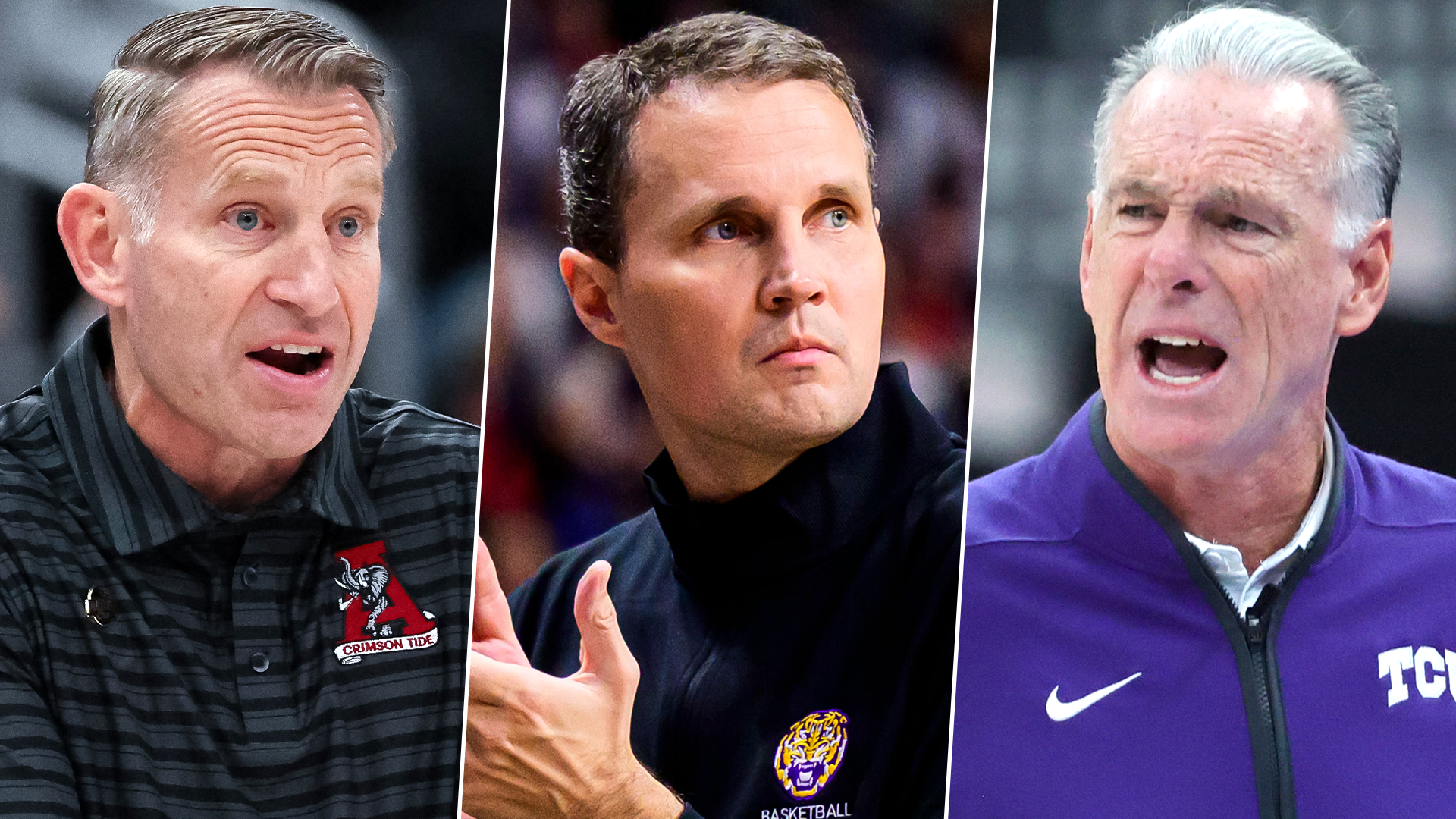
Even out in Vegas, where there are huge games to play, the LSU vs. SEC battle continues to capture the attention of most

• 7 min read
LAS VEGAS — Amid one of the more loaded Thanksgiving-week slates of college basketball ever, the LSU/SEC/RJ Luis/Will Wade story continues to draw the most attention, curiosity and speculation from people across college basketball.
(As does the Michigan's egregious gaffe with its athletic director search, but we'll put that to the side for now.)
Throughout Tuesday here at the Players Era Tournament, coaches and administrators were quick to bring up the continually evolving saga: Is the SEC really prepared to kick LSU out of the league? Even the remote possibility of such a drastic action has a lot of people wanting to know more about how things could get so contentious between a conference and one of its founding members (dating back to the early 1930s).
And for us to get here all for a player who spent last season away from college basketball? It's not even football that's catalyzing this escalation?
The melodrama has refused to die because of the ability of so many players to win court battles to earn an extra year of eligibility. That in mind, there were two particular people whose opinions I wanted to hear from in Vegas. Both coaches, both with different scenarios — one with a current player and one with a former.
Alabama's Nate Oats and TCU's Jamie Dixon.
For all of the understandable uproar over Luis' situation at LSU, it's sort of been glossed over that Robbie Avila was allowed to leave Saint Louis (because SLU had the max of 15 players on its roster; there was no budging on that rule) and transfer to TCU after the start of the season. Avila hasn't even been with the team for three weeks. There he was on Tuesday afternoon, helping Dixon's team to an 84-71 upset of No. 17 Miami out here on the Vegas Strip. Avila started, played 25 minutes and scored 11 points.
Trotter's Trends: Inside the Big Ten's rough start; Robbie Avila is doing Robbie Avila things already
Isaac Trotter

Remember, he played Summer League games with the Lakers, then needed multiple court hearings to get eligible for a fifth season. It's basically unprecedented for a player to transfer in-season and subsequently start at the high-major level. Yet Avila's done it. Why was Dixon OK with the move?
"Because 23 other guys were added in our league," Dixon said, referring to the Big 12's run on fifth-year players who sued to get a bonus year in the summer and fall. Dixon calls them "litigation guys." Now he's got one of his own, yay. "We're not talking about, like, high school guys or freshmen — we're talking about all-league players. ... Completely changed the course of our league."
Kansas' Trey Kaufman-Renn, who is now in his sixth season on a college campus, is also quite the controversial player; he was in Vegas last week and a big factor for KU in going 2-1 in the Players Era 8.
Dixon was resistant in the summer to the idea of using the courts to get another player, but like most coaches, he ultimately went with what could best help his team. Adapt or risk getting left behind.
"Every situation is different; we kind of find our ways, and that's the way we justify everything," he said. "We completely changed the course of the college basketball season through litigation."
He's right. I just found it interesting how Avila's bonus year was mostly celebrated, as opposed to some other cases.
And then there's Oats, who has built a reliable reputation as one of college basketball's IDGAF moguls. Go back to January. Charles Bediako returns to college basketball after years away. Oats was the pariah of college sports for a good month because Bediako literally went from playing in G League games to suiting up for SEC battles in less than a week's time. Bediako ultimately lost his fight at the state supreme court level in Alabama after he logged five games. Oats was so irked by the fallout of the Bediako situation, he intentionally stayed clear of any five-for-five cases that would require litigation. (His program received numerous calls, of course.)
Weirdly enough, Oats' 15th-ranked Alabama team lost on Tuesday here in Vegas to Baylor. Almost a year ago Baylor pushed, and won in its plea to the NCAA, for James Nnaji to play — despite being a former NBA pick. (Nnaji is still in college basketball, having transferred to George Mason.)
"I just thought that the way the NCAA was interpreting their rules, particularly ... when they made James Nnaji eligible after being drafted, involved in a trade in the same draft that Bediako put his name in, and then he played three years in the EuroLeague at the top level in Europe, which is professional basketball," Oats said. "When they granted him four years of college eligibility, to me it made all the sense in the world that Charles Bediako would be eligible. I mean, you line him up, we all know what the rules state: if you've been a pro, if you declare for draft, but like, that's not the way they were interpreting them."
So Oats has stood in the background and watched how the sport has added one debatable player after another and been keeping tabs on the coaches whose actions haven't aligned with their words from just nine, 10, 11 months ago.
"I don't know enough about the LSU thing to speak on all that," Oats said. "But there's a lot of guys playing on court orders in college basketball this year, and a lot of those coaches wanted to speak on the Bediako thing. Well, they're doing the exact same thing this year."
Does it bother Oats?
"Yeah, it does bother me," he said. "They're kind of hypocritical, to be honest with you. So if you're going to say whatever you said last year on that, and then you're just going to go do the same thing, I mean that's how all these guys are playing on a court order."
The SEC continues to roil with discontent at the AD and presidential level. The threats toward LSU are real. And the temperature continues to rise: Luis' lawyers filed an amended lawsuit against the SEC and Greg Sankey, suing the league for damages in light of Luis' college career seemingly coming to a swift end in the past week.
SEC schedules vote on possible LSU expulsion as RJ Luis dispute pushes league to the brink
John Talty
Where Wade is right now is where Oats was earlier this year: the center of white-hot scrutiny. I wondered if the two had talked in recent days or weeks.
Oats said no; the two haven't spoken since the summer.
I think that's also interesting: Wade has been largely isolated from the rest of the coaches in his league. Lawsuits tend to put people on islands. Lawyers get in the way. The SEC is a fractured league right now, there's no doubt on that. Part of the reason why was because the Bediako situation caused a lot of angst. And the schools thought they were able to get through that saga, wounded pride and all, and move on.
The LSU situation has been even worse.
"I don't know all the particulars with all that," Oats said, re: the LSU vs. SEC fight. "And I've learned in a few things I've been involved with, if I don't have good enough background and know everything going on, I probably just shouldn't speak on it, so I don't."
But Oats does think that the Luis situation, and everything college basketball has been faced with in the past four-plus months, has presented the sport and the NCAA with an urgent issue as it pertains to eligibility of foreign pros. Oats' sticking point is the inconsistency with international players who are given wide latitude for eligibility from the NCAA after those players have spent many years playing high-level international basketball.
"It seemed like everybody that played in the EuroLeague was kind of considered not a pro, but we all know they are pros, and in the U.S. you don't have the option like in Europe," Oats said. "You come up high school age, you just go. You're pro. In the U.S., you can't declare for the draft out of high school, so you're kind of forced to go to college. And then the distinction they've been making the whole time is, well, you went to college first and then declared. Well, you don't do that in Europe. So the whole thing's been vastly, to me, done a huge disservice to our American-born (players)."
That's an NCAA governance issue.
Luis' situation is about the SEC having the ability to enforce its own rules.
And now Luis' is suing the commissioner for damages, with more than $2 million in promised earnings at stake. A federal case between the conference and LSU still looms over all this. And on Dec. 3, a scheduled meeting with the league's most powerful people to determine if expulsion should be on the table for a vote.
LSU finds itself in this spot for the same reasons Oats and Alabama did last winter: Coaches, athletic directors and presidents are looking out for their own interests over the collective good of the group.
KioskNews shows a cleaned-up reading view extracted from the publisher’s page — the original always lives on their site, not ours.