Could trees developed with gene-editing technology protect Florida's citrus industry?
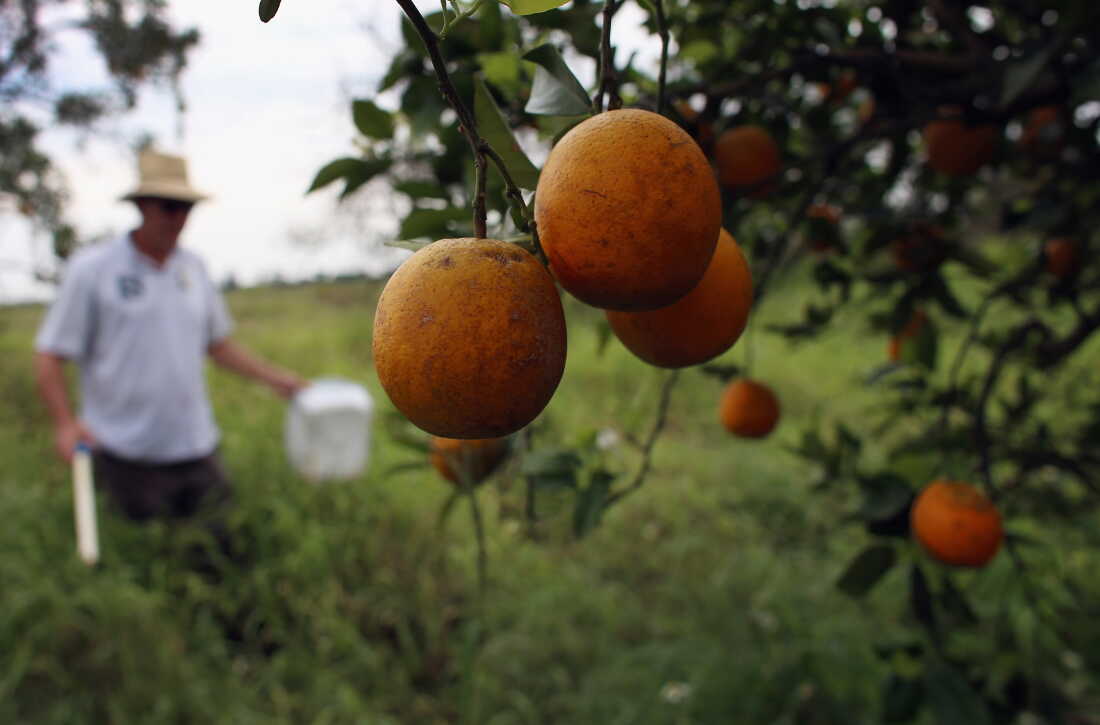
Guy Davies, an inspector for the Florida Division of Plant Industry, checks an orange tree for the insect Asian citrus psyllid that carries the bacterium causing disease, "citrus greening," from tree to tree on May 13, 2013, in Fort Pierce, Florida. Joe Raedle/Getty Images hide caption
toggle caption
Joe Raedle/Getty Images
Citrus growers in Florida are planting new trees that have been modified using gene-editing technology to ward against the lethal citrus greening disease.
Growers have tried everything from tents to sprays to protect citrus trees from the bacterial infection, which has killed off many of Florida's citrus trees and led to a massive decline in the amount of citrus the state produces. Now growers are waiting to see if the genetic modifications, which the Environmental Protection Agency approved earlier this year, will keep the trees alive.
Citrus greening arrived in Florida in 2005. The disease is spread by a tiny winged insect called an Asian citrus psyllid. It attacks the trees' immune system, so they can't fight the infection. Once infected, a tree produces bitter, discolored fruit and usually dies a few years later. There's no cure.
Ron English's family ran a citrus business in Valrico, Fla., for generations until greening wiped it out, forcing them to close in 2015.
"We had some of the best looking groves around, and all the time and effort that we had spent, you just see it diminish right before you," English said.
In the late 1990s, before citrus greening arrived in Florida, growers were shipping out around 300 million boxes of fruit each season, said Matt Joyner, CEO of Florida Citrus Mutual, a trade association that represents citrus growers. By comparison, they shipped a little more than 15 million boxes during this year's season, which ended in June, he said.
Soilcea, a Tampa-based company, used CRISPR gene-editing technology to design a rootstock that resists greening. Known as CarriCea T1, it keeps a tree's immune system working, allowing growers to rely less on insecticides.
Focusing on the rootstock to fight the bacteria is key, said Soilcea CEO Yianni Lagos. He explained that although the first sign that a tree is infected is yellowing leaves, "before you even have symptoms, half the root system is already dead."
Lagos is now waiting to see what happens when the rootstock is grafted onto trees and planted.
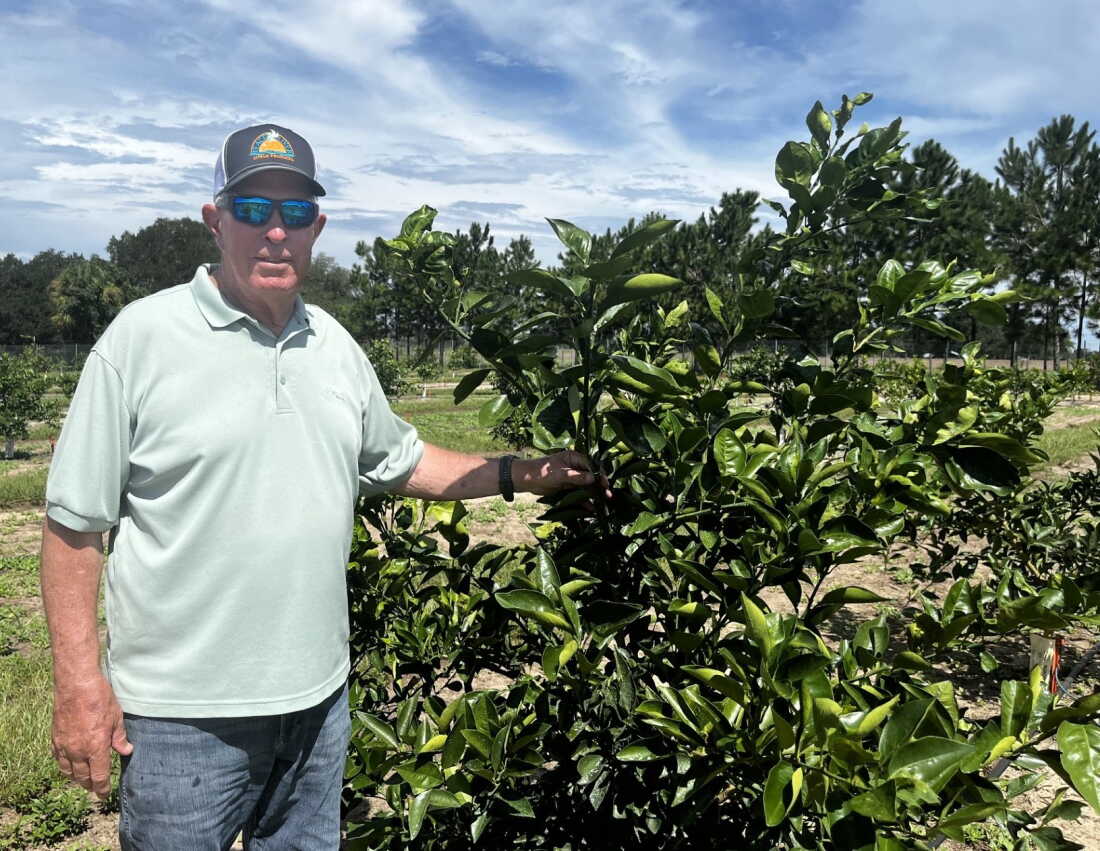
Ron English shows off citrus trees planted with the CarriCea T1 rootstock at Soilcea's test field in Thonotosassa, Fla. Catherine Welch hide caption
toggle caption
In a SoilCea test field, the results so far are promising. Trees with the CarriCea T1 rootstock are taller and greener.
English cares for the dozens of trees in the test field that have the modified rootstock. They were planted last summer next to trees without it.
"That's the CarriCea rootstock — see how big the leaves have filled out," English said, pointing to a tree with the modification.
The smaller tree next to it does not have the CarriCea T1 rootstock. It's smaller with yellower leaves.
"See the discoloration, that's the disease already working through the tree," he said.
The real test for the CarriCea T1 tree will be the fruit, which takes years to show up — not only how it grows, but also how it tastes.
"The data suggests it's gonna work, but until you have a 10-year-old tree, you don't know how the tree is going to perform," Lagos said.
KioskNews shows a cleaned-up reading view extracted from the publisher’s page — the original always lives on their site, not ours.