2026 Elections: Election-eve permits secured in 1 second since 2020
By Ho Yu-hua / Staff reporter


Since 2020, election-eve rally permits have been snapped up within one second, the Taipei City Government’s Public Works Department said yesterday, denying allegations of unfair treatment.
The department issued the statement after netizens questioned how Taipei Mayor Chiang Wan-an’s (蔣萬安) re-election campaign team managed to secure a coveted election-eve rally venue in just 0.35 seconds, with some joking that their speed surpassed that of a robot and others suspected the use of automated software.
The controversy stemmed from an announcement by Democratic Progressive Party (DPP) Taipei mayoral candidate Puma Shen (沈伯洋) on Wednesday canceling his election-eve rally.
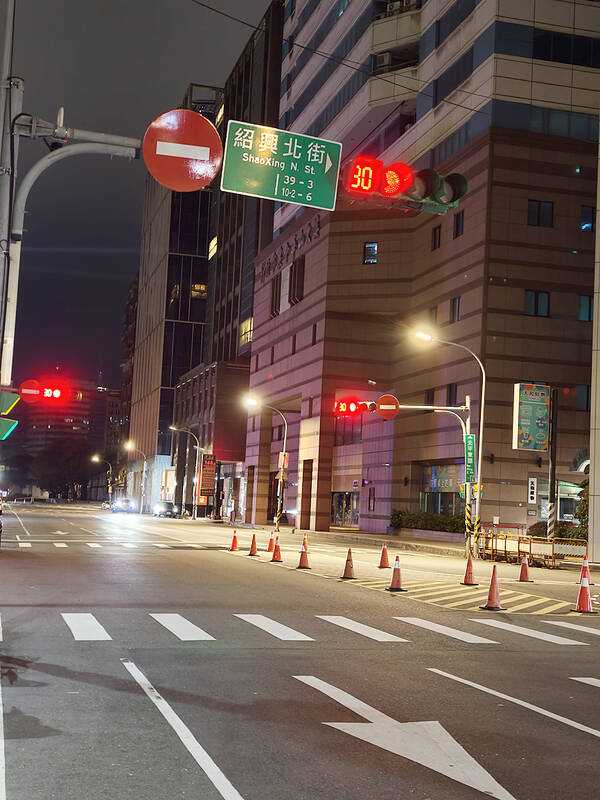
Beiping E Road in Taipei is pictured last night.
Photo: Wang Yi-sung, Taipei Times
Shen said that Ketagalan Boulevard, City Hall Road and Beiping East Road had been booked by other people, so his campaign planned to use Renai Road Sec 4 for the rally. However, he ultimately decided to cancel the rally, as the event would require closing the road, inconveniencing commuters and nearby residents.
Shen said he would hold an online election-eve rally instead.
Political commentator Wen Lang-tung (溫朗東) yesterday said applications for road use permits for today’s election-eve rallies opened at midnight on Oct. 28, exactly 30 days in advance, on a first-come, first-served basis.
The Taipei City Government road use application system received an application for Ketagalan Boulevard 0.35 seconds after midnight, he said, adding that at 0.36 seconds, two more applications came in, securing two sections of Zhongshan S Road.
Another one arrived at 0.38 seconds for City Hall Road, he said.
This was not the first time such a situation had occurred, Wen said.
On Oct. 26, an application secured Beiping E Road for Wednesday 0.4 seconds after midnight, and City Hall Road at 0.83 seconds, he said.
The next day, an application submitted at 0.35 seconds after 12am secured Ketagalan Boulevard and City Hall Road for Nov. 26, while Beiping E Road was claimed at 1.11 seconds, Wen said.
Given the speed, Wen questioned whether Chiang’s team had used automated software, or even the city government’s internal network, to secure major event venues for the election eve and the preceding two days.
DPP Media Division Deputy Director-General Huang Tzu-yi (黃子一) said that he tested the application process and found that it involved 11 steps and required applicants to fill in 16 fields of information. He questioned how anyone could complete the process and secure a venue in under one second.
The department said that since 2020, applications for Ketagalan Boulevard permits for election-eve rallies have been submitted 0.630, 0.380, 0.330 and 0.350 seconds after the application window opened.
Each applicant may apply to use a maximum of two road sections for up to two consecutive days, and they are limited to one application per month, it said.
Applicants must submit their requests through the Taipei City Road Use Application System. Each application is jointly reviewed by the police department and the relevant precinct, after which the public works department issues a road-use approval or rejects the request based on the review findings, it said.
Obtaining road-use approval does not automatically grant permission to hold an assembly or march, the department said.
Applicants must submit the required documents under the Assembly and Parade Act (集會遊行法), including an application form, the road-use approval, identification and a list of participants, to the local police precinct. A permit will be issued only after the police department approves the application, it said.
KioskNews shows a cleaned-up reading view extracted from the publisher’s page — the original always lives on their site, not ours.