SpaceX Starlink cuts hobbled Ukraine before Russian bombardment
Restrictions on Ukraine’s use of SpaceX’s satellite technology came just weeks after its forces relied on the network for a surprising and successful counter-offensive that retook critical territory from Russian forces.
Sign In or Create an Account
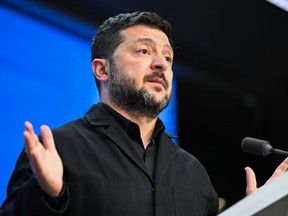
The temporary limits landed ahead of a fresh Russian bombardment, hobbling Ukraine’s air defense interceptors — which rely on a militarized version of SpaceX’s Starlink known as Starshield — and spurring a blame game as President Volodymyr Zelenskyy accused President Donald Trump and SpaceX chief Elon Musk of allowing it to happen.
Amid fresh outrage from U.S. lawmakers about the Russian attack and simmering White House frustration about Kyiv’s long-range strikes on Russian energy facilities, what was less obvious was just how essential the Starshield platform was to Ukraine’s recent efforts pushing back Russian forces inside its own territory.

Get a dash of perspective along with the trending news of the day in a very readable format.
By signing up you consent to receive the above newsletter from Postmedia Network Inc.
A welcome email is on its way. If you don't see it, please check your junk folder.
The next issue of NP Posted will soon be in your inbox.
We encountered an issue signing you up. Please try again
That campaign — known as Operational Vivaldi — concluded this month after liberating more than a dozen Ukrainian settlements, preventing Russian forces from capturing all of the crucial Donetsk region. Ukrainian forces used the satellite terminals to remotely drive drones, bombs and robots both into and behind the Kremlin’s forces, where they destroyed heavily fortified positions and isolated Russia’s logistics hubs.
The unit responsible said last month that Starlink was the primary platform it used to carry out the operation.
“We’re dependent on Starlink to maintain connectivity of our people, command centers, soldiers, drones,” said John Roberts, a senior U.S. military adviser to the Ukrainian third army corps, which launched Vivaldi. “As a product we love it and want to keep using it. There’s not an alternative that’s as easy to use.”
The offensive demonstrated to allies that Kyiv can still take initiative on the battlefield, which is crucial given most analysts believe the war will only end if Ukraine and its allies increase pressure on Russia. It also underscored just how vital the Starlink and Starshield networks are to Ukraine’s broader armed forces, as Kyiv pushes for a full restoration of the service.
On Friday, Zelenskyy told reporters that while connection speeds have improved, the platform hasn’t yet been fully restored.
Why it was restricted this week remains unclear. Trump said on Friday he didn’t order limits on Ukraine’s access to Starshield and didn’t think Musk did so either. “It wasn’t me and I don’t think it was Elon,” he said.
What’s more clear is how valuable Musk’s satellite-enabled internet network has become to Ukraine.
Starshield enabled Kyiv’s use during the counter-offensive of robotic kamikaze vehicles carrying bombs — which Ukrainian forces had converted from Soviet-era armored personnel carriers known as BTR-60s — that were sent deep into Russian lines. Smaller four-wheeled Hyena robots were also air dropped behind Russian forces, with the SpaceX platform driving the unmanned ground vehicles.
At the same time, the system isn’t used for the long-range strikes on Russian energy facilities that have strained ties between Kyiv and the White House, which is nervous about energy prices ahead of U.S. midterm elections on Nov. 3. Ukraine uses “Starlink for strikes against enemy military targets within temporarily occupied territories,” Zelenskyy said. The platform is not used for deep strikes inside Russian territory, he said.
Starlink’s not only proven vital to Ukraine, but it has occasionally provided Russian troops with a tactical advantage when they were able to covertly utilize the network.
The US Defense Intelligence Agency earlier this year disclosed how Ukraine was able to retake territory after Russia’s use of Starlink was hobbled, allowing them to regain about 154.44 square miles (400 square km) after thousands of portable Starlink internet terminals operated by Russian forces were deactivated. That counter-offensive marked Kyiv’s first territorial gains since 2023.
Ukraine Retook Territory After Hobbling Starlink, Pentagon Says
By contrast, Operation Vivaldi allowed Ukraine to regain more than 100 square miles. Even if the advance — about twice the area of Manhattan — appeared modest, it still stymied Russia’s attempts to close in on the cities of Slovyansk and Kramatorsk, the last major settlements under Ukrainian control in Donetsk. A key war aim of Russian leader Vladimir Putin is to seize all of the Donetsk region.
The importance of Starlink on the battlefield has Ukrainian soldiers worried that it could be restricted again without warning.
“It’s depressing: we consider the U.S .and a U.S. company like SpaceX to be our allies against Russia. It makes us sad when things like this happen,” Roberts said in an interview this week. “We’re not sure why it happened just yet. Maybe it did for a technical reason. And hopefully it didn’t happen because there was any intention to hurt us.”
—With assistance from Olesia Safronova and Daryna Krasnolutska.
Our website is the place for the latest breaking news, exclusive scoops, longreads and provocative commentary. Please bookmark nationalpost.com and sign up for our daily newsletter, Posted, here.
Join the Conversation
This website uses cookies to personalize your content (including ads), and allows us to analyze our traffic. Read more about cookies here. By continuing to use our site, you agree to our Terms of Use and Privacy Policy.
KioskNews shows a cleaned-up reading view extracted from the publisher’s page — the original always lives on their site, not ours.