Hedge fund UG courts Taiwan to tap AI wealth
MILLIONAIRES’ MARKET: Banks and asset managers are racing to offer more private-market products to high-net-worth clients in Taiwan as their fortunes swell
UG Investment Advisers, a hedge fund overseeing US$3.7 billion, is targeting Taiwan’s wealthy as a new source of capital, betting on a surge in private fortunes fueled by the nation’s artificial intelligence (AI) boom.
The Singapore-headquartered firm signed a deal with Taiwan’s E.Sun Commercial Bank Ltd (玉山銀行) last month to distribute one of its long-short equity funds, its first tie-up with a local lender.
The move marks a homecoming of sorts for the hedge fund, which has roots in Taipei, but has largely relied on offshore investors such as Asian and European family offices for almost three decades.
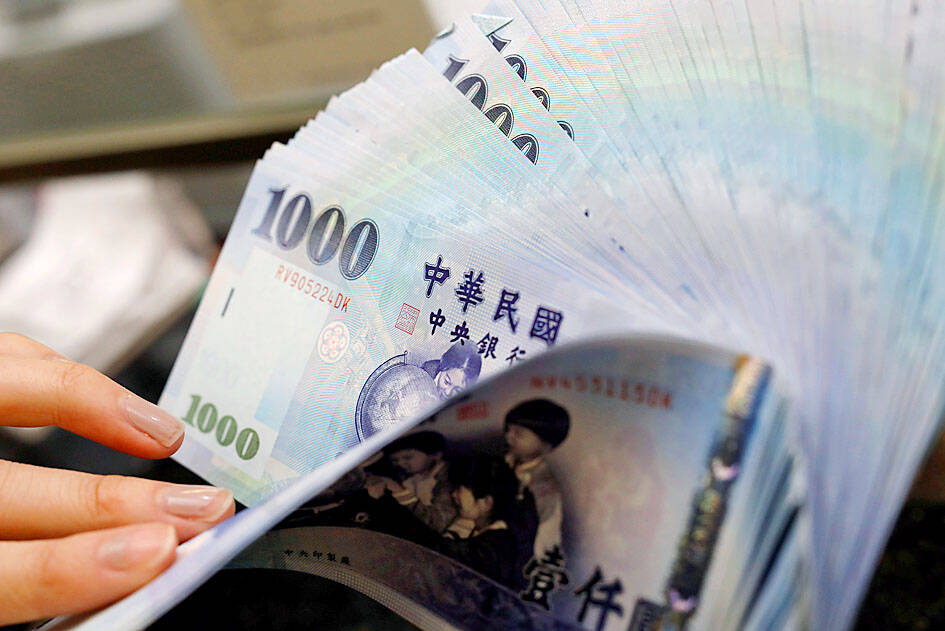
A teller counts NT$1,000 banknotes at a bank in Taipei on Feb. 23, 2017.
Photo: Tyrone Siu, Reuters
“AI is rapidly creating new wealth in Taiwan, while the regulatory environment is becoming more favorable as the government pushes to develop the island into a financial hub,” UG Investment chief operating officer Brandy Chen said in an interview. “The stars are aligned for us to enter the onshore market.”
Banks and asset managers in Taiwan are racing to offer more private-market products to high-net-worth clients as their fortunes swell. The wealth boom is being fueled by the nation’s buoyant economy and stock market, underpinned by local chipmakers and sprawling supply-chain companies.
Taiwanese banks have made distribution deals with other global investment firms. Cathay United Bank Co (國泰世華銀行) said last month it was partnering with Carlyle Group Inc to sell private equity offerings to wealthy individuals in the nation’s dedicated wealth zone. CTBC Bank Co (中信銀行) teamed up with European private equity firm Ardian to offer funds investing in the secondaries market.
Offshore private equity, private credit and hedge funds must be distributed to Taiwanese individual investors through licensed banks or asset managers. Each fund is capped at 99 investors with at least NT$30 million (US$953,000) in assets, a limit the Financial Supervisory Commission (FSC) has pledged to ease as demand for alternative investments grows.
The outstanding balance of private funds sold to high-net-worth clients totals NT$7.38 billion, the FSC said earlier this year. That accounts for just 0.32 percent of the total assets under management for high-net-worth clients, a relatively small share.
Taiwan has more millionaires as a percentage of the adult population than anywhere else in Asia, with the exception of Hong Kong and Australia, according to this year’s UBS Global Wealth Report.
“The wealth creation is opening up onshore opportunities, while the rise of family offices reflects the new fortunes being minted by Taiwan’s AI supply chain,” Chen said.
UG Investment runs a 43-person team of fund managers, analysts and quants across Singapore, Shanghai and Taipei that pursue long-term, fundamental-driven strategies, she said.
UG’s largest fund, which it plans to offer in Taiwan, manages more than US$2 billion and focuses on technology stocks across the US and Asia, Chen said.
It has gained 14.2 percent in the first seven months of the year, despite a 2.5 percent drop in July amid a global tech selloff.
The fund has delivered an annualized return of 15.4 percent since inception in 2007, she said.
“Equity long-short hedge fund products are still relatively rare in Taiwan,” Chen said.
Most alternative offerings currently concentrate in private credit, private equity and infrastructure.
KioskNews shows a cleaned-up reading view extracted from the publisher’s page — the original always lives on their site, not ours.