6 Essential Horror Books for Beginners

Sign in to your Collider account
Spooky season is now officially upon us, so what better time to get into some amazing horror books? Veterans of the genre probably already have a list lined up and ready to go to get them in the mood for Halloween, either comprised of old favorites or new prospects. However, not everyone is into literary horror — in fact, not everyone is into reading at all (though people really should be).
If you're looking to get into the spirit of the season and get into some horror novels, there are a few great books that allow newcomers to dip their toes in. These books aren't just revolutionary — they're classic, accessible, and from a multitude of subgenres. From cosmic entities to unhinged killers and even haunted houses, these are the best and most essential horror novels for beginners.
'The Fisherman' (2016)

John Langan's The Fisherman is a textbook example of cosmic horror, a subgenre which relies on beings from beyond space and time, and the idea that humanity is utterly insignificant in the grand scale of the universe. This novel follows a widowed man who uses fishing as a means of coping with his grief. He befriends a fellow fisherman and the two make plans to try a renowned spot called Dutchman's Creek. This creek has a haunted reputation, with local legends stating it is cursed, and has the potential to bring back deceased loved ones. Arriving at the creek, they meet a man known only as "Der Fisher," who spends his days trying to catch a mysterious beast known as the Leviathan.
The Leviathan in this book rarely makes a physical appearance, and even when it does, it remains mostly out of view. As such, this book isn't super in your face when it comes to horrifying imagery. However, it does do a good job of playing upon the idea that there are forces bigger than us, and that they are not to be trifled with. The Leviathan is by far one of the scariest monsters in fiction, which is probably why this book won the 2016 Bram Stoker Award. It's just fantastic all around, and is a modern masterpiece that is sure to go down in history.
'The Woman in Black' (1983)

Susan Hill's The Woman in Black is a novel that is written like classic Gothic horror stories. The plot concerns a solicitor called Arthur Kipps, who is sent to the remote English village of Crythin Gifford to sort through the documents and will of a deceased woman named Alice Drablow, who lived in an isolated manor in Eel Marsh. Upon arriving in the hamlet, he finds the locals are cold and refuse to speak to him, though they discourage him from going to Eel Marsh. At Alice Drablow's funeral, Arthur notices a woman dressed head to toe in black, staring at him from a distance.
It should be fairly obvious, but this woman is a ghost, one that the people of the town are all too aware of. Shortly after seeing her, a tragic accident in town kills a small child, establishing the Woman in Black as an omen of death. Despite the title, the ghost herself rarely physically appears in the book. Instead, the horror comes from Gothic tropes, such as isolation and a mounting sense of dread. It's a great novel for beginners, made even better by its two film adaptations.
'The Shining' (1977)
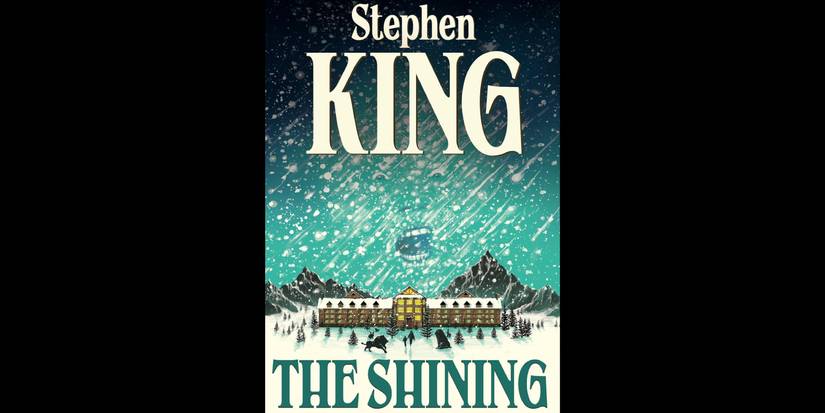
Stephen King is sort of a modern horror master, publishing an impressive catalog of books, many of which receive film or TV adaptations. A lot of his books are nose-dives into the deep end though, as many of them are lengthy, extremely scary, or complex. The Shining, however, is probably the most accessible point in his extensive repertoire. The book opens up with a hotel owner and his family getting snowed in, only for the father to be plagued by a psychic force known as the Shining. Trapped with no way out, the father loses his mind and begins murdering his guests and hunting down his family.
The book is kind of lengthy, admittedly, but it's nowhere near as long as King's other book, It, which is well over 1,000 pages in length. The Shining is a great horror story because there are no real monsters — just supernatural influences and an axe murderer. The book got pretty famous for Stanley Kubrick's stellar 1980 film adaptation, though King himself famously loathed it. In any event, this is a great slasher story, a phenomenal horror book, and a thoroughly entertaining ride from start to finish that's actually fairly frightening. It might be a bit more challenging than some of the other books on this list for beginners, but it's still worth pursuing.
Collider Exclusive · Horror Survival Quiz Which Horror Villain Do You Have the Best Chance of Surviving? Jason Voorhees · Michael Myers · Freddy Krueger · Pennywise · Chucky
Five killers. Five completely different ways to die — if you're not smart enough, fast enough, or self-aware enough to avoid it. Only one of them is the villain your particular set of instincts gives you a fighting chance against. Eight questions will figure out which one.
🏕️Jason
🔪Michael
💤Freddy
🎈Pennywise
🪆Chucky
01
Something feels wrong. You can't explain it — you just know. What do you do? First instincts are the difference between the survivor and the first act casualty.
02
Where are you most likely to find yourself when things go wrong? Setting is everything in horror. Where you are determines which rules apply.
03
What is your most reliable survival asset? Every survivor has a quality the villain didn't account for. What's yours?
04
What kind of fear is hardest for you to fight through? Knowing your weakness is the first step to not dying because of it.
05
You're with a group when things start going wrong. What's your role? Horror movies are brutally clear about who survives group situations and who doesn't.
06
What's the horror movie mistake you're most likely to make? Honest self-assessment is a survival skill. Denial is not.
07
What's your best weapon against something that can't be stopped by conventional means? Every horror villain has a weakness. The survivors are always the ones who find it.
08
It's the final scene. You're the last one standing. How did you make it? The final survivor always has a reason. What's yours?
Your Survival Odds Have Been Calculated Your Best Chance Is Against…
Your instincts, your strengths, and your particular way of thinking under pressure point to one villain you actually have a fighting chance against. Everyone else — good luck.
Jason Voorhees
Jason is relentless, but he is also predictable — and that is the gap you would exploit.
- He moves in straight lines toward his target. He doesn't strategise, doesn't adapt, doesn't outsmart. He simply pursues.
- Your ability to keep moving, use the environment, and resist the panic that freezes most victims gives you a genuine edge.
- The Crystal Lake survivors were always the ones who stopped running in circles and started thinking about terrain, water, and distance.
- You think like that. Which means Jason, for all his indestructibility, would face someone who simply refused to be where he expected.
Michael Myers
Michael watches before he moves. He is patient, methodical, and almost impossible to detect — until it's too late for anyone who isn't paying close enough attention.
- But you are paying attention. You notice the shape in the window, the car parked slightly wrong, the silence where there should be sound.
- Michael's power lies in the invisibility of ordinary suburbia — the fact that nothing ever looks wrong until it already is.
- Your spatial awareness and instinct to map every room, every exit, and every shadow before you need them is precisely the quality Laurie Strode had.
- You are not a victim waiting to happen. You are someone who already suspects something is wrong — and acts on it.
Freddy Krueger
Freddy wins by getting inside your head — using your own fears, your own memories, your own subconscious as weapons against you. That strategy requires a target who can be destabilised.
- You are harder to destabilise than most. You've faced uncomfortable truths about yourself and you haven't looked away.
- The survivors on Elm Street were always the ones who understood what was happening and chose to face it rather than flee from it.
- Freddy's greatest weakness is that his power evaporates in the presence of someone who refuses to give him the fear he feeds on.
- Your psychological resilience — the ability to stay grounded when reality itself becomes unreliable — is exactly the quality that keeps you alive here.
Pennywise
Pennywise is ancient, shapeshifting, and feeds on terror — but it has one critical vulnerability: it cannot function against someone who genuinely stops being afraid of it.
- The Losers Club didn't survive because they were braver than everyone else. They survived because they faced their fears together, and faced them honestly.
- You ask the questions others avoid. You look directly at what frightens you rather than turning away.
- That directness — the refusal to let fear fester in the dark — is Pennywise's worst nightmare.
- It chose the wrong target when it chose you. You are exactly the kind of person whose fear tastes like nothing at all.
Chucky
Chucky's greatest advantage is that nobody takes him seriously until it's already too late. He exploits the gap between how something looks and what it actually is.
- You don't have that gap. You take threats seriously regardless of how they present — and you never make the mistake of underestimating something because of its size or appearance.
- Chucky relies on surprise, on the delay between recognition and response. You close that delay faster than almost anyone.
- Your instinct to treat every unfamiliar thing with appropriate scepticism — rather than dismissing it because it seems absurd — is the exact quality that keeps you breathing.
- Against Chucky, not laughing is already winning. You are very good at not laughing.
'Dracula' (1897)

Bram Stoker's Dracula has seen countless film adaptations, none of them faithful to the source material. The plot follows an English solicitor named Jonathan Harker, who travels to a remote castle in the mountains of Transylvania (a region of Romania). The castle is inhabited by Count Dracula, a wealthy Transylvanian noble, who plans to purchase a house near London. While staying in the gloomy castle, however, Harker discovers a terrifying secret: Dracula is a vampire who has been undead for hundreds of years.
This isn't exactly a spoiler because pretty much everyone knows Dracula is a vampire at this point, right? He's only the most famous vampire in all fiction. Still, this book is responsible for establishing Gothic horror tropes, as well as tropes of vampire fiction. Every stereotype of vampires that modern pop culture includes is a direct result of this novel. For that reason, it is absolutely crucial that any newcomers to the genre, or any new readers in general, should absolutely give this one a go.
'Frankenstein' (1818)

Frankenstein is a novel that was initially published under an alias, as sexism was rampant at the time, and it would have been pretty unlikely that a novel written by a woman would be accepted in society. Regardless, nowadays, almost everybody knows that Mary Shelley is the one responsible for Frankenstein, which became a household name, saw numerous film adaptations, and spawned one of the most recognizable characters in all fiction. The book not only influenced Gothic horror, but also science-fiction, with its influence still being felt over two centuries later.
The book is about a scientist named Dr. Frankenstein, who comes up with a crazy idea to create artificial life. Stitching together acquired body parts from corpses and running an electrical current through it, he creates Frankenstein's monster, which is immediately considered an abomination by pretty much everybody who sees it. Despite the monster having no name and being treated as a social pariah for obvious reasons, he is honestly more of a tragic character who just wants to be left alone. The book isn't just a horror classic, it's one of the most prominent examples of humans being the real monsters. Beyond that, it addresses how humanity has no right to play God, and how the ambitious are often so preoccupied with whether they could that they never stop to ask whether they should. It's a marvelous work of fiction, and a great entry point for beginners to the genre.
'The Haunting of Hill House' (1959)

The Haunting of Hill House is a novel by Shirley Jackson that is similar to Gothic horror, but also fits into its own little niche. The story is about a group of students and their professor who spend a few nights in the infamous Hill House, which is reported to be haunted. They initially don't believe these stories, but quickly find out that the stories are not mere urban legends, but factual accounts. The ghosts in this book are very real, and rapidly begin to torment the students.
Despite its simplistic premise, this book is genuinely really scary. It's one of those books that some people can't read at night. It has no gore, and no jump scares (because let's face it, how exactly can you pull off a jump scare in prose?). It relies mostly on dread and a surmounting feeling that something isn't right. The show famously received a Netflix miniseries adaptation, though this was far from faithful to its source. It barely had anything to do with it, in fact. The original work is not only a fantastic piece of horror, but it's also a superb piece of feminist literature, as there is a subtext about the house itself representing patriarchal society. It's not just an entertaining and unnerving read, it's one that's got a lot to say for itself, too, which is why it's perfect for beginners.
KioskNews shows a cleaned-up reading view extracted from the publisher’s page — the original always lives on their site, not ours.