‘Obsession’ Director Officially Returns to His Roots With a Terrifying New Horror Short

Hannah covers horror, sci-fi, and games at Collider, where she writes news and features, reviews new releases, and interviews the people who make them. She’s helping build out Collider’s gaming coverage, with Pokémon as one of her specialties. If she isn’t writing about a monster, she’s probably watching one on a tape from her VHS collection.
Content warning: The following discusses implied sexual assault and contains spoilers for Mama Bear.Supernatural horror becomes especially disturbing when its consequences extend beyond the person encountering the monster. A creature can hurt someone directly, but it can also leave people responding to violence they cannot fully understand. Curry Barker’s new horror short, Mama Bear, builds its nightmare around that second possibility, placing two people in a confrontation where neither appears to have the information necessary to recognize what has happened. That uncertainty gives the premise an uncomfortable emotional foundation. One person is facing an accusation he cannot explain, while another arrives apparently seeking revenge for something horrific. The supernatural presence connecting them allows both experiences to exist simultaneously. His confusion can be sincere, and her distress can still have a terrible cause.
Written, directed, and edited by Barker, Mama Bear is officially available to watch for free on That’s a Bad Idea, the YouTube channel he shares with Cooper Tomlinson. Made in collaboration with Windows, the short stars Jon Lee Richardson, Katie Sarife, Ericka Kreuz, and Joshua Snyder, and reunites Barker with Obsession production designer Vivian Gray. At just under five minutes, it gives the filmmaker another opportunity to turn a relatively simple supernatural premise into something deeply uncomfortable.
‘Mama Bear’ Turns Mistaken Identity Into a Supernatural Nightmare

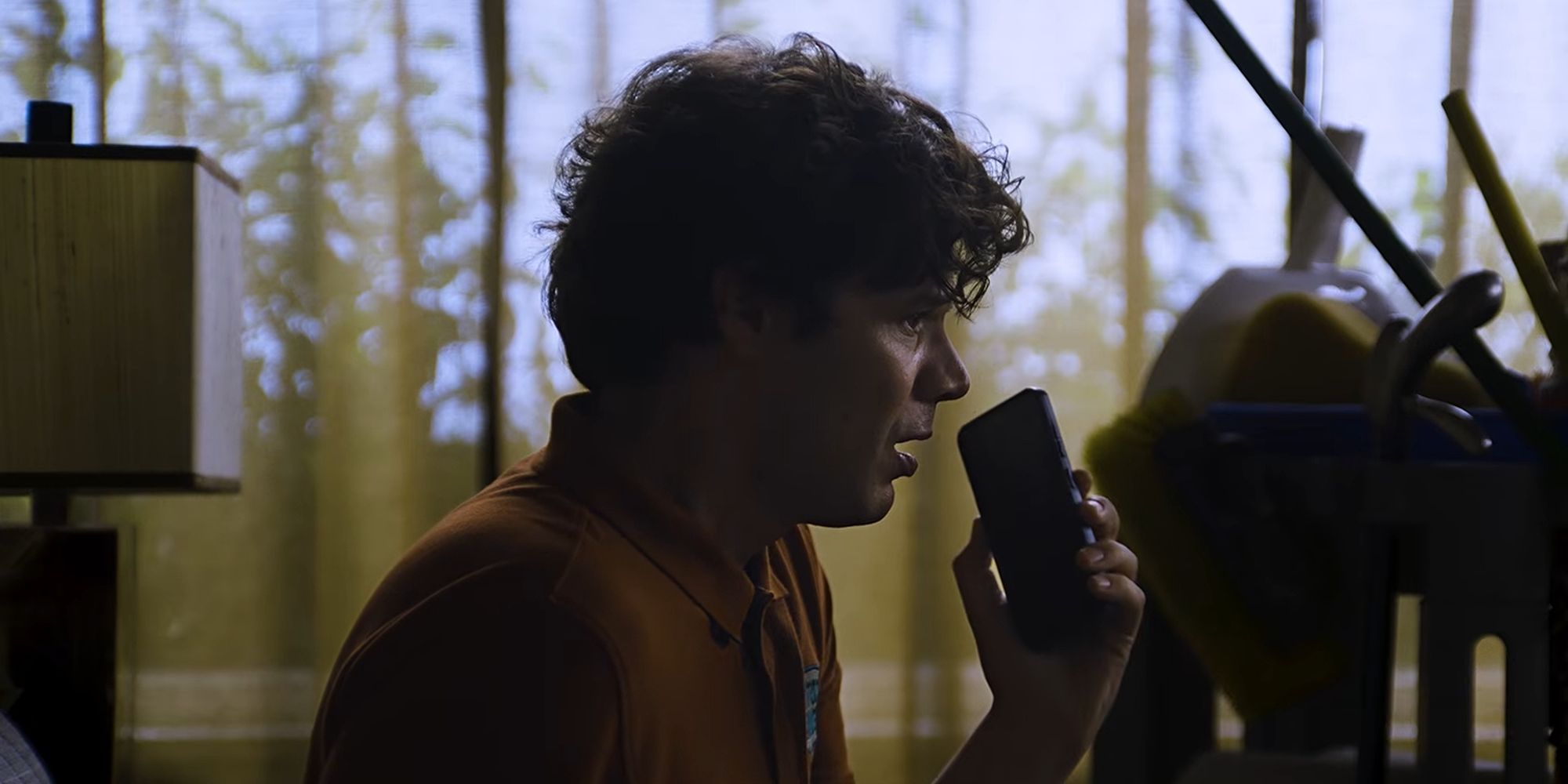
Richardson plays Floyd, a house cleaner who wakes to a phone call warning him that Lacey (Sarife) is coming to kill him. The caller appears to understand a situation Floyd knows nothing about, immediately putting him at a disadvantage, as he is being warned about the consequences of an incident before he can even establish what he is accused of doing. Bloody evidence nearby and a figure standing in the room gradually suggest an explanation: someone who looks like Floyd has done something terrible.
The doppelgänger premise makes Floyd’s confusion especially frightening because the truth offers him very little protection. His appearance is the reason he is being targeted, and explaining that another version of him is responsible requires someone to believe the impossible. Every attempt to deny responsibility could sound exactly like an excuse. Barker places him in a situation where being innocent does not give him a believable defense. That helplessness becomes the foundation of the short’s horror. Floyd is trying to understand a story that has already progressed beyond the point where he can meaningfully intervene. Whatever the double has done, it has left him to deal with the consequences. The threat is therefore larger than the figure sharing his space: someone else has taken control of how he is perceived, turning his own identity into evidence against him.
When Lacey arrives and shoots him, the confrontation reaches its conclusion. Floyd is the victim of his double’s actions, although the precise nature of the earlier incident remains unexplained. His death resolves the immediate threat against him while leaving the source of that threat intact.
Lacey’s Distress Gives ‘Mama Bear’ a More Disturbing Implication

Lacey’s arrival carries a disturbing suggestion of sexual violence. Her clothing is disheveled, her outer layer slipping from one shoulder, and her visible anguish gives the confrontation an emotional brutality beyond the immediate threat of the gun. The scene strongly suggests someone confronting the person she believes violated her, only to hear him insist that he has no idea what she is talking about. Although the short never explicitly identifies the preceding violence as sexual assault, that reading makes the encounter especially devastating. Floyd’s confusion may be sincere, yet every denial could sound to Lacey like her attacker refusing to acknowledge what he has done.
That disconnect gives the double’s actions an especially cruel reach. Floyd is facing consequences for violence he apparently did not commit, while Lacey may be standing in front of someone she has every reason to recognize as her attacker. Neither has access to the explanation that would make the other’s behavior comprehensible. His innocence does nothing to diminish her suffering, and her certainty cannot account for the impossible presence of another Floyd. The double has placed two people in direct conflict while leaving them unable to understand how they have both been victimized.
Sarife’s distress is essential to that interpretation because it prevents Lacey from functioning solely as a threat to Floyd. Her arrival brings the emotional consequences of the preceding violence into the room, even as the short withholds the event itself. The audience has been following Floyd’s confusion, but her anguish complicates that perspective. Recognizing that he may be innocent does not make what she is experiencing any less real.
Collider Exclusive · 8 Questions · 2 Minutes What Is Your Biggest Horror Nightmare? Elm Street · Chucky · Scream · The Conjuring
Four horror franchises. Four completely different ways of scaring you. One waits until you fall asleep. One makes sure nobody believes you. One is already in your group of friends. And one is in the house with your family. Answer eight quick questions about how you actually watch horror, and find out which nightmare was built for you.
😴Elm Street(Freddy Krueger)
🧸Chucky(Child's Play)
📞Scream(Ghostface)
🕯️The Conjuring(The Warren Files)
01
Which horror scene makes you cover your eyes? Four classic images. One of them is worse than the others for you.
02
You are home alone and you hear a noise. First thought? Everybody has one. It arrives before you have decided anything.
03
Which horror movie rule would you break first? Everybody thinks they would survive. Almost nobody actually does.
04
Something genuinely frightening happens. What do you do? Not in a film. In your actual living room, tonight.
05
How do you actually watch a horror film? Be honest about this one. Nobody is checking.
06
Somebody offers you serious money. Which do you still refuse? The amount does not matter. There is one on this list you are not doing.
07
Which feeling stays with you a week after the film? Good horror does not stop when the credits do.
08
Something wakes you at 3am. What is the worst possibility? Eight questions in, this is the one that decides your nightmare.
The Lights Just Went Out Your Nightmare Is…
Four franchises, four completely different ways of getting underneath your skin. This is the one built out of your particular fear, why it works so well on you, and what it would leave behind.
Elm Street
Your nightmare does not wait outside the door. It waits for you to close your eyes, which you are going to have to do eventually, because nobody has ever won that particular argument.
- Freddy is horror's cruellest idea: a threat that lives in the one place you cannot guard, cannot lock, and cannot avoid forever.
- You are the one who is fine during the film and wide awake at two in the morning. Your own head is where this does its damage.
- These films understood exhaustion as a horror engine. The kids on Elm Street do not lose because they are weak. They lose because they are tired.
- You can lock every door in the house. You still have to sleep.
Chucky
Your nightmare is not really the doll. It is the face of the person you tell, and the way they decide, very kindly, that you have imagined all of it.
- Chucky works precisely because he is absurd. That is the trap: the more accurately you describe him, the less anybody is going to believe you.
- You are the one shouting at the screen because the characters are not listening. You know that feeling from real life too.
- The franchise is at its best when the adults in the room are the real obstacle, and you have met those adults.
- By the time somebody finally believes you, you will have handled most of it on your own.
Scream
Your nightmare has your number, knows your name, and has almost certainly been inside your house before. The worst part is that you already know them.
- Scream is the only one of these where the killer takes the mask off and turns out to be somebody who was at the party.
- You are the person who calls the twist out loud before it lands. You watch people the same way you watch films.
- The franchise made the rules of horror part of the plot, which means the survivors are the ones paying attention. You would be paying attention.
- Everybody is a suspect, including the person who just offered to walk you home.
The Conjuring
Your nightmare is not really about you. It is about the people asleep down the hall, and the feeling that whatever is here is not interested in leaving.
- The Conjuring films are domestic horror. The house, the family, the perfectly ordinary room that quietly stops feeling ordinary.
- Your instinct is to get everybody into one room. Your fear is protective rather than personal, which is rarer than it sounds.
- This is the one franchise where belief is the weapon. The people who come through it are the ones who are not alone and refuse to be.
- Whatever is here did not come for you. It came for the household, and you are the one standing in the hallway.
That loss of control makes Mama Bear an unsettling companion to Obsession. Barker’s feature grounds its supernatural horror in the violation of Nikki’s (Inde Navarrette) autonomy, following the consequences of Bear (Michael Johnston) forcing her into a relationship she never chose. Its emotional weight comes from recognizing the person trapped beneath behavior that has been imposed on her. Nikki’s suffering remains central even when the story follows Bear’s increasingly desperate attempts to manage the nightmare he created. Mama Bear approaches that violation through the double’s ability to separate identity from responsibility. Floyd’s appearance has apparently been used to commit violence he knows nothing about, while Lacey is responding to an encounter whose supernatural circumstances she cannot recognize. Read through the implication of sexual assault, the confrontation becomes another example of Barker using supernatural horror to explore violations with painfully recognizable human consequences. The impossible explanation does nothing to soften the suffering it has caused.
The shadowy, contorted figure also recalls Obsession, particularly the way Barker makes a recognizable human shape feel deeply wrong. That visual familiarity carries an additional cruelty in Mama Bear because the resemblance itself drives the horror. Looking like Floyd allows the double to hurt someone and leave another person to face the consequences. Its appearance is both the source of the supernatural unease and the reason the human confrontation becomes so devastating.
The short is less satisfying in how briefly it develops those consequences. The relationships surrounding Floyd and Lacey remain largely unexplored, giving their confrontation little context beyond the immediate crisis. Withholding the double’s origins preserves its menace, but leaving so much of the human story unexplained limits the emotional weight of the ending. The premise suggests a larger tragedy than the short has time to examine. Even with those limitations, Mama Bear offers a disturbing premise for Barker’s return to short-form horror. Its strongest idea is that Floyd’s apparent innocence and Lacey’s anguish can coexist without either saving them. The double has created a nightmare in which recognizing the wrong person can feel exactly like recognizing the right one, and the consequences become permanent before either character can understand the difference.
Mama Bear is available to watch for free on YouTube.
- Release Date
- May 15, 2026
- Runtime
- 108 minutes
- Director
- Curry Barker
-

Michael Johnston
Bear
-

Inde Navarrette
Nikki
-

Cooper Tomlinson
Ian
-
Megan Lawless
Sarah
- Writers
- Curry Barker
- Producers
- Haley Nicole Johnson, Christian Mercuri, James Harris, Roman Viaris
KioskNews shows a cleaned-up reading view extracted from the publisher’s page — the original always lives on their site, not ours.