Iguazú Falls closed amid flood warnings linked to El Niño
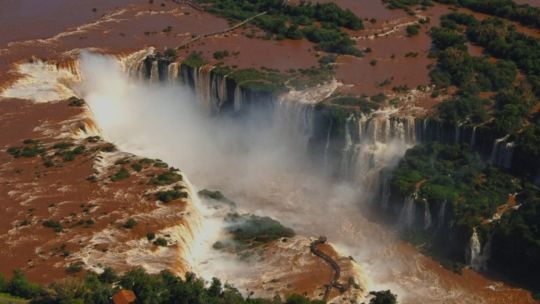
Authorities closed access to Iguazú Falls in northeastern Argentina on Monday as the river swelled following heavy rainfall.
Warnings were also issued over rising water levels in the Paraná and Uruguay rivers amid forecasts of further rain linked to the El Niño phenomenon.
The Iguazú National Park administration and the company operating the tourist circuit restricted access to the falls, located in Misiones Province, after the river's flow exceeded 12,000 cubic metres per second – more than six times its average level.
“Temporary restrictions are being imposed on the movement of people and access to public-use areas,” Iguazú National Park said in a statement on Monday, without specifying when it would reopen.
Park director José María Hervás said the closure was a precautionary measure because “it just keeps raining” and the volume of water being released from dams upstream on the Iguazú River was not falling.
The park has previously been closed due to flooding, in 2023 and 2024, during another El Niño episode that destroyed walkways in the 'Garganta del Diablo' ("Devil's Throat") section of the tourist circuit.
In August, park authorities closed that section and removed walkways as a precaution, in anticipation of a weather event similar to, or even more powerful than, the previous one.
Meteorologists around the world have warned that the current El Niño phenomenon could become the strongest on record.
El Niño raises temperatures in the tropical Pacific, triggering changes in weather patterns that can increase the risk of droughts and floods and exacerbate global warming.
Argentina's National Meteorological Service (SMN) said that, up to September, the country's coastal region had experienced excess rainfall “similar to the average for strong El Niño events."
The SMN warned that “initially, the excess rainfall is relatively small, but it increases as the year progresses, particularly during the austral summer and autumn,” which fall in 2027.
Meanwhile, the binational entity responsible for the Yacyretá hydroelectric plant on the border between Argentina and Paraguay reported on Monday that flows in the Paraná River were 37 percent above historical averages in September and 40 percent higher so far in October.
Rising water levels in the Uruguay River, another major river basin in Argentina's coastal region, have forced the evacuation of dozens of people from riverside areas in Concordia, Entre Ríos province, and Paso de los Libres, Corrientes province, according to municipal reports carried by local media on Monday.
KioskNews shows a cleaned-up reading view extracted from the publisher’s page — the original always lives on their site, not ours.