Matthew Lau: Productivity Mega Deduction another case of Carney having the right idea, wrong policy
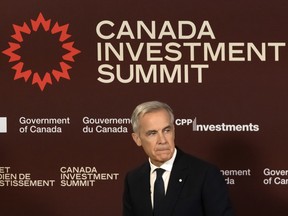
To give credit where it’s due: finally, after 18 months in office, Prime Minister Mark Carney has announced a substantial economic policy change to improve Canada’s business environment. His “Productivity Mega Deduction,” which permanently allows businesses to immediately deduct the cost of new investments on a wide range of machinery, equipment and technology is a meaningful change. The government estimates that the new policy halves Canada’s marginal effective tax rate on new business investments from approximately 13 to 6.4 per cent.
Sign In or Create an Account
On the other hand, to also assign blame where it’s due, the benefits of cutting taxes on business investment will be limited because Carney chose the wrong policy. As economist Jack Mintz explained in the Financial Post, Carney’s tax change “fails the three criteria for a good tax structure: efficiency, fairness and simplicity. A far better choice would be to reduce corporate income tax rates so as to spur investment in all business activities, not just those chosen by government.”

Columnist Jesse Kline keeps you up to date with what’s happening in Israel and the effects of antisemitism on life here in Canada. Friday mornings.
By signing up you consent to receive the above newsletter from Postmedia Network Inc.
A welcome email is on its way. If you don't see it, please check your junk folder.
The next issue of Channel Israel will soon be in your inbox.
We encountered an issue signing you up. Please try again
Carney’s tax deduction gives favourable treatment to certain types of investments but not others, thus giving more favourable tax treatment to certain industries. It also produces unfair situations in which businesses are incentivized to use capital-intensive instead of labour-intensive processes, complicates the tax structure because the deduction is mixed in with other existing investment credits and will likely be of limited effectiveness. Mintz is right: a general corporate tax cut would have been better.
So while moving in the direction of lower business taxes is beneficial — and necessary given the extremely weak investment in Canada in recent years — by choosing the wrong policy, Carney limits the benefits. This is not the first time he has expressed the right sentiments, said the right things, signalled a move to improve Canada’s economic competitiveness after more than a decade of under-performance and then announced a policy that is limited in its effectiveness because it is poorly designed or combined with other harmful policies that largely undo whatever improvement the new initiative might have achieved.
For example, reversing former prime minister Justin Trudeau’s insane electric vehicle mandate, which by 2035 would have banned the sales of conventional automobiles, was a good idea. But instead of just getting rid of the bad policy, Carney restored the federal government’s deeply uneconomical EV consumer subsidies and added his own greenhouse gas emissions standards, with the goal of pushing EV sales to 75 per cent of the market by 2035 and 90 per cent by 2040. A 90 per cent government target by 2040 is less harmful than a 100 per cent mandate by 2035. But bad policies that are slightly less harmful than Trudeau’s bad policies are not good enough.
Similarly, Carney’s push to reduce the size of the federal public service was widely applauded — and rightly so. Earlier this year, the Treasury Board reported that the federal workforce shrank by over 12,000 positions in the last fiscal year, or about 3.5 per cent. That is a positive step, but the government’s latest fiscal projection, the spring economic update, has total program expenses excluding net actuarial losses rising from $489.9 billion in 2024-25 to $512.8 billion in 2025-26, and then to $536.1 billion in 2026-27. So whatever savings are being achieved through headcount reductions are being offset by more spending elsewhere.
The Canadian economy badly needs more private enterprise, more private investment and less government control, but Carney has mostly delivered the opposite. Last year, one of his larger initiatives was the Major Projects Office, which allows for projects to receive speedier approvals if they are deemed to be in the “national interest.” The problem is that the government, not the private sector, determines what is in the “national interest” and therefore slants the playing field by giving government-favoured projects preferential regulatory treatment.
Even worse was Carney’s so-called sovereign wealth fund, which is funded by debt instead of wealth and designed to marshal private capital towards political objectives such as fighting global warming. And last week’s Canada Investment Summit, at which Carney announced the Productivity Mega Deduction, placed far too much emphasis on the role of the state in directing investment. The tax deduction itself could have some positive effects and is better than past efforts to increase private investment, but better than disastrous is not good enough. Much better policies are needed to restore Canada’s economy.
National Post
Join the Conversation
This website uses cookies to personalize your content (including ads), and allows us to analyze our traffic. Read more about cookies here. By continuing to use our site, you agree to our Terms of Use and Privacy Policy.
KioskNews shows a cleaned-up reading view extracted from the publisher’s page — the original always lives on their site, not ours.