Apple TV’s Neuromancer Ends An Era For Cyberpunk Sci-Fi

Dhruv is a Lead Writer in Screen Rant's New TV division. He has been consistently contributing to the website for over two years and has written thousands of articles covering streaming trends, movie/TV analysis, and pop culture breakdowns.
Before Screen Rant, he was a Senior Writer for The Cinemaholic, covering everything from anime to television, from reality TV to movies.
After high school, he was on his way to become a Civil Engineer. However, he soon realized that writing was his true calling. As a result, he took a leap and never looked back.
William Gibson's Neuromancer is often touted as one of the most seminal works in cyberpunk sci-fi. However, the sci-fi subgenre did not emerge out of one single book or author. Its roots can be traced back to literary works that were published even before "cyberpunk" was a well-known concept.
Be it in Philip K. Dick's Do Androids Dream of Electric Sheep or Samuel R. Delany’s Nova, traces of the subgenre's themes surrounding cybernetics, corporate power, and AI can be found in many sci-fi stories from the '60s and '70s.
During the '80s, however, cyberpunk fully materialized into a whole movement when authors like William Gibson, Bruce Sterling, and Rudy Rucker, among others, started defining its core themes and aesthetic.
This is when Neuromancer became a defining literary landmark. It marked the inception of an era where a long line of movies, shows, books, and other storytelling mediums either rehashed or reimagined its tropes and ideas. Now, over 40 years after Neuromancer's initial publication, Apple TV is adapting the William Gibson book for the small-screen, and it feels like it is ending an era for the subgenre.
Apple TV’s Neuromancer Is A Full-Circle Moment For Cyberpunk

William Gibson's Neuromancer is among the few cyberpunk books that helped the subgenre acquire its own solid identity. It, in fact, arrived before cyberpunk had been fully accepted as a mainstream sci-fi subgenre. In the years that followed, though, many iconic sci-fi movies and TV shows drew from the foundational ideas set by Neuromancer.
For instance, The Matrix built on Neuromancer's conception of cyberspace as a digitally constructed simulation and even borrowed the concept of "jacking in." Meanwhile, other works like Ghost in the Shell delved deeper into Neuromancer's hard-hitting themes surrounding cybernetic augmentation, artificial consciousness, and skewed identities in a hyperconnected world.
Even in more recent times, one can notice Neuromancer's influence on games like Cyberpunk 2077 and shows like Mr. Robot. All of them belong to a long cultural lineage that the novel helped establish. Owing to this, Neuromancer's TV adaptation is full circle moment for cyberpunk because it is arriving decades after its source material's "descendants" already have long-running cinematic legacies.
Put simply, it seems like an ironic end of a cyberpunk era where the progenitor is finally arriving after its successors.
Apple TV's Neuromancer Will Prove Classic Cyberpunk Is Progressively Becoming More Realistic

Since William Gibson never explicitly revealed the year Neuromancer is set in, the book almost has a timeless appeal.
However, the elements that make it appealing today are significantly different from the ones that drew readers towards it in the '80s and '90s. Back then, William Gibson wrote the book on a typewriter, envisioning a speculative future while knowing little about how realistic his ideas would eventually become.
Gibson used cyberspace, AI, and megacorporations as mere plot devices to ask questions surrounding autonomy, labor, and power in a world driven by "high-tech and low life." However, now, before Neuromancer lands on Apple TV, many ideas and themes from the book no longer fall into the speculative fiction domain. They are incredibly relatable and relevant for the times.
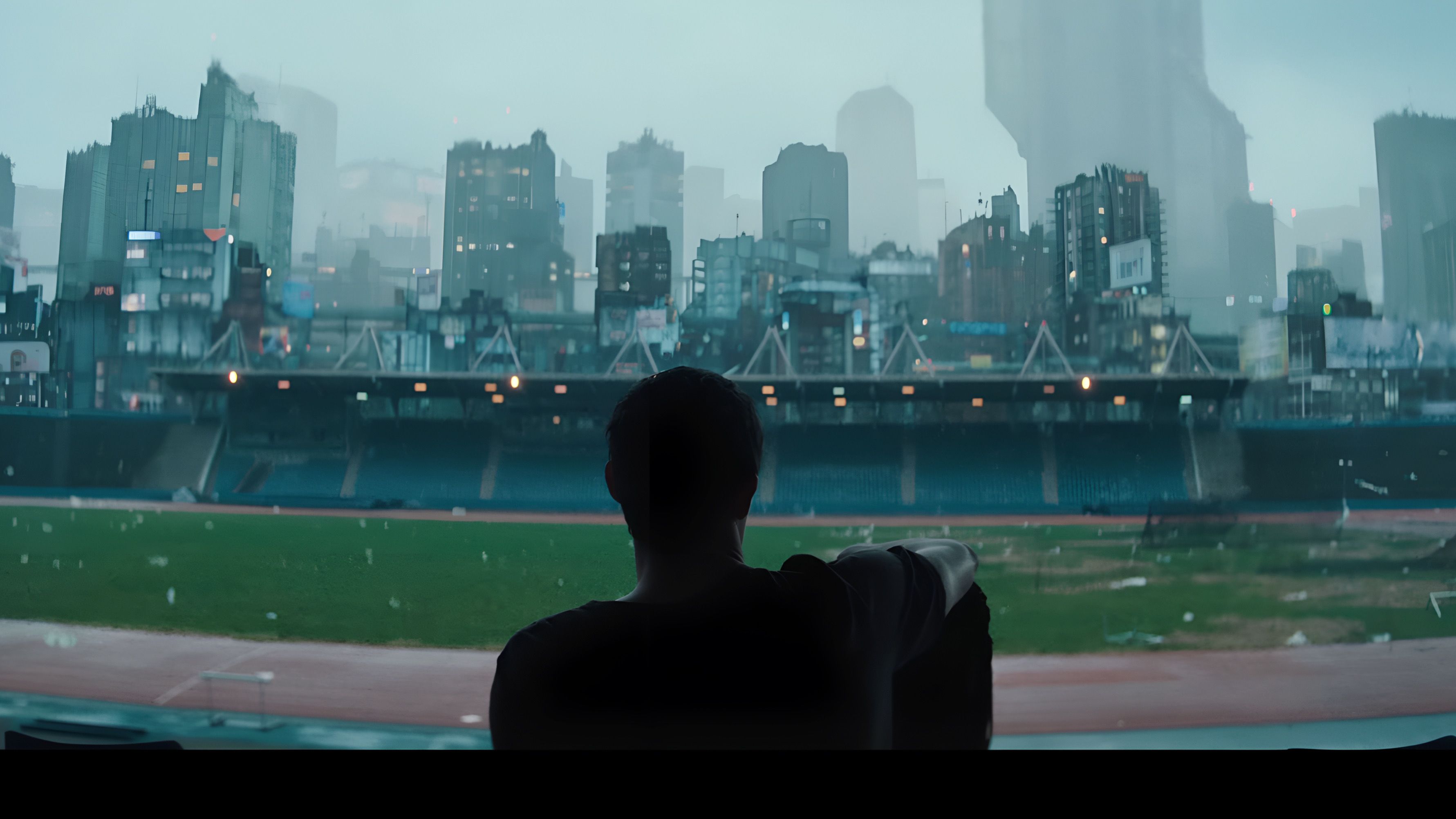
What seemed like distant warnings about humanity's unchecked ambition and growing reliance on technology in Neuromancer has now turned into recognizable debates about the present. Even Neuromancer's iconic opening line -- "The sky above the port was the colour of television, tuned to a dead channel" -- has transcended its original meaning both literally and metaphorically.
This shift in how Neuromancer is perceived and interpreted in the present compared to the past highlights how the Apple TV adaptation is ending an era for cyberpunk sci-fi.

Neuromancer
- Release Date
- January 22, 2027
- Network
- Apple TV+
- Showrunner
- Graham Roland
Upcoming Apple TV+ sci-fi series adapting the novel Neuromancer by William Gibson, the first in his Sprawl trilogy and a foundational cyberpunk text. In it, a crew of mercenaries and a master hacker target a massive corporation with a high-stakes heist.
- Cast
- Callum Turner, Briana Middleton, Mark Strong, Peter Sarsgaard, Max Irons, Joseph Lee, Clemence Poesy, Marc Menchaca, André De Shields, Sam Woolf
- Directors
- J.D. Dillard
- Main Genre
- Sci-Fi
- Creator(s)
- J.D. Dillard, Graham Roland
- Executive Producer(s)
- Drake, Dana Goldberg, David Ellison, William Gibson, Adel 'Future' Nur, Jason Shrier, Graham Roland, J.D. Dillard, Matt Thunell, Zack Hayden
- Producers
- Karl Caffrey, Satch Watanabe
- Seasons
- 1
- Streaming Service(s)
- AppleTV+
KioskNews shows a cleaned-up reading view extracted from the publisher’s page — the original always lives on their site, not ours.