A UN mission says the US likely committed war crimes in Iran. But who defines them?
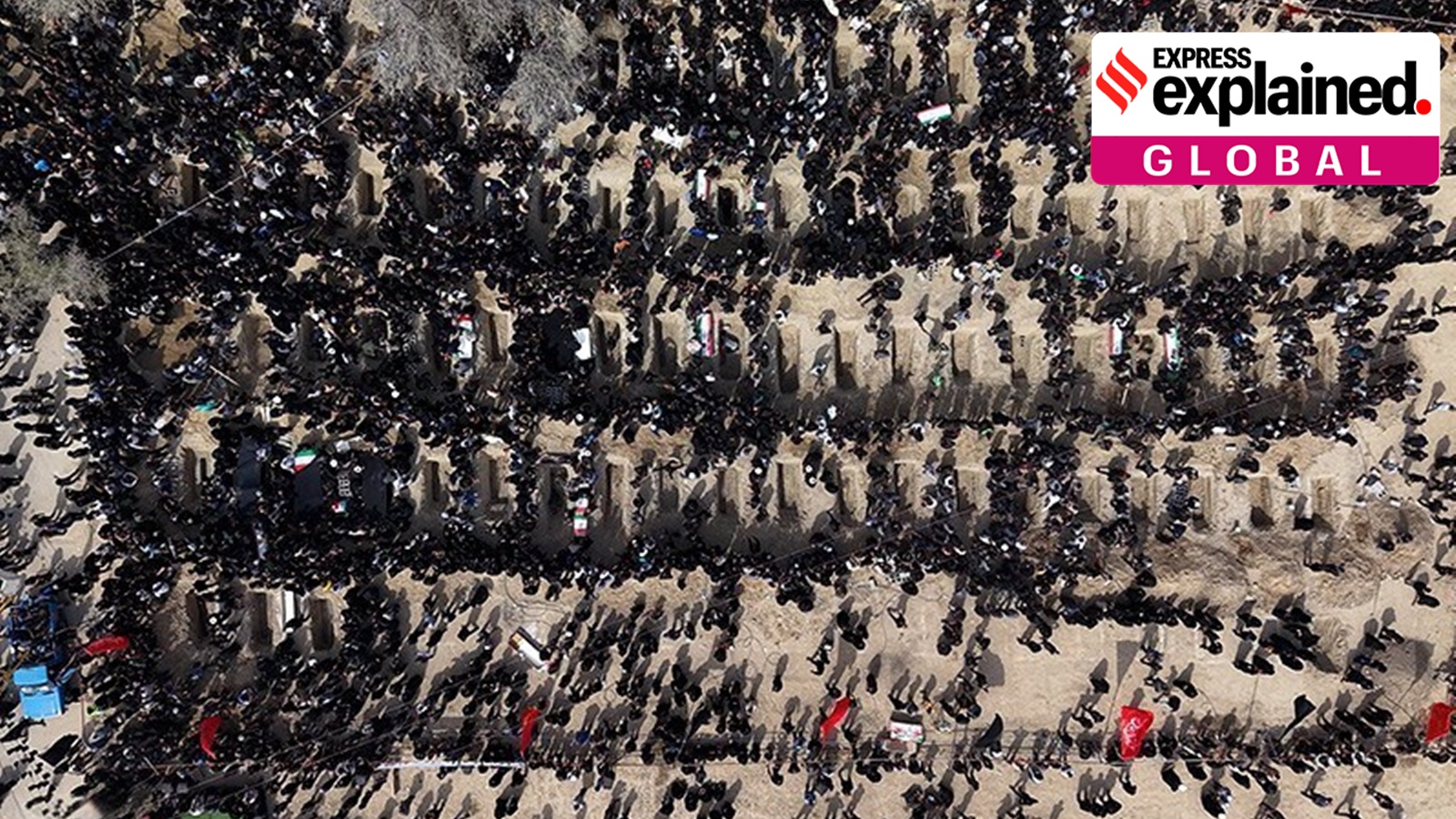
Funeral of the children of Minab Primary School in Iran. A US attack led to the killings. (Wikimedia Commons)
A UN fact-finding mission on Iran said on Thursday (September 18) that there were reasonable grounds to believe the US government committed war crimes when it attacked a school and a sports centre at the beginning of its war.
The attack on a primary school in Minab killed 156 people, including 120 children, while the strike on a sports centre in Lamerd led to 22 deaths in late February 2026. Amid the heightened violence of war, how are certain actions deemed “war crimes” and what happens after that assessment is made? We explain.
Defining a war crime
In its report, the UN mission said it examined whether actions during the war “violated IHL (International Humanitarian Law) pursuant to the 1949 Geneva Conventions and customary international law.”
IHL is a set of international rules, established by treaty or custom, which are specifically intended to solve humanitarian problems directly arising from armed conflicts, according to the global humanitarian organisation Red Cross. Underlying these rules is a recognition that even amid the brutality of war, there are lines that cannot be crossed, and that civilian lives must not become collateral damage.
The Geneva Conventions are primarily applicable in cases involving international armed conflict. They also state that the Red Cross can offer its services during conflicts.
The conventions trace their origins to the Convention for the Amelioration of the Condition of the Wounded in Armies in the Field, adopted in 1864 in Geneva. Swiss businessman Henry Dunant was moved to work towards the landmark document after witnessing the Battle of Solferino in 1859.
He also founded the Red Cross and was awarded the Nobel Peace Prize in 1901. “He proposed that all nations should establish organisations to help sick and wounded victims of war, regardless of nationality. Dunant’s book was sent to national leaders throughout Europe. In 1863, the International Committee of the Red Cross was founded… A year later, an international congress approved the first Geneva Convention,” the Nobel website says.
Story continues below this ad
Role of Geneva Conventions
Flowing from such documents, the Geneva Convention of 1949 was signed in the aftermath of the Second World War (1939-45) and has been ratified by 196 countries. It includes four separate conventions, such as those on the Treatment of Prisoners of War, and the Protection of Civilian Persons in Time of War.
Among its most significant sections is an article that defines the concept of “grave breaches”, which include actions such as “wilful killing, torture or inhuman treatment, including biological experiments… not justified by military necessity and carried out unlawfully and wantonly.”
These are war crimes, as defined under the Rome Statute of the International Criminal Court (ICC) in 1998 as well. The court has jurisdiction in such cases.
In the case of Iran and the US, the UN report said, “Irrespective of the intended target of the U.S. strikes in a populated area in Lamerd that hit a sports centre, an adjacent elementary school and residential buildings in the neighbourhood – all civilian objects – the Mission found that these strikes constituted an indiscriminate attack in violation of the principle of distinction.”
Story continues below this ad
It also accounted for the US government’s “deprioritisation” of civilian harm mitigation, “expressed through public statements by senior U.S. leadership, including the President and the Secretary of Defense, which dismiss binding obligations under International Humanitarian Law”.
Question of enforcement
International Humanitarian Law imposes obligations and criminal responsibility for grave breaches of the Geneva Conventions. States also have a collective responsibility to ensure respect for the conventions in all circumstances.
But punishment and enforcement have long been challenging, ranging from states’ opposition to procedural gaps. In response to the report, the White House said in a statement that the human rights body has “accomplished nothing for human rights while spouting unserious nonsense for decades.”
Former US Ambassador Clint Williamson once told The Wilson Quarterly magazine that “Common crime cases (such as murder, rape, robbery)… are generally straightforward prosecutions with a known single perpetrator and single victim, easily accessible witnesses, are of limited scale and involve a finite amount of evidence.”
Story continues below this ad
“War crimes, on the other hand, are often connected events that take place over wide swaths of territory, involve multiple victims that are otherwise unrelated, frequently require tracking down witnesses that have been displaced and dispersed to any number of third countries, and involve direct perpetrators that are impossible to identify,” he said.
Apart from gathering evidence, linking perpetrators to the crimes involves “military analysis that determines which unit was in a given place at a given time… Assembling the evidence for both the crime base and linkage elements of a war crimes case tends to be more complex and lengthier,” Williamson said.
Still, reports like the UN’s can be cited if a case is made at forums like the ICC or national courts. The ICC has functioned at The Hague since 2002, but countries such as the United States, Russia and India are not signatories, further complicating the process.
KioskNews shows a cleaned-up reading view extracted from the publisher’s page — the original always lives on their site, not ours.