Protection of healthcare workers from abuse needs to evolve as new harms surface: Workgroup co-chair
SINGAPORE – Doxing and online stalking are among possible new threats healthcare workers may face that require the existing protection measures in the sector to continually evolve.
“If we start seeing more doxing cases, we will probably need to convene a sub-group that looks specifically at... which cases should be escalated immediately (to the Online Safety Commission) and which cases should be handled at the hospital level first,” said Chua Hong Choon, co-chairperson of the tripartite workgroup for the prevention of abuse and harassment of healthcare workers.
Chua, who is also the chief executive of Khoo Teck Puat Hospital (KTPH) and Yishun Community Hospital (YCH), was speaking to The Straits Times in an interview to mark the conclusion of the tripartite workgroup, which was set up in 2022.
The workgroup comprises representatives from the Ministry of Health (MOH), Healthcare Services Employees’ Union, public healthcare clusters, community care partners and private healthcare providers.
Its work contributed to the release in 2023 of the standardised framework laying out a common definition of abuse and harassment, and a consistent set of standards to safeguard healthcare workers.
But Chua said the tripartite framework is a living document that should be updated from time to time to incorporate new measures to protect healthcare workers from new forms of abuse and harassment, particularly on online platforms.
He said the newly minted Online Safety Commission (OSC) sent representatives to attend the final meeting of the workgroup and share how healthcare institutions can tap the commission’s services.
The OSC began operations on June 29 and has legal authority to force entities such as platforms and group administrators to quickly remove harmful content through takedown orders. These platforms include Facebook, HardwareZone Forums, Instagram, TikTok, X and YouTube.
For a start, OSC is tackling five of the most prevalent and serious online harms: intimate image abuse, image-based child abuse, doxing, online harassment and online stalking.
With the tripartite workgroup standing down, Chua said a community of practice (COP) will take over: The three public healthcare clusters will take turns to organise two or three meetings every year with representatives from the various healthcare institutions and community care partners.
COP members will share with one another how they have dealt with certain difficult cases of abuse and harassment for learning purposes, and will also discuss emerging topics based on what the institutions face.
Based on the framework, unsolicited video recordings and stalking of staff are considered harassment incidents that cause moderate harm and distress to healthcare workers. The hospital can take actions like issuing written warnings and removing the abusive person from the premises.
For instance, a YCH nurse previously was harassed by an inpatient who repeatedly made suggestive remarks directed at her and demanded for her personal phone number.
Even after he was discharged, he continued to stalk her by repeatedly visiting the wards in the name of visiting another patient whom he befriended during his stay, but was in fact trying to find the nurse.
The hospital eventually blocked his access to the ward, and also alerted the hospital’s security team to keep a lookout for him.
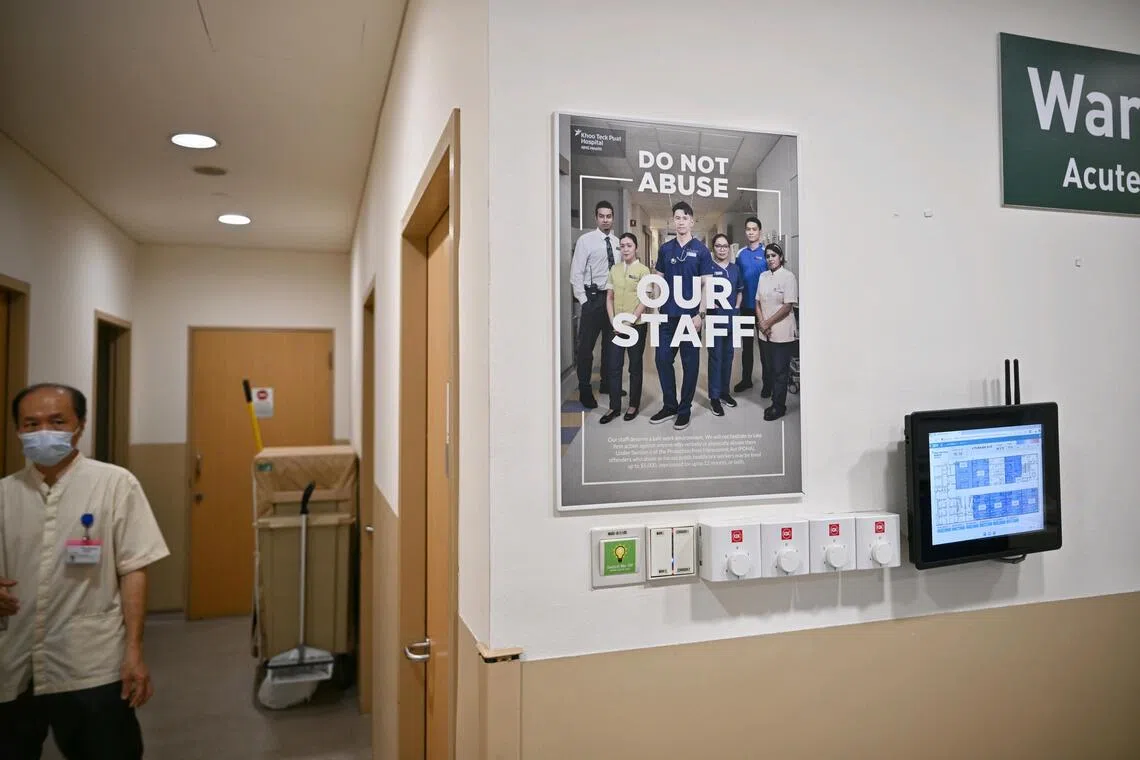
Posters and signages were put up in KTPH to remind the public on acceptable behaviour to take when interacting with healthcare workers.
ST PHOTO: ARIFFIN JAMAR
YCH also provided counselling support for the nurse, and also gave her time away from work to recuperate. As there were concerns for her safety, her supervisors also arranged for her to be escorted home after work daily for a period of time.
According to MOH figures, there were around 2,200 cases of abuse and harassment in 2023 reported by public healthcare institutions. The number increased to 3,000 in 2024, and spiked another 40% to 4,200 in 2025.
Chua is not alarmed by the increase.
Providing some perspective, he said that the number of reported cases is expected to continue rising over the years, as such cases were severely under-reported previously, rather than there was an increase in abusive perpetrators over the years.
An MOH survey conducted in 2022 showed that two-thirds of healthcare workers experienced abuse in the 12 months preceding the survey, but 75% of them did not report the incidents, with some respondents treating abuse and harassment as part and parcel of their care duties.
Chua emphasised that the vast majority of patients and their caregivers do genuinely appreciate and respect the healthcare workers, and incidents of abuse and harassment were restricted to a small minority of individuals.

KTPH and YCH chief executive Chua Hong Choon said the vast majority of patients and their caregivers do genuinely appreciate and respect the healthcare workers.
ST PHOTO: ARIFFIN JAMAR
Even if the number of reported cases rises, Chua perceives this as a healthy indication that there is good awareness on what constitutes abuse and harassment, and reflects institutions’ desire to improve the situation.
In the interest of de-escalating and resolving potential conflicts, he said the use of legal measures to protect healthcare workers is a last resort for the workgroup.
A 2025 paper published by researchers from the National University of Singapore’s Yong Loo Lin School of Medicine in The Frontiers of Public Health looked into eight studies conducted in Singapore involving healthcare workers as victims of workplace violence.
Among other things, it suggested stricter legal consequences and public awareness campaigns to tackle the issue.
Currently, perpetrators referred to the police may be charged under the Penal Code or the Protection from Harassment Act. If convicted, they may be liable to a fine and/or imprisonment.
Chua said that the workgroup had discussed pushing for stricter laws, but the worry was that this would risk pitting patients and caregivers against healthcare workers.
“More may need to be done if we cannot control the situation, but at this point in time, we realise that with the current laws in place and this approach of trying to promote better relationships and empowering both sides to act responsibly and responsively... (the use of legal measures) is a last resort,” said Chua.
KioskNews shows a cleaned-up reading view extracted from the publisher’s page — the original always lives on their site, not ours.