Fedora 45 beta drags the Linux console into the 21st century
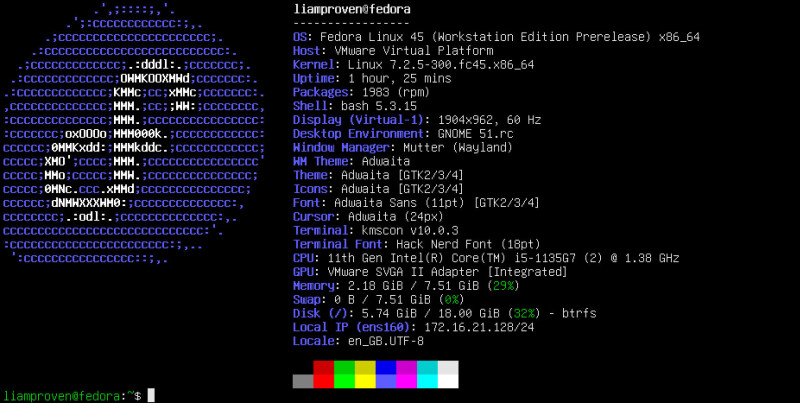
Kmscon brings smooth scaling, richer colors, and better Unicode support beneath GNOME 51
Fedora Linux 45 beta has arrived with Linux kernel 7.2, a release-candidate build of GNOME 51, and extensive changes beneath the desktop.
The biggest surprise is that Linux's legacy in-kernel console – the text-mode interface normally hidden beneath the GUI – has been replaced with a software-controlled alternative.
The replacement is kmscon, a userspace terminal emulator that has been in development for more than a decade. Its Freedesktop project page explains that it uses the kernel's Direct Rendering Manager (DRM) and Kernel Mode Setting (KMS) facilities to configure the display, while offering better internationalization support. Kmscon was announced way back in 2012, but after a few years' work, developer David Herrmann moved on to other things. Fortunately, another developer, Peifeng Yu – nicknamed Aetf – maintained a fork for a decade until the original team resumed work last year.
REG AD
Some of the benefits of kmscon may sound a little theoretical: it has better Unicode support, which will help people working with scripts and alphabets beyond plain old US English, and it has multiseat support, allowing multiple users to share one PC simultaneously with separate keyboards and displays. We suspect that this isn't so common in 2026, but it could be useful to someone somewhere. We first heard of the advantages of kmscon via a blog post about Veronica Explains' writer deck: she uses it to display more than 16 colors on the console, and it also adds the ability to zoom in and out on the fly in Linux text mode. That does sound useful to us, especially with modern HiDPI screens.
REG AD
GNOME 51 is not yet final, so the closest thing to release notes is a fairly uninformative change log. It doesn't look to be a very exciting release, but there are improvements to keyboard navigation and the Orca screen reader, automatic screen rotation on devices with orientation sensors, refinements in the Settings app, Files, Calculator, and the login screen, and more. KDE users get Plasma 6.7.
The browser-based installer now offers initial installation flows for the immutable Atomic Desktops and supports partitioning with Red Hat's Stratis storage system, which we looked at back in 2022.

Under the hood, the RPM package manager now enforces package signing, and the higher-level DNF5 packaging tool now avoids switching package vendors during upgrades – which should prevent one category of unpleasant surprise. Atomic Desktop ISO builds now use image-builder, while Fedora CoreOS gains zram memory compression and the systemd-oomd memory pressure handler, although, as we reported last year, the latter is not universally popular. Fedora 45's security tooling has been updated and tweaked in several areas, and as usual, all the various programming languages and runtimes have been updated.

Fedora Asahi Remix 45 is also in beta and, as The Register covered earlier this month, it includes preliminary support for Apple's M3, M3 Pro, and M3 Max chips, although performant 3D GPU acceleration is not yet available. That is good news for anyone running a headless system, but less useful to desktop and laptop users. For now, though, there is no Asahi Linux support for Apple's M4 and M5 systems.

We briefly tried the Fedora Workstation beta under VMware, and it doesn't look very different from before – but we very much like the ability to resize console text with Ctrl and + or -. Even at larger sizes, text remains smooth and sharp. It may be a small change, but we suspect plenty of users will appreciate it. ®
KioskNews shows a cleaned-up reading view extracted from the publisher’s page — the original always lives on their site, not ours.