Delimitation Bill: How many more seats will each state, UT get? Minister Arjun Meghwal explains composition
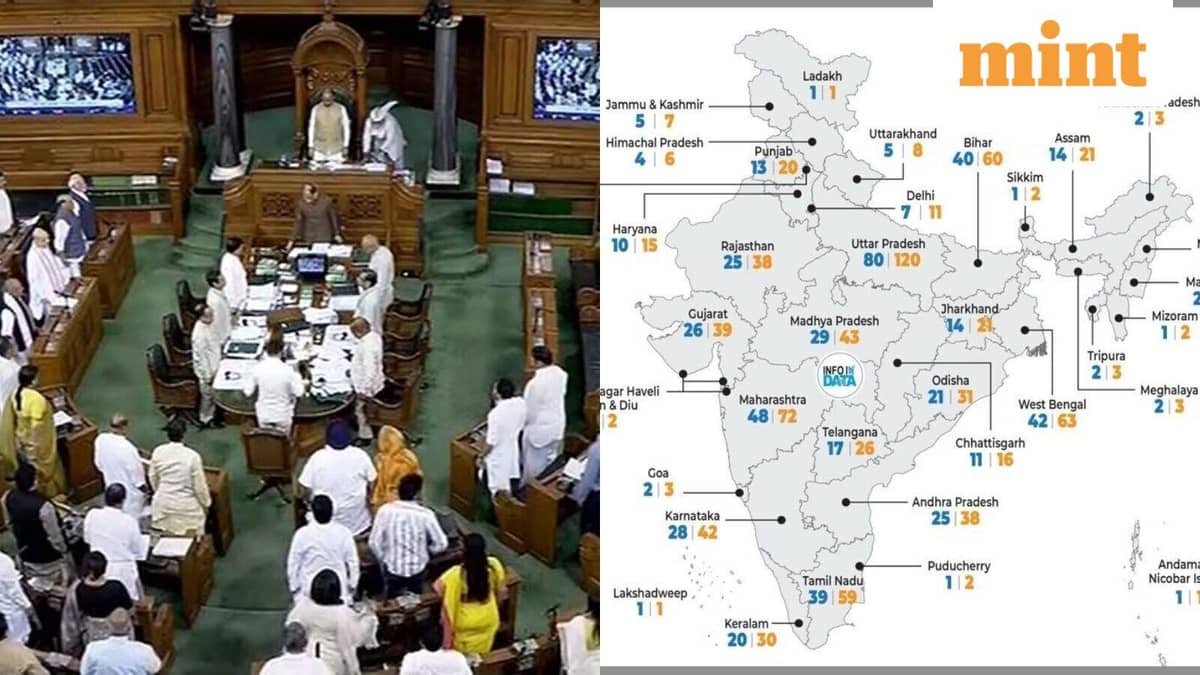
Months after failing the Lok Sabha test, the bill to increase the strength of the Lok Sabha from 543 to 816 (states) will be reintroduced in the lower house on Monday — the first day of the Special Parliament Session.
The Lok Sabha will meet for four days from Monday, while the Rajya Sabha will sit for two days from December 2.
The Lok Sabha will take up three key bills on Monday: the Constitution (132nd Amendment) Bill, 2026; the Delimitation (Second) Bill, 2026; and the Union Territories Laws (Amendment) Second Bill, 2026.
The Delimitation (Second) Bill seeks to give effect to the 33 per cent reservation of seats for women in the Lok Sabha and state and Union Territory assemblies, and to provide for a readjustment of seat allocation and the delimitation of constituencies.
The Delimitation (Second) Bill, 2026 will replace the Delimitation Bill, 2026.
How many more seats will each state get if new delimitation and Constitution amendment bills are passed in Parliament?
Union Minister Arjun Ram Meghwal said on Saturday that the proposed delimitation framework would mark a significant step towards reshaping India’s parliamentary landscape, with the strength of the Lok Sabha projected to increase by 50 per cent from the existing 543 seats to 816 seats.
In a post on X, Meghwal shared state-wise figures showing the projected changes in parliamentary representation under the proposed framework.
According to the figures he shared, Uttar Pradesh would record the largest increase, from 80 to 120 seats, followed by Maharashtra, from 48 to 72 seats, and West Bengal, from 42to 63 seats.
Meghwal, however, clarified on Sunday that the Delimitation Commission alone will make the final determination of seats for each state and union territory in accordance with the provisions of the bill.
Here's how the composition will change if the bill is made into law:
| State / Union Territory | Current Lok Sabha Seats | Proposed Lok Sabha Seats | Change (+/-) |
|---|---|---|---|
| Andaman & Nicobar Islands | 1 | 1 | 0 |
| Andhra Pradesh | 25 | 38 | +13 |
| Arunachal Pradesh | 2 | 3 | +1 |
| Assam | 14 | 21 | +7 |
| Bihar | 40 | 60 | +20 |
| Chandigarh | 1 | 2 | +1 |
| Chhattisgarh | 11 | 16 | +5 |
| Dadra & Nagar Haveli Daman & Diu | 2 | 2 | 0 |
| Delhi | 7 | 11 | +4 |
| Goa | 2 | 3 | +1 |
| Gujarat | 26 | 39 | +13 |
| Haryana | 10 | 15 | +5 |
| Himachal Pradesh | 4 | 6 | +2 |
| Jammu & Kashmir | 5 | 7 | +2 |
| Jharkhand | 14 | 21 | +7 |
| Karnataka | 28 | 42 | +14 |
| Keralam (Kerala) | 20 | 30 | +10 |
| Ladakh | 1 | 1 | 0 |
| Lakshadweep | 1 | 1 | 0 |
| Madhya Pradesh | 29 | 43 | +14 |
| Maharashtra | 48 | 72 | +24 |
| Manipur | 2 | 3 | +1 |
| Meghalaya | 2 | 3 | +1 |
| Mizoram | 1 | 2 | +1 |
| Nagaland | 1 | 2 | +1 |
| Odisha | 21 | 31 | +10 |
| Puducherry | 1 | 2 | +1 |
| Punjab | 13 | 20 | +7 |
| Rajasthan | 25 | 38 | +13 |
| Sikkim | 1 | 2 | +1 |
| Tamil Nadu | 39 | 59 | +20 |
| Telangana | 17 | 26 | +9 |
| Tripura | 2 | 3 | +1 |
| Uttar Pradesh | 80 | 120 | +40 |
| Uttarakhand | 5 | 8 | +3 |
| West Bengal | 42 | 63 | +21 |
North vs South representation
Union Minister Arjun Meghwal said on Sunday that the proposed delimitation bill aims to increase the total number of Lok Sabha seats across all states and union territories by 50 per cent, in equal proportions, while maintaining their current share.
“One positive aspect of the delimitation proposal is that it also seeks to maintain the current ratio of seats among states,” Meghwal said.
He posted on X on Saturday, “Every state in the country, whether in the south or the north, has its own importance. As development progresses, it is essential to maintain a balance in representation for every state.”
Sharing figures on the representation of southern states, Meghwal said the five states currently hold a combined 129 of the 543 Lok Sabha seats, accounting for 23.76 per cent of the House. Under the proposed expansion to 816 seats, their combined strength would increase to 195, taking their share to 23.90 per cent.
According to the figures shared by him, Tamil Nadu’s representation would increase from 39 seats, or 7.18 per cent, to 59 seats, or 7.23 per cent. Andhra Pradesh would rise from 25 seats, or 4.60 per cent, to 38 seats, or 4.65 per cent, while Telangana would increase from 17 seats, or 3.13 per cent, to 26 seats, or 3.18 per cent.
Karnataka’s representation would increase from 28 to 42 seats, while its share would remain unchanged at 5.15 per cent. Keralam would rise from 20 to 30 seats, retaining its existing share of 3.68 per cent.
Meghwal said the figures showed that all five southern states would gain in absolute numbers, while their combined share in the expanded Lok Sabha would also register a marginal increase.
View full Image
What is delimitation? Why is it needed?
Delimitation is a constitutional process to redraw the boundaries of Lok Sabha and Assembly constituencies and to reallocate seats. It reflects current population and demographic changes, ensuring fairer and more equitable representation.
For over five decades, India’s electoral map has remained frozen at 543 Lok Sabha seats, based on 1971 population figures, even as the country’s population has nearly tripled to over 1.4 billion.
The government argues that by 2029, India is expected to add nearly 2.5 crore first-time voters. "These citizens deserve representation based on today's population, not the demographics of 1971," it said.
“So, a larger and more representative Lok Sabha means more voices in Parliament. Better representation leads to stronger governance and more responsive policymaking. A Parliament aligned with today's India is vital for achieving the goal of Viksit Bharat @2047,” it added.
In line with this goal, the fresh Delimitation Amendment Bill, to be introduced on Monday, will increase Lok Sabha seats by 50 per cent across states, ensuring broader parliamentary representation. It also paves the way for 33 per cent reservation for women in the 2029 Lok Sabha elections.
What happened in April?
The Constitution (131st Amendment) Bill, 2026 was taken up for consideration in the Lok Sabha on April 16 and 17, 2026. However, the Bill could not be passed as it failed to secure the two-thirds majority required to pass a constitutional amendment bill under Clause (2) of Article 368 of the Constitution.
Consequently, the Delimitation Bill, 2026, and the Union Territories Laws (Amendment) Bill, 2026, which were consequential to the said Constitution Amendment Bill, were not proceeded with after introduction, and the Delimitation Bill, 2026, continues to be pending in the Lok Sabha.
It is proposed to withdraw the Delimitation Bill, 2026.
What changes have been made in the new bill?
The fresh delimitation Bill includes a provision to increase the number of seats in the Lok Sabha and state Assemblies by 50 per cent to give immediate effect to the women's quota law.
The seats reserved for women shall be allotted by rotation in such manner as the Delimitation Commission may deem fit.
"A new provision has been made for an increase of 50 per cent in the number of seats, for the purpose of giving immediate effect to the reservation of seats for women under Article 334A of the Constitution," according to the statement of reasons for withdrawal of the Delimitation Bill, 2026.
The new Bill substantially alters the provisions of the earlier Bill in the following respects: its long title has been revised to provide that the Bill is to give effect to the reservation of seats for women in the House of the People (Lok Sabha) and the Legislative Assemblies, besides providing for the readjustment of the allocation of seats and the division of each state and Union territory into territorial constituencies.
Also, "the definition of the expression 'population' has been omitted and the expression 'latest census figures' has been defined to mean the latest census figures published as on the date of the commencement of the proposed legislation," according to the statement.
The bill also extends the freeze on the allocation of Lok Sabha seats among States until 2051. It provides for the use of the latest published Census figures (presumably the 2011 Census) for redrawing constituencies and determining the number of seats reserved for Scheduled Castes and Scheduled Tribes until 2051.
KioskNews shows a cleaned-up reading view extracted from the publisher’s page — the original always lives on their site, not ours.