Hospital touts doctors’ rankings
By Jake Chung / Staff writer, with CNA


Three Chang Gung Memorial Hospital doctors have been named among Taiwan’s top 20 researchers in clinical medicine in this year’s World’s Top 2% Scientists rankings.
The list is compiled by Stanford University based on data from Elsevier’s Scopus citation database, ranking top researchers using standardized bibliometric indicators.
The three doctors are Liaw Yun-fan (廖運範), Tain You-lin (田祐霖) and Kuo Ho-chang (郭和昌).
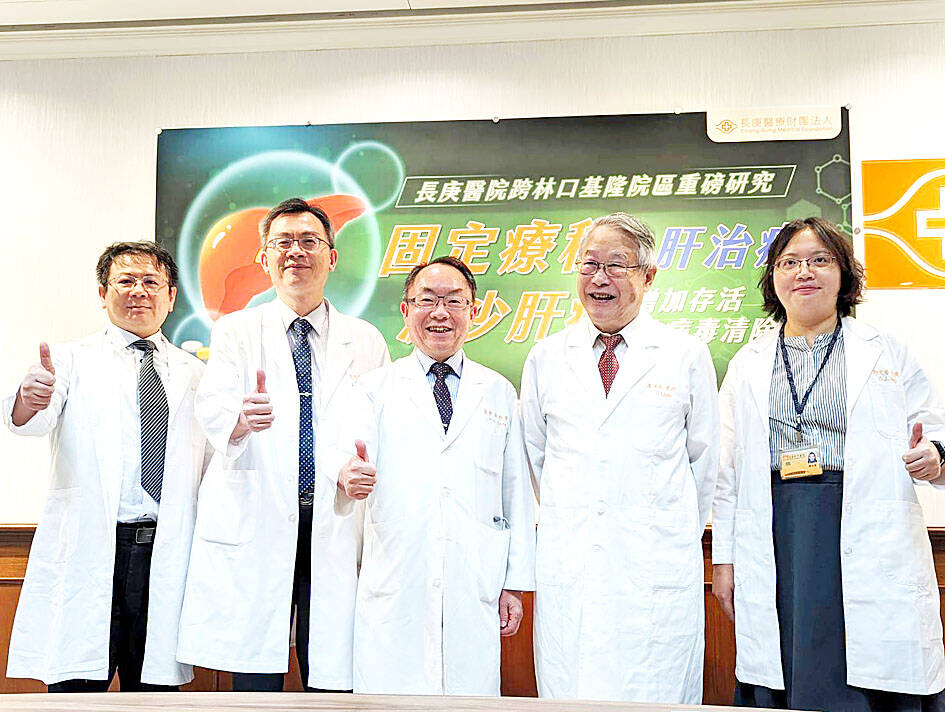
Chang Gung Memorial Hospital doctor Liaw Yun-fan, second right, poses with other doctors from the hospital in Taipei on Sept. 14, 2023.
Photo: Wu Liang-yi, Taipei Times
Chang Gung steering committee chairman Cherng Wen-jin (程文俊) yesterday said the hospital has long invested in research and fostered an environment that encourages doctors to conduct clinical and basic research.
Tain has emerged as a prominent researcher at Chang Gung, Cherng said, adding that he published 167 academic papers between 2020 and last year.
His research has included developing tests for nitric oxide, short-chain fatty acids and oxidative acids.
Kuo, a pediatric rheumatologist, has focused on Kawasaki disease research for many years and is regarded as a leading expert in the field.
Kuo’s research has combined microRNA with machine-learning algorithms to develop a highly accurate diagnostic model for Kawasaki disease, which has been published in leading international immunology journals and contributes to doctors being able to tell Kawasaki disease from normal fevers.
The work has helped advance molecular testing for Kawasaki disease and has been published in leading international immunology journals, Cherng said.
Kuo has published about 284 academic papers, received 115 academic awards in Taiwan and abroad, holds 15 invention patents, and has authored five Chinese and English-language textbooks, Cherng said.
At Academia Sinica, Liaw spent decades researching viral hepatitis and liver cancer, Cherng said.
Liaw’s research has focused on the natural history of hepatitis B, immune mechanisms, and clinical research on hepatitis B and C. He has also participated in developing clinical guidelines on hepatitis and liver cancer in the Asia-Pacific region.
Liaw is an internationally recognized authority on viral hepatitis research, Cherng said.
So far, only the rankings of Taiwan’s top 20 clinical medicine researchers have been released, and Chang Gung would continue to monitor this year’s list, Cherng said.
According to last year’s World’s Top 2% Scientists rankings, 75 researchers from the Chang Gung medical system appeared on the annual scientific impact list, while 52 appeared on the career-long scientific impact list.
The two lists accounted for 127 entries. After removing duplicates, 88 people were included: 76 physicians, three medical professionals and nine researchers, Cherng said.
According to Chang Gung’s internal statistics, the number of researchers from its medical system included in last year’s World’s Top 2% Scientists rankings was the highest among medical institutions in Taiwan, Cherng said.
KioskNews shows a cleaned-up reading view extracted from the publisher’s page — the original always lives on their site, not ours.