Budapest Jewish community reopens, rededicates 100-year-old historic Rákospalota synagogue

In a moving event steeped in history, the Budapest Jewish community marked the reopening and rededication of the historic synagogue in the Rákospalota district.
The building, originally constructed exactly one hundred years ago, has been restored to its original purpose after decades of serving as a book warehouse and storage facility for the Hungarian National Library (Széchényi).
The event opened with prayers, the ceremonial entry of a Torah scroll, and the unveiling of memorial plaques honoring the building's founders, attended by rabbis, public figures, donors, and representatives of the founding families.
From closure, communism, and book storage to revival
The synagogue was first built and dedicated in 1926, the culmination of decades of effort by the community’s legendary rabbi, Rabbi Michael (Mihály) Dushinsky, who served the area for over 40 years. Less than two decades after its inauguration, the majority of the community - nearly 8,000 people - were deported to extermination camps. Only about ten percent survived.
Under communist rule, the building was stripped of its religious character; it was converted into a warehouse for newspapers and books for the National Library, remaining sealed off and cut off from its surroundings for decades. Rabbi Shlomo Köves, Rabbi of the Association of Torah-Observant Communities in Hungary (EMIH), described the building's redemption process in his speech.
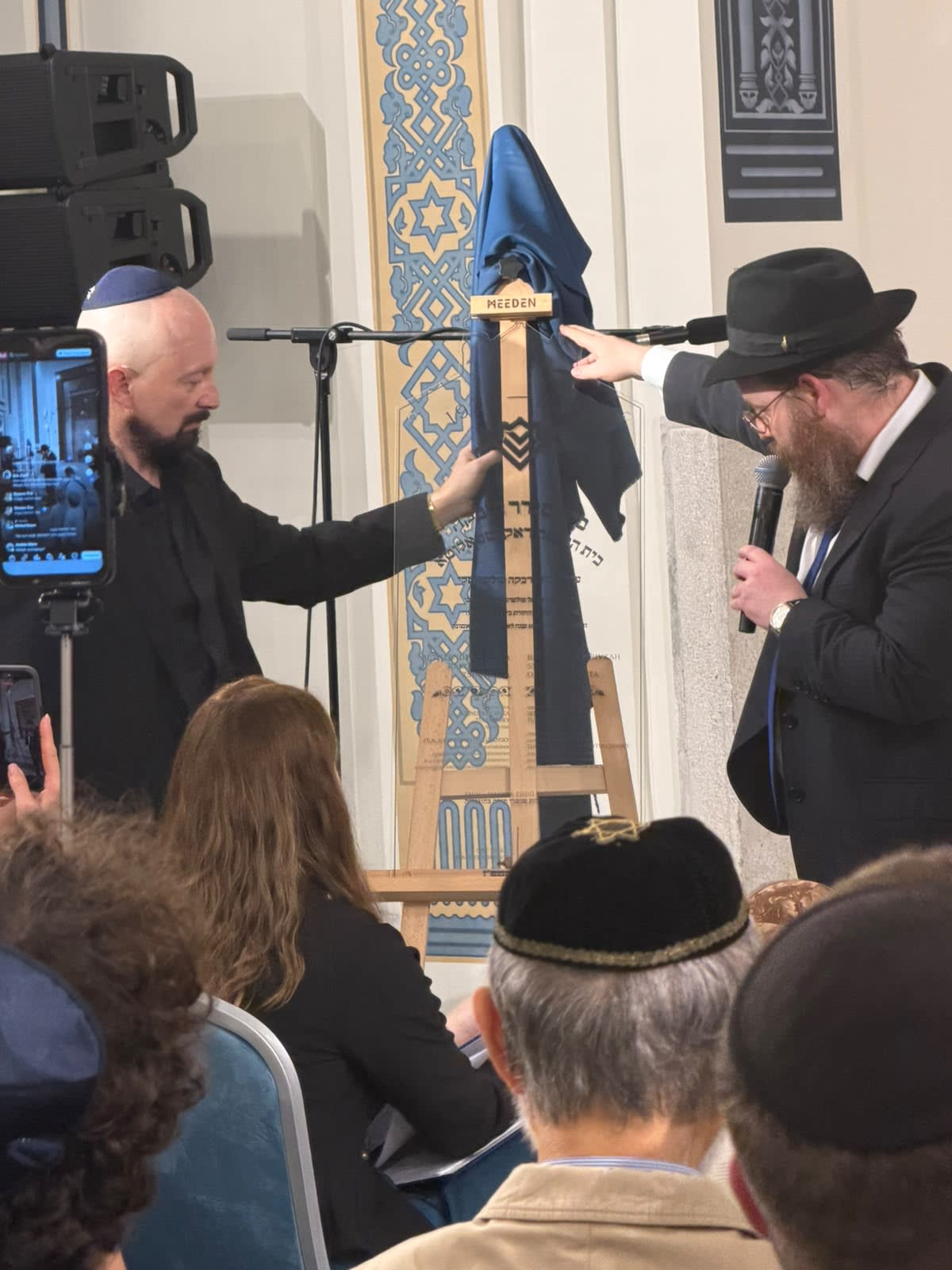
"Just a year ago, we entered this building when it was boarded up and filled with book storage. A passerby who saw us entering burst into tears, saying he had walked past the site for years on his way to the grocery store, heartbroken by the synagogue's degradation. Today, we have proven once again: the People of Israel live, and our lives or our identity cannot be taken from us."
This is the sixth historic synagogue the community has restored to life and active use over the past 16 years. The project was made possible following negotiations to relocate the national library, a comprehensive renovation lasting less than a year, and major support from philanthropists - foremost among them, benefactor Igor Plotnikov.
Coming full circle
One of the event's highlights was the arrival of the founder's grandson, who bears his name - Rabbi Michael Dushinsky (80), the former Chief Rabbi of Northern Ireland (Belfast).
In an exclusive interview, Rabbi Dushinsky spoke of the mixed emotions, balancing the pain of the past with the revival of the present.
Regarding his grandfather's character and the community, he said, "My grandfather received his rabbinic appointment back in 1898 and established the synagogue in 1926. He was a Torah genius, very open-minded, and an ardent Zionist.
"Although the community was not entirely observant, he embraced everyone and maintained a unified, respectful Orthodox framework. He even traveled to Tel Aviv in the 1930s to officiate at the wedding of my father, who had immigrated to the Land of Israel in 1933."
Rabbi Dushinsky said that he'd first walked into the synagogue 23 years ago. "There were bookcases on all sides and local workers sitting at desks; I recited a hurried, one-minute 'El Maleh Rachamim' prayer right there. Today, standing here as rabbis, the community, and a Torah scroll fill the space - it is a deeply moving moment."
He discussed the disconnect between his thoughts as a Zionist toward the synagogue and his thoughts about the local community. "On one hand, as a Zionist, I believe the future of the synagogues of Babylonia lies in the Land of Israel, and the pain regarding the family members who perished here is ever-present. Yet, on the other hand, hundreds of Jews have been located in the area."
It is worth noting that Hungary is currently considered a safe place for Jews, whereas the situation in other parts of Europe is becoming increasingly complicated.
Looking to the community’s future
Rabbi Baruch Oberlander, Head of the Rabbinical Court (Av Beit Din) of the ultra-Orthodox communities in Hungary, also addressed the gathering, alongside other rabbis. They emphasized that the synagogue’s role is not to serve as a museum or a site of nostalgic commemoration, but rather as a house of prayer, Torah study, and education for the younger generation.
With the introduction of the Torah scroll and the affixing of the mezuzahs, the period of the magnificent building’s dormancy came to an end; it opened its doors for Sabbath and holiday prayers exactly one hundred years after its founding.
KioskNews shows a cleaned-up reading view extracted from the publisher’s page — the original always lives on their site, not ours.