How Indira Gandhi turned the sari into a powerful political statement
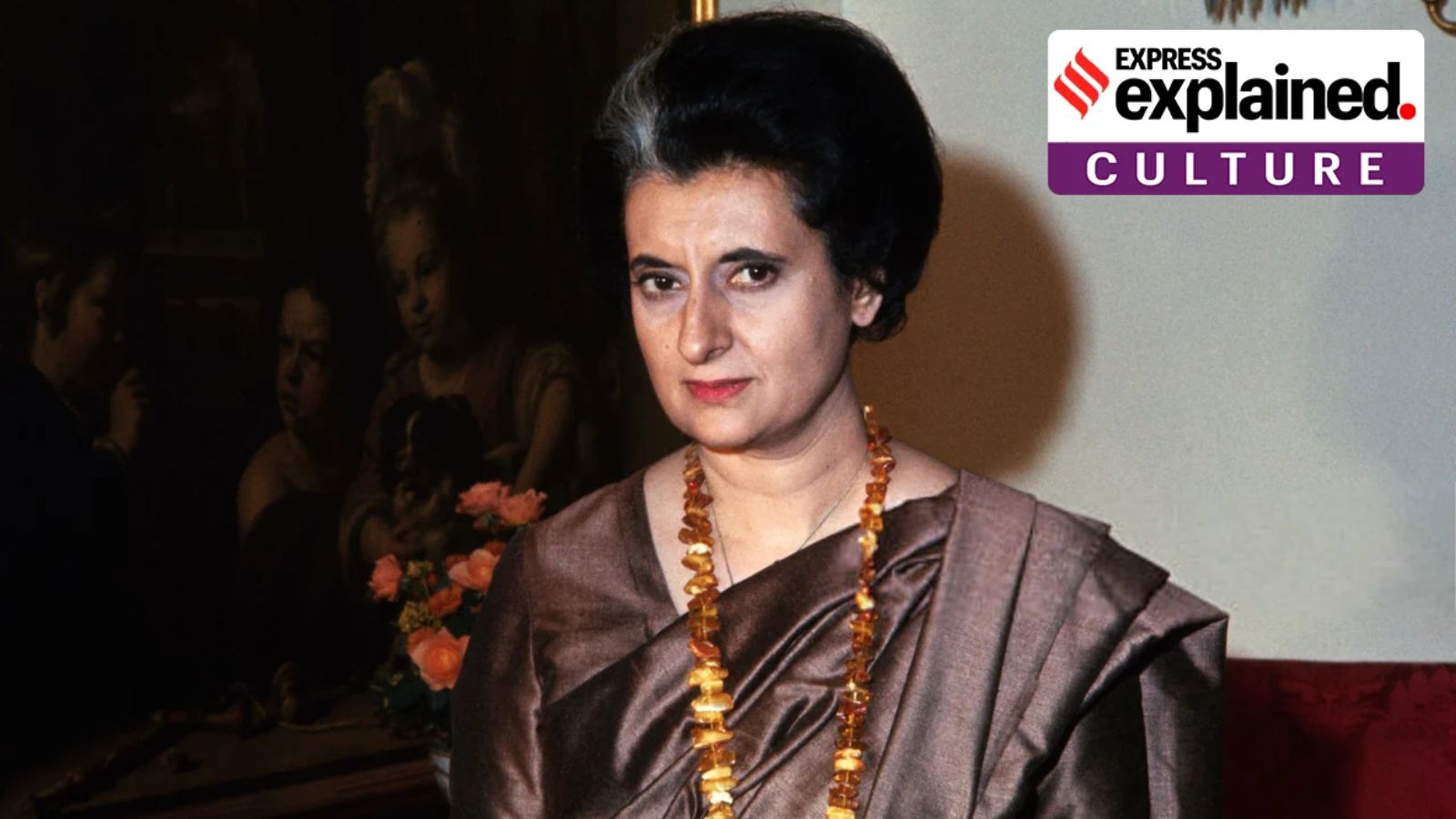
The year was 1978. After crucial victories in the Andhra Pradesh and Karnataka Assembly elections in February, Indira Gandhi’s next fight was a Lok Sabha by-election in her home state of Uttar Pradesh—Azamgarh.
Gandhi handpicked her party’s candidate: Mohsina Kidwai, a Muslim woman who belonged to one of Uttar Pradesh’s old Congress families. In Indira Gandhi: A Biography (1995), Pupul Jayakar wrote, “On her behalf Indira, dressed in a handspun cotton sari with a coarse long-sleeved blouse, her head modestly covered, fought a relentless campaign.”
In the campaign’s final phase, with Kidwai by her side, Gandhi addressed 24 meetings in less than 30 hours. Along the way, she stopped to speak to groups of peasants, women and members of minority communities. “Though illiterate, the peasants of India through the centuries had gathered a wisdom through listening deeply and through direct and close observation. For them it was a wondrous thing that after fourteen hours on the road, travelling through dust and heat, Indira’s sari remained unwrinkled,” wrote Jayakar.
What might appear trivial to the urban Indian could be deeply significant to the villager. “She would arrive to address them, her head covered; her fragility and the feeling of empathy that glowed from her, touched them.”
We take a closer look at how Gandhi turned the humble sari into an instrument of political mobilisation and spectacle.
The Nivi style of draping
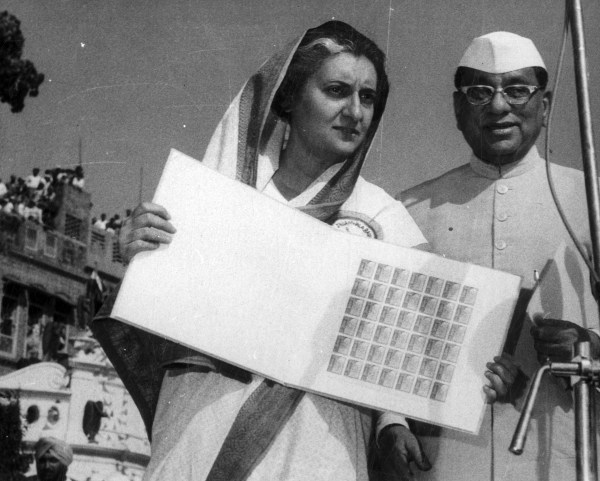 Former Prime Minister Indira Gandhi holding an album of the commemorative stamps to release in honour of Jallianwala Bagh Martyrs. (Express Archive, 1969)
In The Sari (2008), Mukulika Banerjee and Daniel Miller observed: “Just as Mahatma Gandhi had spent years trying to find the right ‘look’ for a leader of a poor country bonded in political and economic oppression, so Indira Gandhi adroitly positioned herself in the status of Mother India, recognisable and familiar, yet transcendent and perfect.”
The drape she favoured was known as the Nivi. It emerged in the nineteenth century, arguably by Jnanadanandini Devi, the wife of Satyendranath Tagore. In the following decades, it gained popularity among women entering public life, including those participating in the platforms, protests and demonstrations of the anti-colonial movement. Their images, widely circulated in newspaper and magazine coverage of their political activities, helped popularise the style. “The Nivi style also featured in iconic nationalist propaganda images, such as the sari unfurled as the map of Mother India, by Raja Ravi Verma,” Banerjee and Miller noted.
Story continues below this ad
After Independence, the sari received a further boost from government information posters, film stars, politicians and Indian ambassadors. It was made the official uniform in the army, police and national airline.
Gradually, alternative regional draping styles began to recede from public view or remained confined to domestic spaces. The result, according to Banerjee and Miller, was a growing consciousness that what women wore was no longer simply a traditional, locally draped garment but the Sari—a recognisable national symbol.
“This association was cemented when, under the guidance of that consummate politician, Mrs Gandhi, the sari for a while became central to the construction of a visual image of India both internally and abroad,” they wrote.
How Indira Gandhi made the sari her political signature
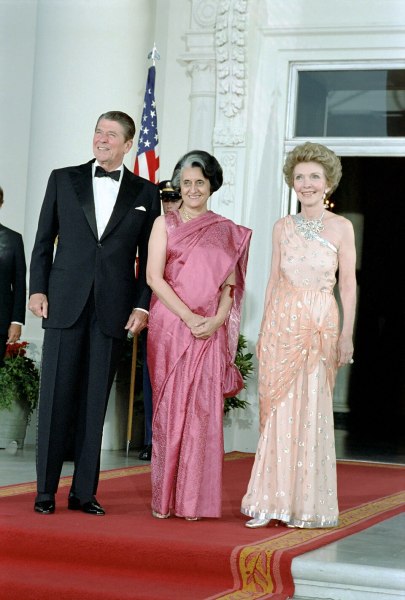 Former US President Reagan and Nancy Reagan with Prime Minister Indira Gandhi of India on the North Portico before a state dinner in July 1982 (Wikimedia Commons)
Jayakar’s account of Gandhi’s first visit to the United States in 1966 offers insight into the care she took over her appearance abroad. As meticulous about her wardrobe as she was about her speeches, Gandhi planned her attire down to the smallest detail. “Her sari, her blouse, her shoes, her bag were selected for every single function.” She even wrote to friends in the US seeking the latest cosmetics to conceal the shadows under her eyes and make her nose appear less prominent, Jayakar wrote.
Story continues below this ad
This attention to her appearance became particularly significant during her subsequent visits to the US in the 1970s, when the sari was increasingly associated with India’s national identity. Against the backdrop of the Cold War and India’s close economic and diplomatic ties with the Soviet Union, her public image carried considerable diplomatic significance. “For the American audience, she coiffured her hair with its distinctive streaks of white, and wore lipstick to complement the silk saris she had chosen, which were far more luxurious and colourful than her usual handlooms,” Banerjee and Miller wrote.
Back home, however, her saris were invariably handloom cotton, evoking the swadeshi and khadi movements championed by her father, Jawaharlal Nehru, and Mahatma Gandhi. According to Banerjee and Miller, “Indira wanted to look like an ordinary Indian woman, but as the quintessence of such womanhood, not merely an instance of it.”
As Nehru’s heir, she was conscious of her exceptional place in the popular imagination. Her challenge was to strike a delicate balance: to appear familiar and accessible to the masses while retaining the mystique that set her apart and inspired reverence. In this, she arguably succeeded. Women still recall the apparent effortlessness with which she wore saris.
“In public she never fidgeted, touching the pallu only to pull it over her head or hitching it up if the hot sun or muddy lanes demanded it. She moved in a fluid way that made you believe she was totally at home in a sari,” the authors wrote. For many middle-class women, Indira Gandhi thus became a style icon: a modern, professional woman who embraced traditional Indian attire.
Story continues below this ad
Another hallmark of her public appearances across the country was her choice of a sari made in the region she was visiting: a Tangail in Bengal, Coimbatore cotton in the south, or the distinctive Sanganer prints in the western states. “The sari conveyed a vivid message,” Banerjee and Miller observed, adding that it signalled “solidarity with the region”. Seeing the Prime Minister of India dressed in a regional weave gave local traditions national legitimacy.
The authors conclude: “If the nationalist movement determined a new pan-Indian style of wearing the sari, Mrs Gandhi set the trend for their enthusiastic acquisition.”
How Indira Gandhi used the sari to shape India’s global image
Indira Gandhi acquired considerable diplomatic experience travelling with her father, in the capacity of de facto ‘First Lady’. Later, as Prime Minister, she was equally meticulous about hosting foreign dignitaries at home.
The careful following of protocol was visible in the numerous state visits Gandhi hosted and made as Prime Minister herself,” Smriti Sawkar wrote in her journal article Champion of the Third World: Indira Gandhi and the spectacle of the 1983 NAM Visit (2022).
Story continues below this ad
Her principal secretary in the 1980s, PC Alexander, recalled her close supervision of even the finer details of state hospitality, from selecting banquet menus to overseeing seating arrangements to ensure a smooth flow of conversation among guests.
An equally important consideration was her choice of clothing. Indira Gandhi meticulously calibrated her appearance to suit different settings.
Gandhi’s information adviser, B G Verghese, recalled: “At home she wore simple cotton or khadi saris with no more than a dark-beaded necklace, and kept her head covered. On state occasions, and especially when traveling abroad, she would dig into her rich wardrobe and appear elegantly attired, wearing high heels, her face lightly made up, and hair smartly styled…”
“Like her father who popularised the north-Indian achkan during his public appearances, Gandhi was also a champion of the traditional Indian sari,” Sawkar wrote.
KioskNews shows a cleaned-up reading view extracted from the publisher’s page — the original always lives on their site, not ours.