Samsung raises spending to 60% after AI chips sell out
Samsung Electronics Co plans to increase spending more than 60 percent this year after selling out of high-end chips for next year, yet its stock fell after the company failed to outline plans to share ballooning profits.
The world’s largest maker of memory chips expects capital expenditure to jump to 84.4 trillion won (US$63.1 billion) this year, targeting market share from SK Hynix Inc. and Micron Technology Inc.
However, chip-division operating income fell about 2 percent shy of estimates and the company withheld plans for future shareholder payouts until January.
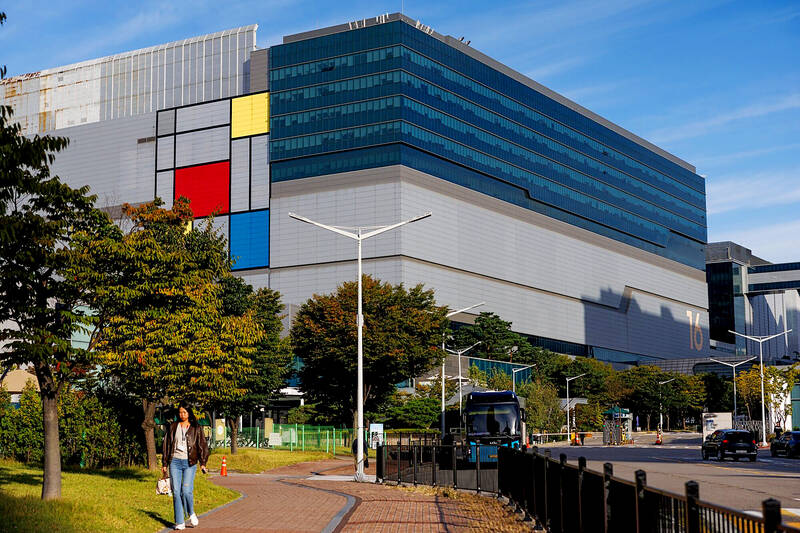
A person walks past Samsung Electronics Co’s semiconductor manufacturing plant in Hwaseong, South Korea, on Oct. 3.
Photo: Bloomberg
While Samsung’s semiconductor profits surged 15-fold — reflecting a severe shortage of storage for servers and smartphones — investors had expected more after SK Hynix soundly beat expectations a day prior. Samsung let the market down after its smaller rival announced total new payouts of US$45 billion.
Longer-term, the world’s biggest memory maker is trying to mobilize its financial resources to catch up in securing lucrative long-term contracts, particularly for the high-bandwidth memory (HBM) essential for Nvidia Corp’s accelerators.
Samsung sees the next-generation of such advanced chips — to work with Nvidia’s Vera Rubin platform — as a once-in-a-decade chance to catch up to SK Hynix.
“Samsung is also lifting capex by around 60 percent this year, so until it spells out how this windfall gets split between new capacity and shareholders, there’s a genuine question mark over how much actually comes back to investors,” eToro lead analyst for Asia Pacific Josh Gilbert said. “That turns January into a must-deliver moment.”
Samsung yesterday reported that group-wide net income also missed estimates.
While earnings are bounding ahead, the shortfall versus expectations coincides with growing doubts about the extent and durability of the global artificial intelligence (AI) boom, as well as Samsung’s ability to sustain higher margins.
The company has secured 10 long-term supply agreements with key customers, executives said.
However, while SK Hynix said its HBM was sold out through 2029, Samsung said its HBM was sold out only through next year.
Appetite for AI linchpins like Samsung and SK Hynix had waned in the past few weeks after a series of setbacks for neoclouds like CoreWeave Inc, specialist developers of AI data centers.
While hyperscalers including Meta Platforms Inc and Amazon.com Inc are pouring hundreds of billions of dollars into infrastructure, questions persist over whether and when those investments would generate sufficient returns to justify the spending.
Samsung needs to demonstrate progress in advanced memory such as HBM4, where competition with SK Hynix remains intense. Samsung tripled HBM4 sales in the third quarter over the prior three months, and said it plans to start mass production of the next-generation HBM4e in the first half of 2027.
Samsung Electronics’ sales and operating profit could rise sharply this quarter, as the company expects DRAM and NAND bit demand to rise more than 15 percent sequentially, Bloomberg Intelligence analyst Masahiro Wakasugi said.
Higher HBM4 shipments and pricing should support profit growth next year, he said.
In foundry, demand exceeding capacity at 8 nanometers and below could drive a substantial earnings recovery from the fourth quarter onward, Wakasugi said.
Samsung also announced additional shareholder returns for this year.
Strong memory earnings should sustain robust cash flow beyond next year, potentially supporting further increases in shareholder returns over the next few years, Wakasugi said.
KioskNews shows a cleaned-up reading view extracted from the publisher’s page — the original always lives on their site, not ours.