‘Like a Disney movie’: Three wild dog brothers make Africa’s longest journey
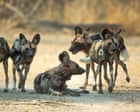
It sounds like a Disney movie: three wild dogs, all brothers, on an epic journey to find a home of their own after their family tells them to leave. They dodge cars and hunters in search of a new life, navigating bushmeat snares and the hostility of a human-dominated landscape until they find a new haven on the African savannah.
But this is exactly what happened in Zambia last year, when three endangered African wild dogs made the longest-ever recorded single journey of any mammal from the continent. The brothers travelled more than 2,500 miles (4,100km) over eight months in their “dispersal” – when a young dog comes of age and must establish new territory to find a mate and start a family of their own.
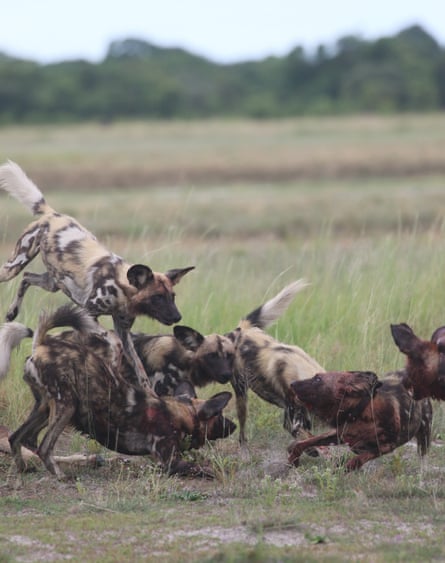
From point to point, starting in Kafue national park in western Zambia to their final destination in the Luangwa valley in the east of the country, the brothers covered 340 miles (546km), which is also a record.
The epic single journey is almost equivalent to travelling the length of Chile by foot and farther than the famous wildebeest and zebra migration across the Serengeti in east Africa. The previous record was 2,418 miles, also made by African wild dogs, which moved between Loliondo, in northern Tanzania’s Ngorongoro district, and Tsavo West national park in southern Kenya in 2012.
Dr Matt Becker, chief executive of the Zambian Carnivore Programme (ZCP), whose scientists were monitoring the wild dogs and have published their findings in the journal Ecology, says: “These extraordinary journeys show that natural connections between Africa’s wildlife strongholds still exist. But they also reveal how difficult and dangerous those journeys have become.
“Rather than relying solely on fenced protected areas, these findings reinforce the value of investing in connected landscapes. The dogs are showing us that connectivity still works; now we need to do more to protect and strengthen it.”
The researchers tracked 19 separate groups of wild dogs to monitor their dispersals, including a group of sisters to the three brothers who were far less successful at finding a new range. Two of the sisters died, probably caught in snares, but not before they had a touching final encounter with their siblings.
Two months into their journey, the group of brothers and sisters came across each other deep in Zambia’s copper-belt mining region, spending the day together before going their separate ways again. Related dogs do not form new family packs, and typically have to travel long distances through the landscape to find prospective mates.
Only 6,600 or so adults remain of 39 distinct populations of African wild dogs, and the species is classified as endangered on the International Union for Conservation of Nature’s red list. Habitat loss, declining numbers of natural prey, bushmeat hunters’ snares and human conflict are among the biggest threats to their survival.
But researchers say the three brothers’ epic journey shows the wild dogs can still survive in a human-dominated landscape despite the enormous challenges they face. Alongside African savannah elephants, whose ancient migration routes are increasingly being blocked by human development, African wild dogs need to be able to make long journeys to find new homes.
“These long-term studies provide key evidence that connectivity between large landscapes is still there,” says Dr Nyambe Nyambe, director of the Kavango-Zambezi transfrontier area secretariat, a key conservation region that spans five countries, including Zambia, where governments are trying to keep space for wildlife to move through the landscape.
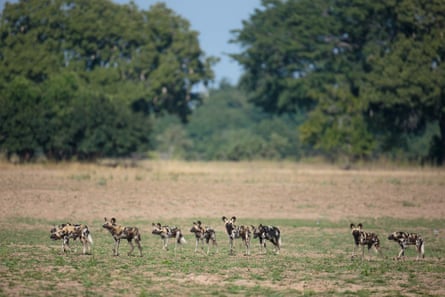
“If we conserve and continue to improve these connections – spanning the range of national parks, community areas, nations and regions – a lot of species like wild dogs can make the rest happen,” Nyambe says.
Find more age of extinction coverage here, and follow the biodiversity reporters Rebecca Ratcliffe, Phoebe Weston and Patrick Greenfield in the Guardian app for more nature coverage.
KioskNews shows a cleaned-up reading view extracted from the publisher’s page — the original always lives on their site, not ours.