Organilleros: Is Mexico City’s centennial profession at risk of disappearing?
Unlike his fellow street organ players, Don Miguel Santiago García has not been in this line of work his entire life.
“I’ve been playing the organillo for eight years,” the musician tells me, “and I do it with great pride.”
The organillo, or street organ, arrived in Mexico during the Porfiriato, at the dawn of the 20th century, and was originally designed to play German and Swiss polkas.
Organ owners rented their instruments to musicians, who used them on the streets to earn a few coins — a trade that has remained virtually unchanged for over a century.
Beyond being an integral part of the capital’s sonic and cultural landscape, this craft supports hundreds of families, like Don Miguel’s.
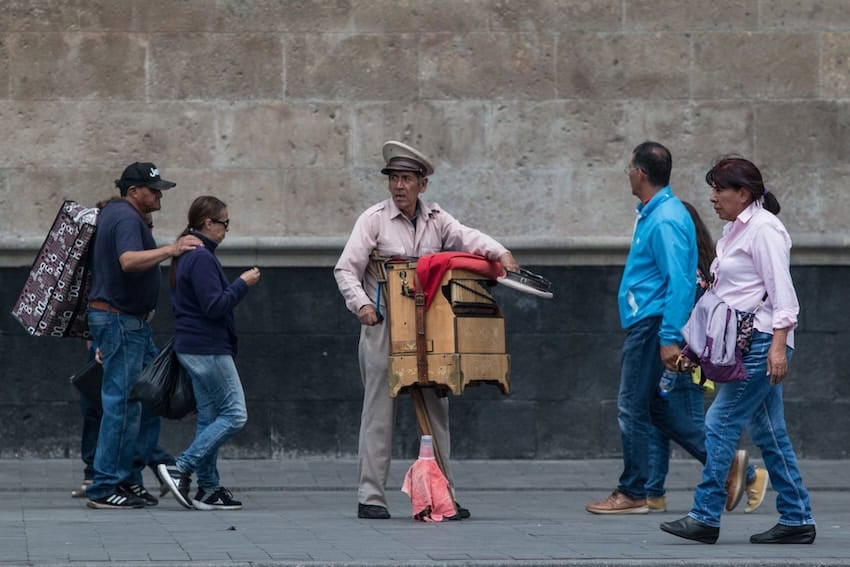
At 65 years old, Don Miguel leaves his home in the Gustavo A. Madero borough, north of Mexico City, at 6:00 a.m., Monday through Friday, arriving in the Historic Center around 7:30 a.m.
He takes public transportation, and after a commute of more than an hour through the capital’s traffic, he emerges from the Pino Suárez Metro station to retrieve his organillo from a local warehouse.

By 9:00 a.m., he’s standing on Isabel La Católica Street, near the Museo del Estanquillo, turning the crank that makes the instrument sing — just as he and his colleagues have done for more than a century.
Despite the long tradition of street organ players in Mexico City, Don Miguel could well be one of the last of his kind in the city.
How one elotero’s 40-year journey reflects Mexico City’s economy
An inherited musical craft
Don Miguel started playing the organillo to support his daughters’ families.
“They brought me into the business,” he says with a toothless grin, “because they had children of their own, and they simply didn’t have the time anymore.”
Unlike Don Miguel, who inherited the work from his daughters, other organ grinders come from a lineage dedicated exclusively to the trade, which is unique to Mexico City.
Along Isabel La Católica Street, several of his colleagues take turns playing the instrument. “It’s easy money,” he explains.
Organilleros can be identified by their traditional beige uniforms and police-style caps, as well as the 20-kilogram (44-pound) instrument they rest against their bodies.
“The instrument isn’t ours,” Don Miguel says. “The woman who rents it to me charges 100 pesos a day.”

Typically, Mexico City’s street organ players spread out across the surrounding area — most notably along Madero Street, where they have long been a part of the Historic Center’s soundscape.
Today, roughly 700 street organ players work in Mexico City, 337 of whom are affiliated with the Unión de Organilleros del Distrito Federal y de la República Mexicana A.C. The others operate independently.
All of them, however, are subject to a poorly regulated working arrangement that offers few labor protections.
A centennial profession without a fixed salary
Traditionally, Don Miguel says, organilleros do not earn a fixed wage, instead living off what passersby give them throughout the day.
“Some days go well, and some days go poorly.” On a good day, he can bring in as much as 300 or 400 pesos (US $16 to $21) — “especially in December, when there are so many people here in the Historic Center.”
On a bad day, however, Don Miguel says he barely earns “enough to cover the rental cost of the instrument.”

In contrast, pet sitters in the Roma and Condesa neighborhoods can make in a single house visit what an organillero might make in an entire day.
What’s more, if an organillero fails to make enough money, they can’t simply work extra hours, hoping to close to the gap.
“By 5:00 p.m.,” Don Miguel says, “I no longer have permission to continue, because other colleagues are coming in who will be there until 10 p.m.”
Today, street organ players in Mexico City cannot operate without a state permit. To bring some semblance of formality to the industry, the Mexico City government issues a “Non-Salaried Worker Credential” through the Labor and Employment Promotion Ministry (STYFE). This license is granted to artists and individuals who work independently in public spaces, providing a degree of regulation for how they earn their living.
Despite the precarious labor conditions facing the country, these long-standing, traditional professions remain active — and organilleros are resisting disappearance by submitting formal petitions to the Mexico City government.

A new breath of life
Street organ grinders like Don Miguel rarely have contact with the authorities.
They do so through a leader “who handles those administrative matters and organizes us by street,” he says. Generally, these leaders belong to the Union, which works to protect the craft.
For instance, Excélsior notes that through the union, the workers sought greater protection for fine-tuning their instruments, as well as suitable spaces for training and properly maintaining the barrel organs.
It was a necessary battle. Back in 2000, organ grinders were nearly brought to the brink of extinction, largely due to a lack of knowledge and spare parts needed to maintain their instruments.
All of their hard work and advocacy paid off in May, when the city government published a decree recognizing organilleros and their music as Intangible Cultural Heritage of Mexico City.
“The presence of organ grinders in public spaces […] fosters a sense of community and social interaction,” the decree states.
Essentially, this recognition provides the organilleros with greater protection from the state, enabling them to practice their profession safely.
The Mexico City government also organizes an annual Organillero Festival, featuring musicians from Mexico and Chile who perform and compete throughout the Alameda Central.
“Every year, we compete against the Chileans in the Alameda,” Don Miguel says. “Sometimes they beat us, because they bring along people who dance while others play, but generally, we Mexicans are better.”
These government actions aim to secure a place for organ grinders in public life, so that this living tradition may be preserved with dignity.
“Before television or radio existed, this instrument already brought joy to people,” Don Miguel says. “We have to protect it.”
Andrea Fischer contributes to the features desk at Mexico News Daily. She has edited and written for National Geographic en Español and Muy Interesante México, and continues to be an advocate for anything that screams science. Or yoga. Or both.
KioskNews shows a cleaned-up reading view extracted from the publisher’s page — the original always lives on their site, not ours.