Taiwan to crack down on deepfakes ahead of voting
NO ONE SAFE: Politicians from the ruling and opposition parties alike have been targeted by AI-generated fakes, casting a shadow over the nation’s democratic system
By Lin Che-yuan / Staff reporter


The Ministry of Justice yesterday said authorities would crack down on deepfake election content ahead of the year-end local elections.
Law enforcement agencies would step up forensic tracing, take down deepfake content promptly, and strictly investigate and hold perpetrators accountable in accordance with the law, the ministry said.
The agencies would track emerging deepfake trends, enhance intelligence analysis and cooperate with national security forces to counter foreign cognitive warfare, it said, adding they would also streamline cross-agency emergency response and collaborate with news outlets, major digital platforms and messaging apps to enable the fast removal of false content.
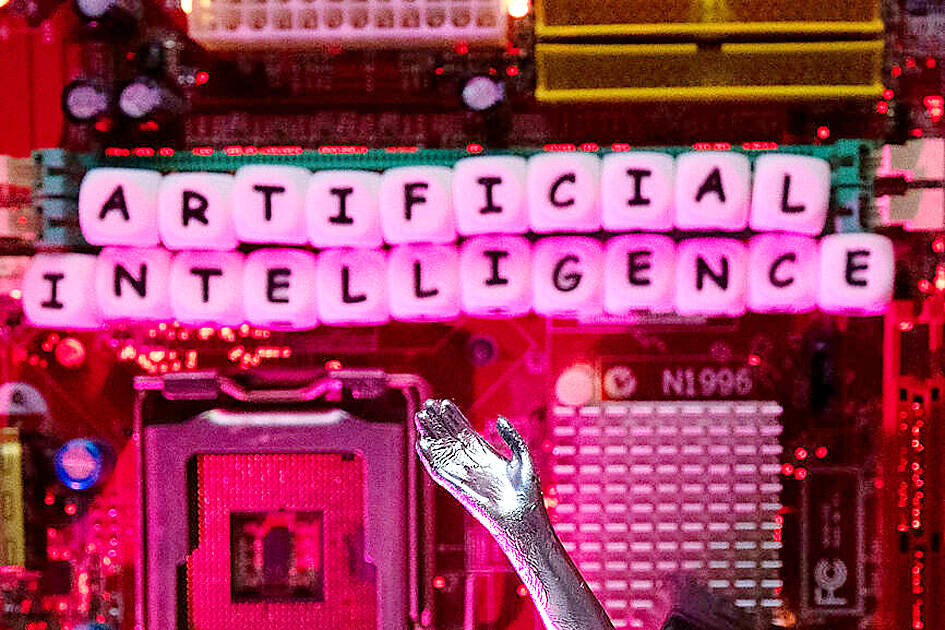
Letters spelling out the words “artificial intelligence” and a plastic hand are pictured on a computer motherboard in an undated photograph.
Photo: Reuters
The Civil Servants Election and Recall Act (公職人員選舉罷免法) mandates that people who disseminate deepfake audio or video misinformation targeting election candidates may face a maximum penalty of seven years in prison, and social platform operators who fail to comply with removal orders also face penalties, the ministry said.
The ministry issued the reminder as the rapid development of generative artificial intelligence (AI) has rendered the adage “seeing is believing” increasingly outdated.
There have been reports of deepfakes of politicians, casting a shadow over Taiwan’s democratic system.
For example, an AI-generated deepfake video showed Democratic Progressive Party (DPP) Changhua County commissioner candidate Chen Su-yueh (陳素月) saying that she can easily “win [the election] hands down.”
In response, Chen’s campaign headquarters held a news conference to clarify the situation, filed a report and demanded that the platform take the video down.
Meanwhile, former Chinese Nationalist Party (KMT) New Media Department director Wei Chun-yu (韋淳祐) was questioned by the Criminal Investigation Bureau for allegedly using AI to fake President William Lai’s (賴清德) voice in a party video when a cooking oil scandal broke out earlier in the summer.
When former Taipei mayor Hau Lung-bin (郝龍斌) last year ran in the KMT chairperson election, he was falsely depicted in an AI-generated video kissing Taipei City Councilor Liu Tsai-wei (柳采葳).
Liu, accompanied by Broadcasting Corp of China chairman Jaw Shaw-kong (趙少康), reported the incident to the police.
Jaw at the time called it a national security issue, accusing China of interfering in the KMT chairperson election.
In the run-up to the 2024 presidential election, several media outlets on Aug. 16, 2023, received an e-mail with an audio file of someone claiming to be Taiwan People’s Party (TPP) founder and presidential candidate Ko Wen-je (柯文哲).
The fake Ko said “Lai’s US trip received significant fanfare, as everyone who went could earn NT$800.”
The TPP said the voice was not Ko’s and filed a report with the Investigation Bureau’s Taipei City Field Division.
In November the same year, a deepfake video of Lai commenting on the KMT-TPP alliance circulated on social media.
“The KMT and the TPP represent the mainstream public opinion in Taiwan, and both their candidates are suitable national leaders, so regardless of who serves as president or vice president, they make the right team,” the fake video said.
Technical analysis confirmed that the video was created using deepfake technology, with a manipulation probability of more than 98 percent, and was likely an attempt to influence voter judgement and turnout.
KioskNews shows a cleaned-up reading view extracted from the publisher’s page — the original always lives on their site, not ours.