GlobalFoundries gets US$21bn for plants in US-Japan deal
GlobalFoundries Inc plans to build two new chip plants with the backing of as much as US$21 billion from the Japanese government, part of an arrangement that also includes the US taking a 4 percent stake in the company.
Under an agreement announced on Wednesday, GlobalFoundries will operate factories at its site in upstate New York that are jointly owned by the US and Japan. The facilities will be funded with money from Japan’s pledge to invest US$550 billion in the US.
The factories will make so-called essential chips, the vital yet less sophisticated semiconductors used in vehicles, industrial equipment and communications gear.
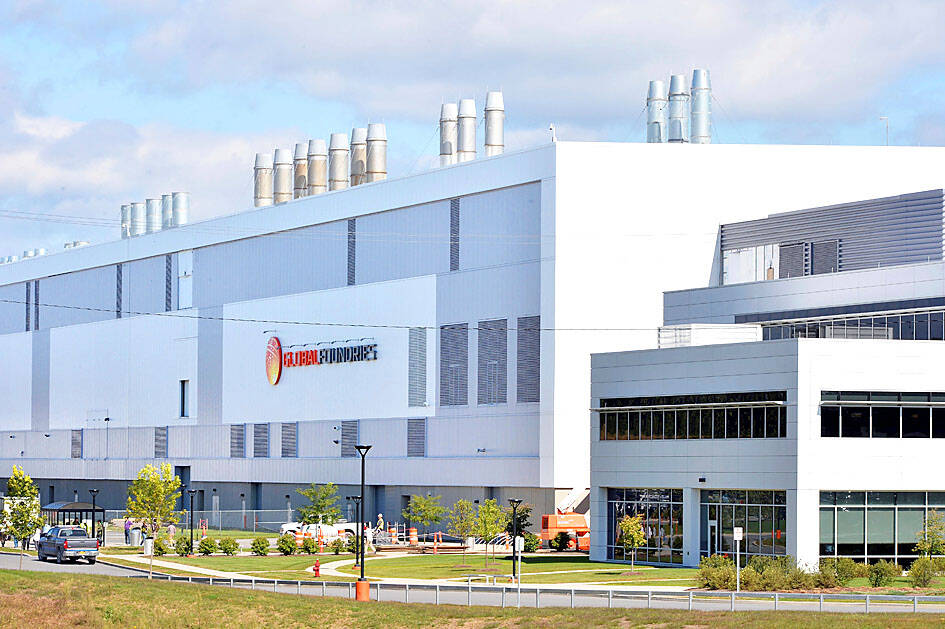
Tthe GlobalFoundries Inc campus is pictured on Sept. 22, 2014, in Malta, New York.
Photo: John Carl D’Annibale, The Albany Times Union via AP
The GlobalFoundries agreement is meant to boost American production of essential chips and reduce dependence on East Asian suppliers — addressing a national security concern for the US.
Under a broader arrangement with GlobalFoundries, the US Department of Commerce will take a roughly 4 percent equity stake in the company, “further enabling the American public to share in GF’s growth.”
GlobalFoundries will get to redirect funds from a previous US CHIPS and Science Act grant to invest in honing its manufacturing abilities. That includes advancing its work in fields such as silicon photonics, chip packaging and silicon germanium.
In a separate statement, the US Department of Commerce said it was reallocating US$955 million in CHIPS Act incentives to go toward GlobalFoundries’ factory expansion and modernization. As part of the agreement, the company will devote US$5 billion to capital investments at its plants in New York and Vermont.
The new Japan-linked factories will be operated in the same way that GlobalFoundries runs its current facilities, which serve customers such as Apple Inc and Japanese firms including Renesas Electronics Corp.
Profits will be divided among the owners and GlobalFoundries, following an approach laid out in last year’s US trade deal with Japan. US President Donald Trump touted the accord on his Truth Social site, saying it would help revitalize America’s industrial base and create jobs.
For GlobalFoundries, the arrangement will help the company meet surging demand for its products, chief executive officer Tim Breen said in an interview.
“We need to respond to what our customers need,” he said. “Right now, the whole industry is in short supply.”
The company has already begun work on the first plant, located by GlobalFoundries’ home base in Malta, New York. It expects to have the factory up and running in 2029. The second will go ahead as quickly as possible after the initial plant is completed. But that will depend in part on future demand, Breen said.
“Of course, it will be market-dependent,” he said. “We’re not going to do it if the market isn’t there, but every indicator I see today is flashing green around market demand.”
GlobalFoundries has taken a more conservative approach to spending on its factory network. That’s made it profitable but often resulted in anemic top-line growth.
Its annual budget for new plants and equipment was less than US$1 billion last year. Taiwan Semiconductor Manufacturing Co (台積電), the biggest chip foundry, spent more than US$40 billion.
The US-Japan deal gives GlobalFoundries a chance to expand in a smart way, Breen said.
“It’s actually a pretty exciting win-win in terms of the economics of it,” he said.
KioskNews shows a cleaned-up reading view extracted from the publisher’s page — the original always lives on their site, not ours.