SocGen flags relative bargains in Treasuries as yields fall

Melpomenem/iStock via Getty Images
Société Générale has identified several U.S. Treasury securities that appear relatively inexpensive compared with bonds of similar maturities, offering investors a way to assess potential opportunities in the government bond market following a decline in yields.
In a fixed-income analysis published October 16, using market data from October 15, the French bank compared yields on individual Treasury securities with a mathematical model of the broader yield curve. The analysis highlights bonds that appear either cheap or expensive relative to comparable government debt, potentially helping investors identify securities whose prices could benefit if those differences narrow.
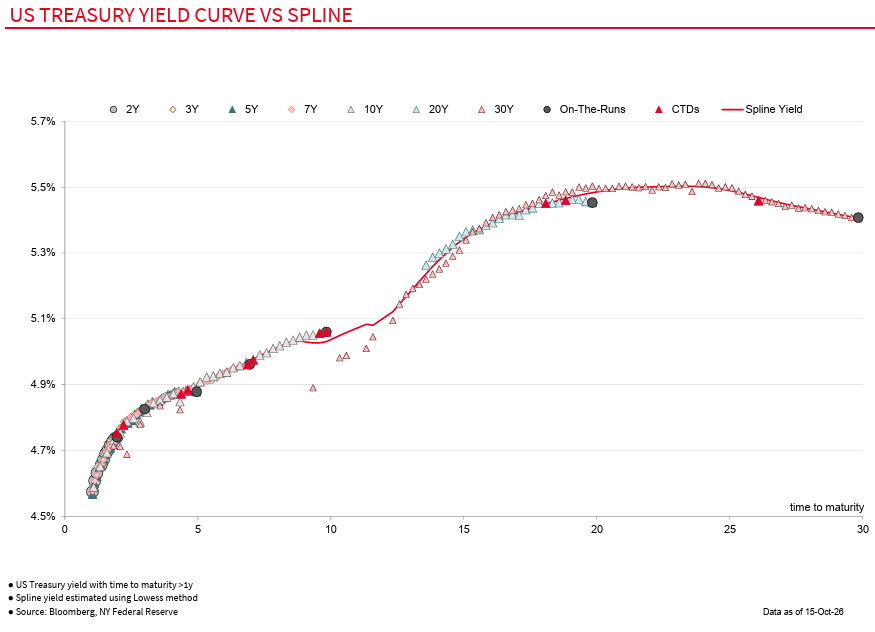
U.S. Treasury yield curve versus spline (Societe Generale)
The report comes as Treasury yields declined across the maturity spectrum. The benchmark 10-year Treasury (US10Y) note maturing in August 2036 yielded 5.060%, down 12.7 basis points from the previous session. The two-year (US2Y) benchmark yielded 4.740%, down 6 basis points, while the 30-year (US30Y) benchmark yielded 5.407%, down 11.7 basis points. Bond prices move inversely to yields, meaning the declines reflected rising Treasury prices.
Finding value along yield curve
Société Générale used a statistical technique known as a spline curve to estimate what Treasury yields should be at different maturities. The model creates a smooth curve from market data, allowing analysts to compare individual securities with a theoretical fair-value benchmark.
A bond yielding more than the model suggests is considered relatively cheap because investors can earn a higher yield than on comparable securities. Conversely, a bond yielding less than the model indicates is considered relatively expensive, or rich, because buyers are accepting a lower return.
Among the securities identified as cheapest by their absolute difference from the model was a 2.5% Treasury bond maturing in February 2045. It yielded 5.485%, approximately 3 basis points above the modeled yield. The 4.625% Treasury note maturing in August 2036 and the 4.375% note maturing in May 2036 also appeared inexpensive, each yielding approximately 2.9 basis points above the model.
The bank separately examined how unusual those pricing differences were compared with the previous month. By that measure, a 1.75% Treasury note maturing in January 2029 ranked among the cheapest, with a yield of 4.790%. A 3.75% bond maturing in August 2041 and a 4.25% bond maturing in May 2039 also ranked among the most unusually cheap securities relative to their recent trading patterns.
Some Treasury bonds look expensive
At the opposite end of the analysis, Société Générale identified several securities trading at relatively rich valuations. A 4.375% Treasury bond maturing in February 2038 yielded 5.010%, approximately 7.3 basis points below the model's estimate. A 5% bond maturing in May 2037 and a 4.75% bond maturing in February 2037 also appeared expensive, with yields roughly 7 and 6.8 basis points below their respective modeled levels.
The distinctions matter because investors holding bonds with similar maturities can experience different returns as relative valuations change. A security trading cheaply could outperform comparable bonds if its yield moves closer to the modeled curve. However, such opportunities aren't guaranteed, and relatively small differences in yield can reflect liquidity, investor demand or other market conditions.
What it means for investors
The report also examines combinations of Treasury maturities known as butterfly trades, which seek to profit from changes in the relative pricing of short-, intermediate- and long-term bonds. Société Générale's analysis shows that some combinations involving 20-year Treasury (US20Y) securities have moved substantially away from their historical averages, suggesting unusual differences in how portions of the yield curve are priced.
For investors, the findings underscore that opportunities in Treasuries aren't limited to predicting whether interest rates will rise or fall. Differences in pricing among government securities can create potential opportunities even when the broader direction of yields remains uncertain.
The report is primarily a relative-value screening analysis rather than an explicit forecast for interest rates or a recommendation to purchase particular bonds. Its findings are based on October 15 market conditions and could change as yields and bond prices fluctuate.
KioskNews shows a cleaned-up reading view extracted from the publisher’s page — the original always lives on their site, not ours.