Global banks back AI-linked Asia currencies to lead next year
Global banks including Goldman Sachs Group Inc and ING Bank NV expect further gains for Asia’s tech-linked currencies, betting that sustained investment in artificial intelligence (AI) and a weaker US dollar will support the advance.
Goldman sees the Korean won, New Taiwan dollar and Malaysian ringgit beating other Asian currencies, strategists including Danny Suwanapruti wrote in a note dated on Sunday. ING favors the Singapore dollar in Southeast Asia, and the Korean won and NT dollar in North Asia. Morgan Stanley sees room for the NT dollar to strengthen once tech sentiment recovers, given its relatively cheap valuations, while the won should benefit from exporters converting more of their US dollar earnings.
The first batch of next year’s currency forecasts points to a relatively benign outlook for Asia, with both Goldman and ING anticipating a softer US dollar and lower crude oil prices. Those calls also suggest that the recent rotation away from tech-linked currencies may prove to be temporary.
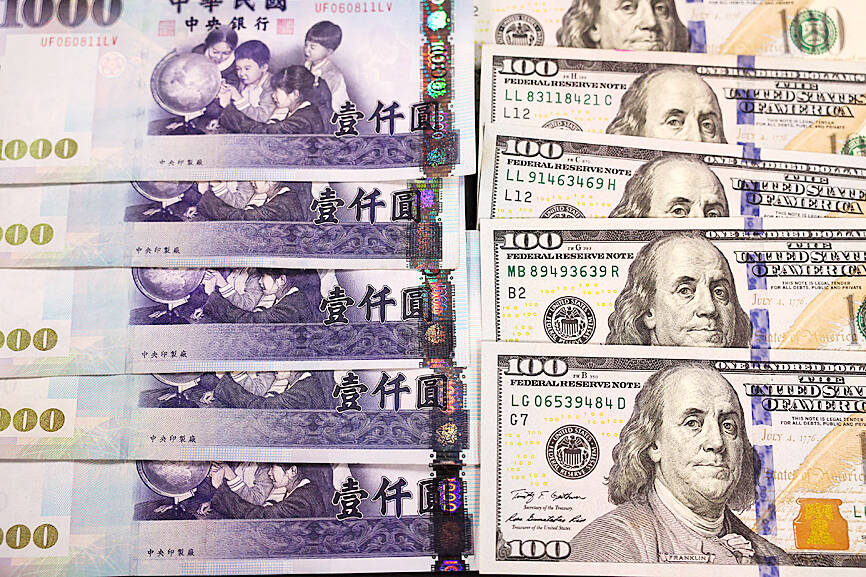
US$100 and NT$1,000 banknotes are pictured in Taipei on Jan. 22.
Photo: I-Hwa Cheng, AFP
Goldman strategists note that robust AI capital spending continues to bolster Asia’s tech exporters, while long-term contracts for AI equipment indicate that much of next year’s demand is already locked in.
“While some rotation into South Asian currencies is already underway, we continue to expect tech-linked currencies to outperform,” ING regional head of research for Asia Pacific Deepali Bhargava wrote in a separate note. “This is thanks to strong current account surpluses and exporter FX [foreign exchange] conversion, which provide ongoing support.”
The Korean won has led gains in Asia this year, rising almost 8 percent. The Singapore dollar and the Malaysian ringgit are also among the region’s top performers. The NT dollar, despite its close ties to the AI trade, has weakened toward its weakest level since 2016 as exporters haven’t repatriated the bulk of their earnings.
The NT dollar fell 0.15 percent to close at NT$32.886 against the US dollar in Taipei yesterday.
Among higher-yielding currencies, the rupee is finding favor after its recent rebound. ING backs the rupee due to India’s resilient growth, supply-chain diversification, and steady foreign direct investment flows, Bhargava wrote.
Elsewhere, the outlook is less encouraging. The Thai baht is likely to remain under pressure on low carry, weak growth and elevated US yields, according to Morgan Stanley. The Indonesian rupiah, which fell to a fresh record low Monday, and Philippine peso are likely to trail regional peers amid domestic policy uncertainty and sluggish growth, the bank said.
KioskNews shows a cleaned-up reading view extracted from the publisher’s page — the original always lives on their site, not ours.