No deal: COP31 talks fail over fossil fuel mention
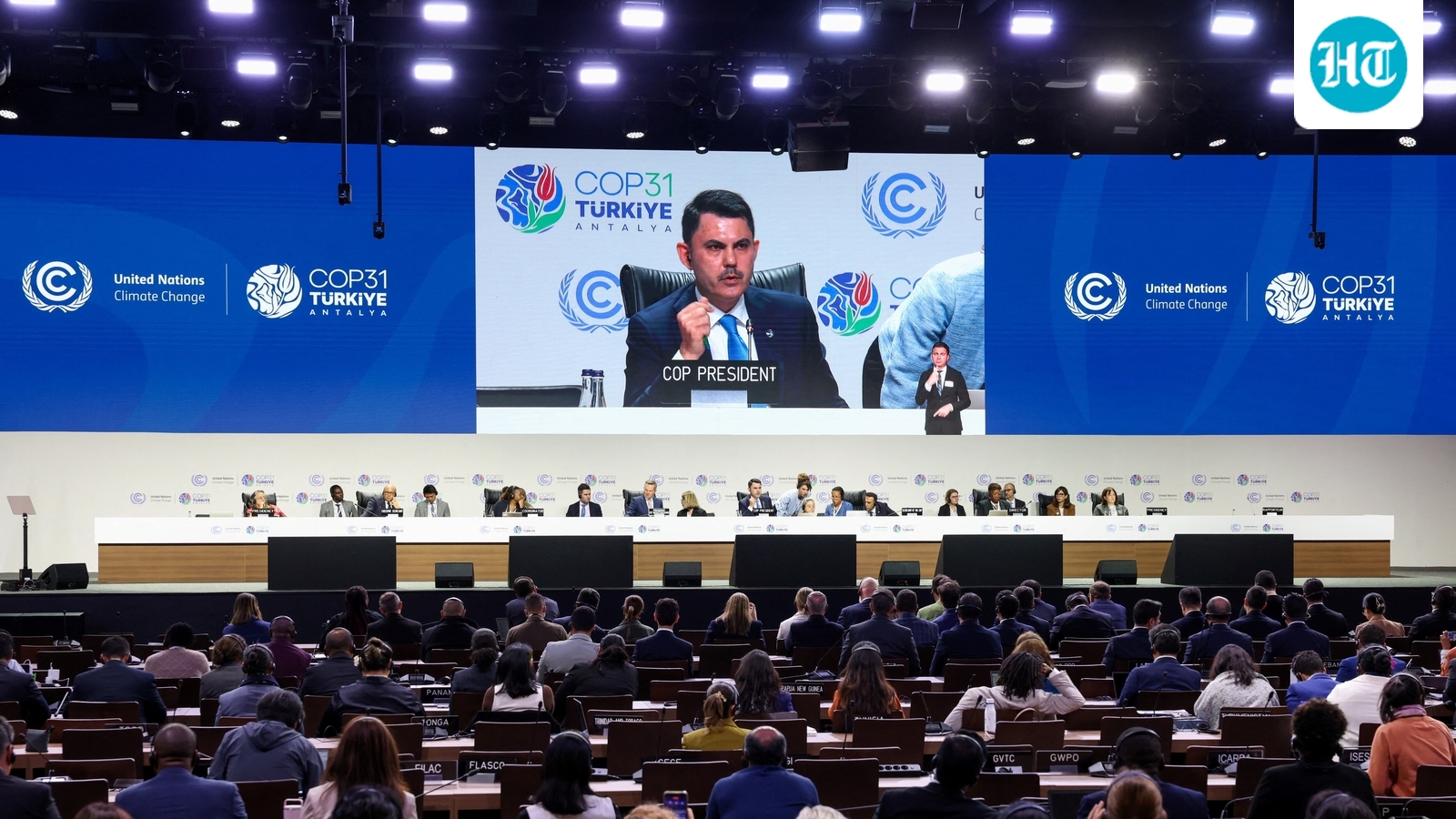
The summit’s proposed pact omitted an explicit fossil fuel transition commitment, prompting objections from the EU and others.

The gavel came down on Cop31 in Antalya on Sunday without its cover decision being adopted, after negotiations ran two days past the scheduled Friday close and countries failed to bridge differences over fossil fuels, climate finance and equity.
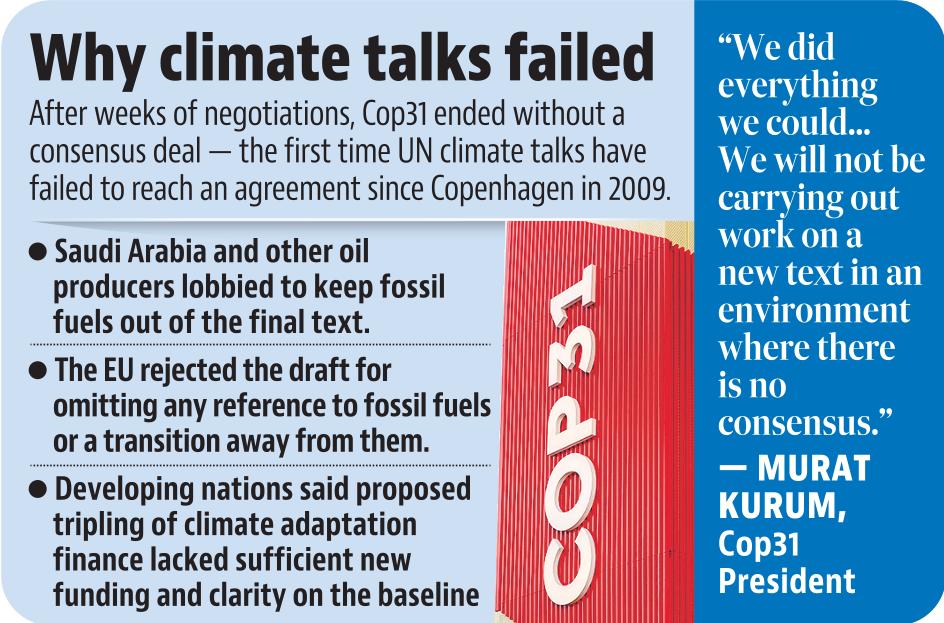
The collapse of the proposed Antalya Pact is a major setback for the Turkish and Australian Cop31 presidencies, with nearly 200 countries unable to agree on a common political outcome. The European Union, the United Kingdom and several developing countries, including vulnerable island nations, opposed the final draft, which did not explicitly mention fossil fuels or commit to a clear pathway for moving away from them.
It was the first time since Cop15 in Copenhagen in 2009 that a summit’s cover decision was not formally adopted, and the first such failure since the Paris Agreement was adopted in 2015.
It was also the longest COP yet. The summit overran its scheduled end on Friday, November 20, by more than 44 hours, beating the record set by Cop25 in Madrid in 2019.
Also Read | COP31 becomes longest-ever UN climate summit, EU rejects 'greenwashing of fossil fuels'
At the closing plenary, Cop31 president and Turkish environment minister Murat Kurum acknowledged that the text lacked consensus. “It is clear that there are parties in this hall who oppose this text. We recognise that there is no consensus on this document. Therefore, these decisions have not been adopted,” he said.
Ireland’s climate and environment minister Darragh O’Brien, speaking for the EU, formally objected. “We will not endorse a cover decision or an Antalya Pact that does not even mention fossil fuels, which is the key driver of climate change,” he said.
India, speaking for the Like-Minded Developing Countries (LMDC), said the group had reservations about parts of the cover decision but had engaged with the presidency until the final stages and remained prepared to move forward. It called on other countries to show flexibility and to uphold consensus and multilateralism.
The group flagged the inadequate reflection of equity and the principle of common but differentiated responsibilities and respective capabilities (CBDR-RC), particularly in paragraphs introducing new global targets. It also objected to what it called the dilution of developed countries’ historical responsibility.
Also Read | The collapse of UN climate talks, over fossil fuels, was years in the making
“At the threshold of crossing 1.5°C warming, we had raised a fundamental point – we need to reflect why we are here. Whose emissions? - both past and continuing, have exhausted the global carbon budget?” India’s representative said.
The draft acknowledged that historical emissions account for at least four-fifths of the carbon budget for 1.5°C, but did not say whose. India said the text repeated earlier paragraphs on responsibility without connecting them to the imminent breach of 1.5°C. It added that developing countries had been told not to expect developed countries to engage on climate finance.
Panama also rejected the text. Its chief climate negotiator, Ana Aguilar, said it repeated existing commitments without closing the gap between current action and what science demanded. She said it also put too much emphasis on carbon capture technologies and weakened language agreed in earlier decisions.
The fossil fuel dispute was the central fault line. Saudi Arabia and Russia resisted stronger language on moving away from oil, gas and coal. More than 130 countries, including the EU and climate-vulnerable nations, wanted the text to restate the transition away from fossil fuels agreed at Cop28 in Dubai in 2023. The final draft instead recalled the Dubai outcome, known as the United Arab Emirates Consensus, “in its entirety”, without a direct commitment.
Climate finance was the second sticking point. The final text recalled Article 9.1 of the Paris Agreement, which obliges developed countries to provide financial resources to developing countries, but attached no new quantified commitments to it. The call to at least triple adaptation finance by 2035 still had no agreed baseline; the draft only asked for options on one by next year. The $120 billion annual adaptation finance figure that developing countries had pushed for was dropped in an earlier draft and did not return.
“Adaptation needs concessional finance, and the push to at least triple adaptation finance by 2035 can help developing countries hold developed countries accountable. But a commitment is only as strong as its definition,” said Suranjali Tandon, associate professor at the National Institute of Public Finance and Policy.
The draft also retained an ambition to raise electricity’s share of global final energy consumption to 35% by 2035, and to scale up carbon capture, utilisation and storage (CCUS) to gigatonne level by the same year. Campaigners argued that the focus on carbon capture risked diverting attention from direct emission cuts.
UN secretary-general Antonio Guterres expressed disappointment at the lack of consensus. “There may be no consensus in the negotiating room. There is no ambiguity in the science. Temperatures keep shattering records… And every delay makes our task harder and more costly,” he said. He called on major emitters to lead on emission cuts, developed countries to deliver climate finance and all countries to accelerate the transition away from fossil fuels.
Also Read | COP31 goes into overtime: Fossil fuel, adaptation finance impasse persists
Aarti Khosla, director of Climate Trends, said the outcome reflected a lack of political ambition and accountability. “For India, this raises serious concerns about equity and trust as the outcome reinforces an inequitable climate regime where expectations of action continue to grow but the means to deliver that action remains uncertain,” she said.
Harjeet Singh, global convenor of the Fill the Fund campaign, said parties were right to reject the text. “No deal is better than a deal that locks in failure. But this cannot become an excuse for more delay: the money and the plan must now come,” he said.
Countries did adopt less contentious decisions, including on the Green Climate Fund. But with the cover decision unadopted, the questions of the fossil fuel transition, climate finance and implementation move to next year’s talks in Addis Ababa, Ethiopia.
ABOUT THE AUTHOR
Jasjeev Gandhiok is an Assistant Editor with Hindustan Times, where he covers environment, climate change, the clean energy transition and wildlife at the National Bureau. Gandhiok has over a decade of experience in journalism and is based in Delhi. He has reported extensively on Delhi and the National Capital Region (NCR). This includes the region's air pollution woes, a polluted Yamuna and on urban wildlife still thriving in the region. He joined HT in October 2021. Prior to that, he had five-year stint at The Times of India in Delhi, where he also covered Delhi, with a focus on environment and wildlife. Gandhiok has covered some recent events around the Capital too, ranging from the farmers' protests, the northeast Delhi riots and the CAA-NRC protests, reporting from the ground on all of these. He also travels across the country to report on how environment and climate change impact everyday life, while also writing on endangered species. His reports in 2019 on toxic leachate from Delhi's landfills led to the National Green Tribunal (NGT) taking suo motu cognisance and ultimately asking the state government to start bio-mining to flatten and remove all three landfills in the capital. He also closely tracks the implementation of government policies on climate, renewable energy and environmental protection. His focus remains on impactful, public-interest journalism which explains how environmental decisions affect people's everyday lives.
KioskNews shows a cleaned-up reading view extracted from the publisher’s page — the original always lives on their site, not ours.