The Spin | ‘I wanted the ball to be hit at me’: life in cricket’s most dangerous fielding position
Out in Arizona, just south of Tucson. Where tumbleweeds tumble in search of a home. There’s a town they call Tombstone where the brave never cry …
On the outskirts of Tombstone stands Boothill Graveyard, the final resting place for the many cowboys who died “with their boots on” in the seconds-long but deadly shootouts of the wild west.
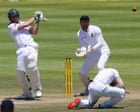
In cricket, “Boothill” is the nickname for the most dangerous fielding position, under the batter’s nose and directly in the line of fire for any full-blooded sweep or pull shot. No one in their right mind wants to wind up at short leg, surely?
“I always loved it in there because you’re right in the thick of the action,” says the former England batter James Taylor. “You’re so close to it and involved every ball. Honestly, you feel so alive!”
Taylor is trying his best not to wake up his three-month-old son but finding it increasingly difficult to contain his enthusiastic reminisces of fielding at short leg. “There’s plenty of people that – excuse my language – shit themselves when they go in there. But I was very fortunate that I didn’t have that fear, I wanted the ball to come to me, be hit at me.”
Taylor’s young son isn’t a great sleeper at the best of times according to his dad but is currently conked out in a papoose strapped to his old man’s chest. Should the BabyBjörn straps momentarily falter then the little one is in good hands. A decade ago Taylor pulled off two cortex-frying catches at short leg in the space of half an hour that helped England win a Test against South Africa in Johannesburg.
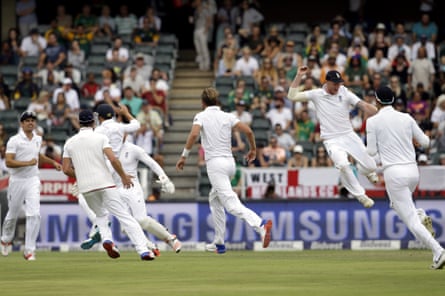
“That has to be two of the most sensational catches I’ve ever seen on a cricket field,” cooed the usually gnarled former South Africa captain Graeme Smith on commentary in the seconds after Taylor’s second grab to dismiss Dane Vilas. “I don’t think you’ll ever know how tough that is.”
Taylor’s first catch saw the back of a perplexed Hashim Amla who had crisply timed a front-foot flick off the bowling of Stuart Broad. Taylor stayed low in his stance a few paces deeper than a regular short leg and grasped the catch millimeters above the turf. The whole drama unfolded in only 0.4 seconds.
“It’s very rare in any sport, that you practise something really hard the day before and then it pays off straight away,” says Taylor. He had spent hours practising this exact catch with England’s then assistant coach Paul Farbrace; the latter would deflect balls at high pace off a boxer’s sparring pad down at Taylor’s toes repeatedly.
“The Vilas catch that happened a few overs later looks better as I’m diving but actually the Amla one is the better catch because it came faster and lower.”
Tactfully, the Spin doesn’t mention this to Vilas as he goodnaturedly relives the dismissal: “Let’s say I played that clip off my hips 1,000 times in my career, 999 times it’s going for runs. I couldn’t believe this little guy caught it.”
At 5ft 6in and nicknamed “Titch”, Taylor was, well, tailor-made for short leg.
“That’s the stereotypical way it works, the smallest guy is shoved in there or the youngest guy in the team … but I was always in there! Even in schoolboy cricket when I was captain, I’d put myself there because I genuinely enjoyed it and was good at it.”
Like the washing up or working out the bill, plenty have considered short leg a job to do badly in order to avoid being saddled with the role, yet there have been those who relish fielding ridiculously close to the bat, many of them senior players in a team.
Think of Ricky Ponting channelling Sheriff JW Pepper, squinting, spitting in his palms and mercilessly chewing his gum only a pace or two away from some poor quaking batter, most often at silly point, the off-side opposite to short leg. Tony Greig used his 6ft 8in frame to try to intimidate and change the way a batter would play. Often with his size 12s encroaching on the popping crease, folding himself down to stare the batter right in the eyes.
after newsletter promotion
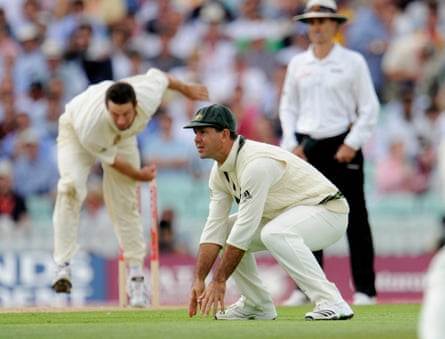
Fielders who brave these close-in positions enter into a twisted kind of intimacy with the batter – they can see them sweat, hear them breathe, are privy to their whispered mantras as the bowler runs in.
“It was intense in there,” recalls Taylor. “You can see when a batter is struggling and is scared. There’s a lot of eye contact. You hear exactly what the bowler is saying in his follow through. I’ve been in there when Jimmy Anderson has being going hard at a batter. You’re thinking: ‘This is really spicy and I’ve got front-row tickets.’”
In the years that have passed, Taylor’s catches have taken on a poignancy. “That was my last shot as a Test cricketer,” says Vilas. “I never played another.” The South African went on to make “some of the happiest memories” of his career at Lancashire where he became club captain.
A crueller fate lay in store for Taylor. A few months after the tour of South Africa he was forced to retire from professional cricket aged only 26 after being diagnosed with an incurable heart condition.

He spent four years in selection roles at the ECB and is now the assistant head and lead batting coach at Leicestershire, his passion for the game undimmed. Taylor holds the memory of those catches dear.
“To have those moments of pure elation … to be lucky enough to get two of them that day, just that feeling inside …”
He trails off, momentarily. “I’m not really an emotional guy … but to have that feeling, like I can almost feel it now just talking about it. It was one of the last games I ever played. It’s special. Really, really special.”
Taylor’s baby wakes and coos. Sometimes a sunset just comes in a different shape.
-
This is an extract from the Guardian’s weekly cricket email, The Spin. To subscribe, just visit this page and follow the instructions.
KioskNews shows a cleaned-up reading view extracted from the publisher’s page — the original always lives on their site, not ours.