An Indian postcard from Venice: Why a pavilion at ‘Olympics of the art world’ matters
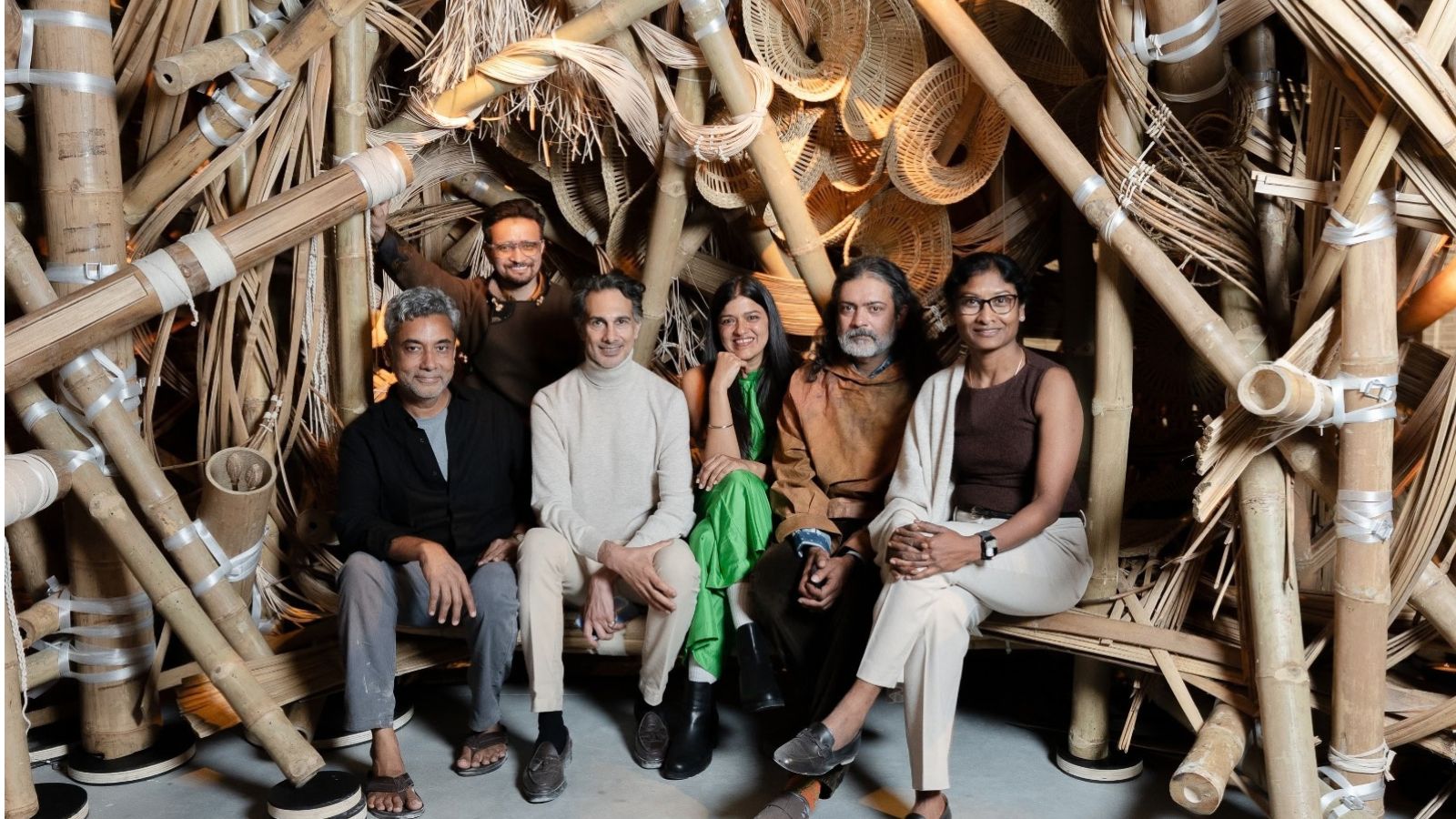
WHAT’s HOME? Or the idea of it? As delicate and haunting as Sumakshi Singh’s white threads that hold up fragments of a broken home, as real as 33 Link Road, Delhi, the artist’s now-demolished house where she spent her summer vacations in the 2000s, the one her grandparents, Partition refugees from Pakistan, built in 1951.
Her installation, Permanent Address, is one of five artworks that are part of the India pavilion at this year’s Venice Biennale, one of the oldest, largest, and most prestigious contemporary cultural and art events in the world. India’s presentation, titled ‘Geographies of Distance: Returning Home’ and curated by Amin Jaffer, marks the country’s return to the event, the ‘Olympics of the art world’, after seven years.
The five artworks, all rooted in Indian craft traditions and material such as clay, bamboo, embroidery, papier-mâché and cotton, explore the idea of home. Besides Sumakshi Singh’s embroidered recreation of a lost home, there is Ranjani Shettar’s floating garden, Asim Waqif’s bamboo scaffolding that mourns the slow erosion of rural architecture, Skarma Sonam Tashi’s Ladakhi homes that rises like a settlement resting on a mountain slope, and Alwar Balasubramaniam’s display of cracked soil sourced from rural Tamil Nadu.
Critics and patrons, including Saffronart’s Minal Vazirani and former British Prime Minister Rishi Sunak, and the global media have described the India pavilion as “dazzling”, “spectacular” and a must-see, with the artworks being hailed for their innovation and craftsmanship.
Is this then Indian art’s golden moment? What does this success entail and, more importantly, does India have a roadmap for a sustained presence at the Biennale?
To pull off an art show
While Indian artists have regularly showcased in their individual capacities at the Venice Biennale’s central exhibitions, this is only the third time in the 131-year history of the art event that India has participated with a national pavilion.
A national pavilion, one that is organised and funded by the government to showcase its own contemporary artists, is the ultimate exercise in soft power and cultural diplomacy. Even smaller countries like Uruguay and Angola either have permanent pavilions at Venice or participate consistently.
Story continues below this ad
China, for instance, has been consistently showcasing its state pavilion since 2005. Though the country is not among the 30 that own permanent buildings at the historic Giardini public park in Venice, the China pavilion has for long had a permanent home at the Arsenale, a complex of former shipyards and armouries that offers spaces on rent during the six-month-long biennale. It’s at the Arsenale, inside a brick-walled former maritime warehouse that’s a five-minute walk from the China pavilion, that India is hosting its pavilion this year.
The last time India put up a pavilion was in 2019, when the Ministry of Culture partnered with the Kiran Nadar Museum of Art (KNMA) and the Confederation of Indian Industry (CII) under a public-private partnership model.
This time, the government has gone with two institutional partners — Nita Mukesh Ambani Cultural Centre (NMACC) and Serendipity Arts.
Culture Secretary Vivek Aggarwal says the process of setting up a national pavilion involved months of discussions and evaluation. “We received multiple expressions of interest and carefully assessed proposals against the vision that the government sought to present at Venice,” he says.
Story continues below this ad
Ministry officials say the proposal by Amin Jaffer, the London-based curator who was eventually chosen to head the India pavilion, dealt with Indians as migrants — from the time they travelled as traders and seafarers thousands of years ago to the present. Officials say that with the theme of ‘Returning Home’, they expected visitors to walk in through the India pavilion, pause and reflect on their own sense of belonging.
Jaffer, who was born in central Africa and raised in North America and Europe but whose ancestral roots go back to Kutch, Gujarat, says he has drawn from his personal history to ask “whether belonging is determined solely by geography or can also be sustained through memory, practice and emotional attachment”.
When Jaffer initially submitted his proposal, it was for a single artist. “But the Ministry felt India’s diversity called for a multi-artist presentation. I then developed the proposal further, expanding its narrative,” he says, talking of how the other four artists came on board.
If the ministry set the ball rolling, the private players, NMACC and Serendipity, with their experience in delivering projects of international scale, took over.
Story continues below this ad
Each of the installations on display required both artistic creativity and engineering ingenuity.
For instance, Asim Waqif’s Chaal uses 12 tonnes of bamboo, sourced largely from Assam and West Bengal, all of which were bent and tied, not screwed or pasted together, to form a 30-foot-high scaffolding-like structure. Waqif’s work is a commentary on the disappearance of rural architecture, with construction rules that favour steel and aluminium in place of bamboo for scaffolding and formwork.
“I use one simple lashing technique — tying two bamboo, sometimes whole and sometimes split, together with a composite nylon strap used in shipping. We don’t make any holes in the bamboo or use joinery, nuts or bolts,” says the Delhi-based, Hyderabad-born Waqif, explaining how his team, along with “three Italian riggers who are trained in climbing and ropes and knots”, built the installation.
Ongoing geopolitical events led to logistical challenges, particularly in the shipment and installation of Waqif’s bamboo work. Ministry officials say several species of bamboo and nearly 10-12 tonnes of material had to be transported and installed within very specific timelines ahead of the biennale that was to start in May. But in February, the US-Iran war broke out and the artworks and other objects had to be flown in, instead of shipped as planned earlier.
Story continues below this ad
Sumakshi Singh’s work, in which she embroidered an entire house on water-soluble fabric, also called for a high degree of sophistication and logistical planning.
For the installation, she recreated the house down to the tiniest of details, from the gates and the stairs to the walls, doors and windows. “Even the chatkanis (door bolts),” she says.
The Ladakh-born Skarma Sonam Tashi says that before he could start working on the project, a trip to Venice was organised for him and the others to see the venue. “Once that happened, I knew exactly what I wanted to make. Because my studio in Delhi’s Garhi was small, I had to rent a bigger apartment to work. Thankfully, I faced no logistical issues and my work reached Venice in about a week,” he says.
His Echoes of Home is a prototype of a settlement of Ladakhi homes that are traditionally built using earth, stone, timber, and collective knowledge that’s passed down generations. For his work, Tashi used recycled materials, including papier-mâché, egg trays, cardboard and old paper.
Story continues below this ad
The installation of Ranjani Shettar’s monumental floral vine suspended from the ceiling and Alwar Balasubramaniam’s two-panelled installation of cracked earth, including one that covers an entire wall at the pavilion, too, required constant innovations.
Shettar and Balasubramaniam could not be contacted for this story.
“A presence at Venice requires much more than selecting artists. It requires curatorial expertise, production capabilities, international partnerships, sustained funding and the ability to build audiences and relationships around the work. We were able to help by committing resources over a sustained period rather than for a single moment,” says Sunil Kant Munjal, Founder and Patron, Serendipity Arts, one of the primary organising partners at the pavilion.
Pietrangelo Buttafuoco, President, Venice Biennale, says India’s presentation at the biennale reflects “a mature awareness in the way India is represented”.
Story continues below this ad
“It is a perfect expression of what India represents today – grounded in its ancient heritage, with a proud gaze towards tradition while at the same time looking firmly to the future,” he says.
India in Venice, now and then
The first time India had a national pavilion was in 2011. That year, the UPA government, which had drawn flak for reportedly failing to accept the biennale’s previous invitation in 2007, was determined to make it work.
According to Jawhar Sircar, who was Culture Secretary from 2008 to 2012, “Until then, going to an art biennale was not part of the government routine. Many Indian artists would go themselves. But then, India as a nation was absent.”
Indeed, for decades, Indian artists, supported by private patrons, have made their presence felt at the biennale. This year, too, Amar Kanwar’s Co-travellers, Dayanita Singh’s ARCHIVIO and Nalini Malani’s Of Woman Born, have received much acclaim at the biennale.
Story continues below this ad
But for long, a national presence at the biennale remained missing or uneven. In 2015, artist Dayanita Singh had said in an interview how she felt “ashamed” at the absence of an India pavilion at the biennale, saying it showed where India placed its contemporary art.
In 2011, Sircar teamed up with Ashok Vajpeyi, then chairman of the Lalit Kala Akademi, to choose historian, poet and art critic Ranjit Hoskote as the curator. “No one laid down a brief for me. I was free to come up with any concept and any choice of artists. I am grateful to have had a great deal of freedom,” says Hoskote, who ambitiously titled the presentation, ‘Everyone Agrees: It’s About to Explode’.
For India’s debut, Hoskote provocatively looked at who had the right to call themselves Indian. The pavilion was as bold in its theme as in its choice of artists. The absence of some of the biggest names then came in both for praise and criticism.
“Because of my own ancestral past, which is diasporic within South Asia, as well as my political and aesthetic concerns, I’m always wary of large entities that claim to define one’s identity. So I naturally gravitated to four artist positions that resisted what other people were telling them about their identity, or where they belonged,” Hoskote says.
For Sircar, “the best thing was that we learned how to do it”.
However, what could have been a marquee moment became a blip as India went back to Venice only after eight years.
When it did so, in 2019, the NDA government decided that the 150th anniversary of Mahatma Gandhi was the occasion for it.
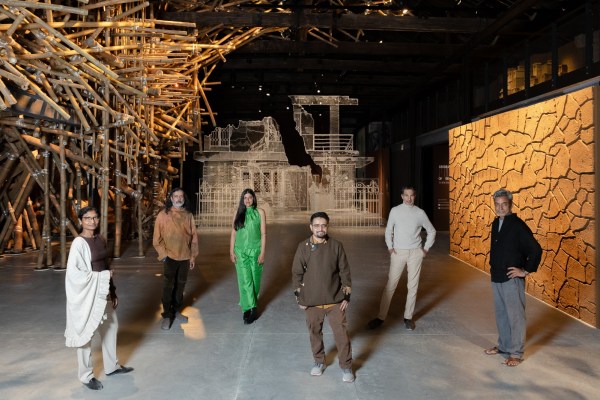 The artists at this year’s Venice Biennale. (Credits: Joe Habben)
The Ministry of Culture brought on board KNMA as the principal partner and financial backer, while CII managed co-organisation, corporate advocacy, and execution.
The presentation, titled ‘Our Time for a Future Caring’, explored the continued relevance of Gandhi in a world navigating conflict. Despite featuring works by leading Indian artists, including Jitish Kallat, Atul Dodiya, M F Husain and Shakuntala Kulkarni, the pavilion was largely dismissed by critics as “government-mandated”, “unoriginal” and “bureaucratic”.
Roobina Karode, Artistic Director and Chief Curator, KNMA, who curated the 2019 India pavilion, recalls feeling restrained. “I did bring it up with the ministry that a given theme wasn’t the standard practice for a national pavilion at Venice. I was told the funds were coming from ‘Gandhi’s 150 year commemoration’. So I convinced them that the curation must have a critical lens,” she says.
Part of the praise coming Jaffer’s way is in the perception that his curation at this year’s biennale feels “innovative” vis-a-vis the “safe” 2019 presentation.
Not everyone agrees, though.
Critics point to how India’s pavilion in 2011, curated by Hoskote, may have been far more radical. Hoskote had presented Desire Machine Collective’s Residue, a short film shot in a defunct thermal power plant on the outskirts of Guwahati, had taken a dig at the Indian State’s thoughtless and rampant industrialisation.
Though Jaffer explores similar themes, as New York-based critic Aruna D’Souza points out, “the show seemed determined not to offend. While both Waqif’s and Tashi’s work argued for reembracing regional architecture as a sustainable solution to the current climate crisis, I wouldn’t say either of the works can be called political, really.”
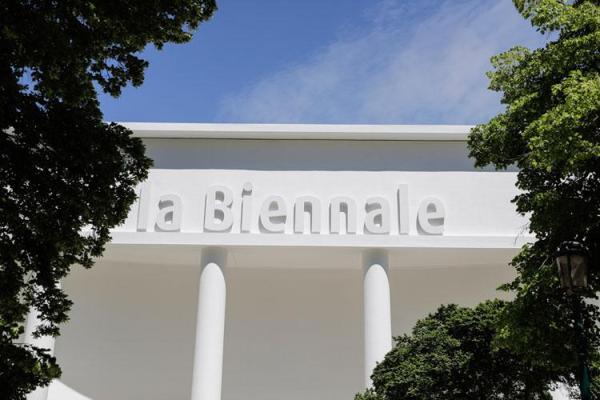 The entrance to the Central Pavilion, in the Biennale Garden (Credits: La Biennale di Venezia)
The Venice Biennale has a rich history of political subversion, with artists often using the state-funded platform to challenge their own governments. In 1993, artist Hans Haacke’s ‘Germania’ was an indictment of the German government’s inaction in the wake of racial violence against immigrants in the country.
Where does India go from here?
Despite these contradictions, the Venice Biennale and the soft power it represents make it vital for the country and its artists to be seen there.
“Continuity and consistency over time,” Buttafuoco notes, “certainly carry their own significance”.
Culture Secretary Aggarwal says India has already confirmed its participation in the 2028 edition of the Biennale. He says India now plans to build on the success of the biennale and is preparing to host its own India Art, Architecture and Design Biennale (IAADB) in Delhi from December 4, 2026, to March 21, 2027, and exploring the possibility of bringing the India pavilion from Venice to IAADB.
Sircar says that with India determined to go back to Venice, getting a permanent space at the biennale would not only be “more economical but… it compels you to return”.
However, getting a permanent space in the Giardini park is increasingly difficult. Besides the cost involved, the space itself is saturated and its historic status means building concessions are hard to get. Getting a space would thus require navigating a labyrinth of diplomatic, legal and administrative clearances, which is what Qatar did, in 2025. Before that, the last country to enter Giardini was three decades ago: South Korea in 1995.
A permanent address for the India pavilion may be a long shot, but the success of this year’s biennale may be a sign that Indian art can aspire for a home in Venice.
But then, as the handwritten note on a postcard left behind at the reception of the India Pavilion in Venice says, “Home — where is home? Does it travel with you? Do you remember the smell? To return to or build a home?”
KioskNews shows a cleaned-up reading view extracted from the publisher’s page — the original always lives on their site, not ours.