Labor suffered a cataclysmic defeat. The red flags were ignored in an expletive-laden rant
A heavy, hungover silence sat over the conference room as 71 contented Labor MPs dragged themselves into the Silverwater Resort, which looks across the San Remo cliffs towards Phillip Island.
It was February 2, 2023, and Victorian Labor had spent the summer basking in its third consecutive electoral triumph, one that had returned the party to government with a thumping parliamentary majority and given Daniel Andrews unrivalled personal authority and power. On the morning of the second day of the caucus retreat, a timeslot that traditionally follows a night of hard drinking and off-key karaoke, then-state secretary Chris Ford had been asked to address the room.
Having directed the 2022 election campaign, Ford decided it was an opportune time to deliver some hard truths about the result. He began by saying the party should be proud of its landslide victory, one that had defied predictions of a political reckoning as Victoria emerged from the social and economic dislocation of its long COVID winter. There were also worrying signs that needed everyone’s attention, he said, according to four MPs in the room.
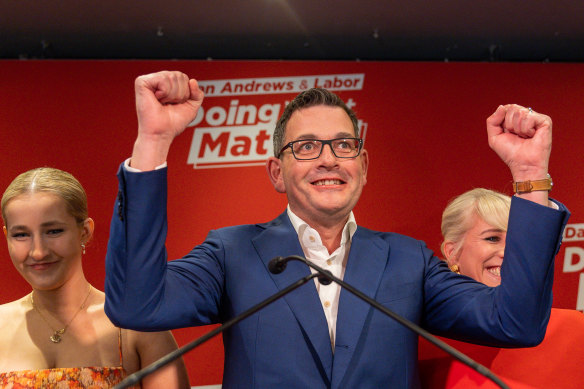
Key among these were sizeable anti-Labor swings recorded in seats in Melbourne’s west and north – suburbs deep in the party’s electoral heartland like Kororoit, Sydenham, Tarneit and Greenvale. He cautioned MPs against misreading an election which had kept the party in power but sent a clear signal that it needed to regain the trust of working people who had always voted Labor and were now turning away.
Some seats had been saved only by the strength of local campaigns, he said, pointing to Kat Theophanous’ win in Greens-heavy Northcote and Jackson Taylor’s swing towards Labor in traditionally liberal Bayswater.
From somewhere near the back, the familiar voice of one of the party’s longest serving MPs, then-energy minister Lily D’Ambrosio, piped up. She pushed back against the state secretary, demanding to know whether he was blaming MPs, rather than campaign decisions, for swings against the party.
After Ford finished his presentation and sat down next to Jacinta Allan, the deputy premier everyone knew was Andrews’ preferred choice to take the top job when he exited politics, D’Ambrosio approached Ford and went on with it. With Andrews and her fellow ministers looking on, she castigated Ford in an expletive-laden rant that accused him of insulting the caucus.
“People know that I’ve always stood up for my values and my community. After the last election, I was forthright in setting out my concerns – as did others,” D’Ambrosio told The Age when contacted.
The central dispute was whether Ford was palming responsibility to MPs for an issue that Labor headquarters should be addressing. Others in the room not too hungover to remember say that was not the point he had made.
Either way, no one in the room came to Ford’s defence. The schedule of the day quietly rolled on. Within two months, Ford had resigned as state secretary.
This story resurfaced in the dying days of a Labor government which, after 12 years, came to a crushing end on Saturday night in a perfect electoral storm that propelled 36-year-old Liberal leader Jess Wilson to power. It is an anecdote which reveals a deep fault line within the party, one that crosses factional lines, over what went wrong, who carries principal blame and how Labor should start to rebuild.
For those in the party close to former premiers Andrews and Allan, Labor’s drubbing comes down to the decision to oust Allan as leader just four months before the election and a campaign strategy that trashed their legacy and failed to talk up 12 years of achievements. “You build on that. You don’t throw that away and pretend it never happens,” one former MP said.
Those who backed Carroll and the leadership team he assembled said that by July, when corruption on government building sites was engulfing Allan’s leadership and the party, it had no choice but to change.
“The toxicity towards Jacinta had to be experienced to be believed,” said Stephen Conroy, a Right faction powerbroker who encouraged and backed Carroll to challenge for the leadership. “Some of it was unfair, but it was so bad. MPs knocking on doors were being told, to their faces, that they were corrupt.”
They also accept that the election was never going to be won or lost by a caucus vote four months out from polling day. “You can’t turn pig shit into strawberry jam,” one Labor figure reflected.
Gabrielle Williams, a senior minister who led the delegation of MPs into Allan’s office to tell her she had lost the confidence of her party room, says that to understand Saturday’s result, you need to go back to the last state election. She describes 2022 and the party’s misreading of the results as the first of several key inflection points for Labor.
“In 2022, we saw our heartland, our base, turn their backs on us in key locations,” said Williams, who served as deputy premier to Carroll.
“There was a sense in the lead-up to 2022, certainly by Dan, that the west would never abandon us. He just didn’t recognise it as an electoral problem. But we had MPs from those areas being really vocal, saying we have a serious problem, telling us that their communities felt like we’ve abandoned them. The answer shouldn’t have been to just point out the roads or train stations we had built or other major projects we’d delivered. There was a deeper sentiment that we weren’t appreciating and responding to.”
The Age has spoken to more than 20 party figures, some on the record and some on the basis of anonymity, to deconstruct the collapse of Labor. Their opinions fall largely on either side of the Andrews/Allan and Carroll divide, but there is also common ground over key decisions taken and others not taken which could made have made the difference between Labor merely losing an election and Saturday’s cataclysmic wipeout of its parliamentary ranks.
The singular figure who looms largest in this dispute is Andrews, the longest-serving premier in Labor’s history.
“We need to find a way where we can be proud of our legacy in government and acknowledge that Daniel was good at winning while reconciling that he was the source of our downfall,” a senior party figure said.
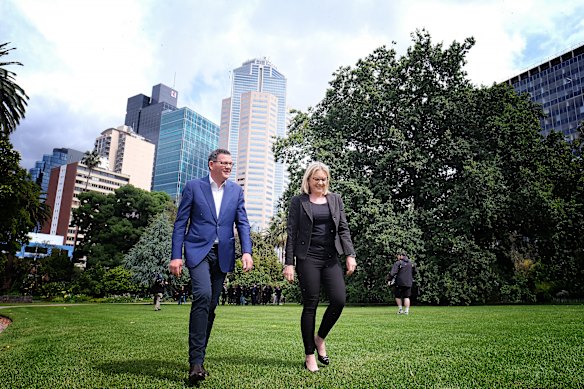
For his part, Andrews used a social media post on Sunday to boast of his government’s achievements, even as he acknowledged they were not perfect. “There’s plenty more to be proud of and to use as inspiration as we rebuild,” he said.
Williams’ three key inflection points are the response to the 2022 election, the manner in which Labor transitioned from Andrews to his chosen successor in Allan, and the false read taken on last year’s federal election result, when Allan and her supporters convinced themselves that it reflected ongoing public support for Victorian Labor and her signature project, the Suburban Rail Loop.
Others point to decisions taken by Andrews when he already had one foot out the door – such as loosening bail laws, a move Allan, against strong caucus resistance, then had to undo, and housing policies, which, by the time of the election, had become a middle suburb referendum on whether people wanted high-rise apartment towers looming over local shopping strips and six-storey developments on neighbourhood streets.
A transition without change
There is broad agreement in Labor that the party and Allan would have benefited from a leadership contest, including a vote among ordinary party members, when Andrews decided to quit politics in September 2023.
Another anecdote, which is disputed, speaks to the difficulty that Allan faced to step from beneath Andrews’ shadow, differentiate herself as a leader in her own right and send a clear message to Labor supporters who felt neglected by their own party that things would change.
Ben Hubbard, an experienced Labor operative who had served as prime minister Julia Gillard’s chief of staff and as an adviser to Victorian premiers Steve Bracks and John Brumby, returned to Spring Street shortly after Allan became premier to oversee the transition of her office. At least, that’s what he thought he was going to do, at the new premier’s request, according to two sources familiar with the episode.
Instead, he discovered that Andrews’ chief of staff Lissie Ratcliff and her deputy Jessie McCrone were still in the building and already doing his job. The idea that Andrews’ staff – even the wonder duo who ran his office with such commanding efficiency – could use his lingering authority to block the new premier from bringing in her choice of chief of staff borders on the bizarre. A third source closely involved in the 2023 transition ridiculed the idea. “Daniel was not on the phone to Jacinta every day,” they said. “It was her government and everyone was clear that she needed space to do that.”
Hubbard decided there was nothing for him to do and took his leave after a couple of days, while Ratcliff stayed on until the transition was complete. The problem for Allan – and for Labor voters frustrated with the direction of the party under Andrews – is that nothing changed. There was no major policy reset. There was no signal that Labor had gotten the message.
Flattening the margin
“In Victoria, haters hate and the rest vote Labor.”
That was Daniel Andrews’ assessment of the political landscape in Victoria as he enjoyed retirement in December 2023. The Resolve Political Monitor published by The Age had Labor’s primary vote on a robust 37 per cent. Exiled Liberal MP Moira Deeming had just lodged a defamation writ against then-opposition leader John Pesutto, a move which would destroy his leadership and rip fresh wounds into the only party capable of challenging Labor.
These were perhaps the last salad days of the state Labor government.
There were also problems starting to emerge for Jacinta Allan, whose likeability in the same Resolve survey had fallen to zero. And statewide polls do not tell the full story.
One of the remarkable things about Andrews’ victories in 2018 and 2022 were the gains made by Labor in the Liberals’ home patch in Melbourne’s eastern suburbs, like the unexpected pick-up of Glen Waverley in 2022. Despite Labor’s statewide primary vote declining from 42 per cent in 2018 to 37 per cent four years later, the party picked up two additional seats.
To the outside observer, the maths don’t add up. How can you lose so many voters and win more electorates?
A closer examination of the results show that as Labor became more competitive and successful in the east, it bled votes in the western and northern suburbs. In 2022, in one of Labor’s safest seats, Broadmeadows, the party had a 10 per cent swing against it. For the first time since 1964, the seat was decided by preferences. Like an electoral see-saw, Labor’s reduced primary vote found equilibrium by securing just enough support across a wide breadth of seats.
This is a phenomenon two Labor sources described as “flattening the margin”.
This left Labor with more seats, but a vote spread dangerously thin. In 2022, traditional Labor voters didn’t have another party to turn to. On Saturday night, One Nation dramatically changed the equation.
“Those voters who dumped Labor in a very significant way didn’t have anywhere to go,” Redbridge political analyst and ex-Labor official Kos Samaras said. “One Nation has turned up and provided them a place to go. Labor made a significant error in 2022 by not taking it seriously. Ben [Carroll] to his credit tried to pivot, but he was way too late.”
A glimpse of mortality
In early 2025, as Labor MPs were about to return to Spring Street at the start of a federal election year, a Resolve Political Monitor published by The Age showed that at a state level, primary support for the party had crashed to 22 per cent. This suggested that, in just over two years, two out of three people who voted for Labor at the 2022 election had abandoned the party.
Within Labor, the poll was dismissed as an anomaly and a rogue. When Prime Minister Anthony Albanese won the 2025 election, in no small part by picking up three additional seats in Melbourne, Allan stood on a stage outside Victoria’s Trades Hall and triumphantly declared that the popularity of her government and its signature project, the Suburban Rail Loop, had helped to keep federal Labor in power.
“The results are not despite what is going on in Victoria, they are because of what is going on here in Victoria,” she declared. The next morning, she was given a standing ovation by Labor MPs as she joined them at an SRL construction site.
This was the third of Gabrielle Williams’ inflection points.
In the same federal election, the seat of Bendigo – which takes in Allan’s old state seat of Bendigo East – recorded a 10 per cent swing against Labor. After Saturday night, Bendigo West and Bendigo East went from Labor to the National Party, with the ALP suffering a vicious, 25 per cent swing against it in the electorate Allan had held since the Bracks government first came to power at the end of the last century. This is part of a pothole revolt which saw regional voters in Geelong, Ballarat and Bendigo punish Labor for neglecting their needs.
Labor’s federal MP in Bendigo, Lisa Chesters, said voters were right to be angry. She wrote on Facebook: “During scrutineering, I saw that lots of Greens voters had preferenced One Nation and the Nationals, parties that want to scrap net zero, before Labor. That’s anger.
“The truth is, I was also angry at the state Labor government. For me it was their glacial pace of increasing government funding for public schools and their failure to educate Victorians about the dire state of Victoria’s privatised energy infrastructure.”
A royal mess
A counter-narrative within Labor is that, as difficult as things were looking under Allan’s leadership, the caucus and Carroll set the party on a path towards electoral oblivion when they removed the leader, called a royal commission into Big Build corruption, and started dismantling the legacy of the Andrews and Allan governments just four months before an election. It is an argument which gains strength the longer the count goes on.
In June this year, primary support for Labor under Allan’s leadership was at level pegging with the Coalition, on 26 per cent. As vote counting continued on Sunday, it was hovering at a historic low of 18 per cent.
Labor are resigned to being reduced to less than 10 seats in an 88-seat parliament. Victoria, when it swings against a government, often swings hard, but this is a wipeout on a previously unimagined scale. As one of Allan’s supporters noted, the party is going through a once-in-a-hundred years electoral disaster. “When people say it could have been worse than this, how exactly?”
Carroll agreed to take the leadership on the condition that the caucus would support a royal commission, and on his first day as premier, he announced he would establish one as quickly as possible. He campaigned on this decision as a virtue – that Labor was finally taking steps to clean up a mess that corruption campaigner Geoffrey Watson, SC, estimated had cost taxpayers somewhere in the order of $15 billion through inflated costs and corruption.
Labor’s Steve Dimopolous, a minister in the last government who might have been a leadership contender in the next parliament but is struggling to hang on to his own seat of Oakleigh, said the decision to call a royal commission should have been taken much earlier, or not at all.
He said the royal commission, and the evidence that public money invested in major projects had ended up in the pockets of bikies and criminals, crystallised the cost-of-living concerns of everyday people. He said one Labor voter confronted him at a voting place after reading that funding for disability assistance was being pulled from her children’s school. On the same day, she’d also read about a union official on a Big Build site putting in a fake invoice for $20,000 worth of souvlaki.
“We either should have called it a year and a half ago and finished by now, or we shouldn’t have called it all,” he told The Age. “But calling it now, I felt that was difficult.”
A Labor insider dismayed by the July leadership change said Carroll in his four months in the job acted less as premier than as another opposition leader.
“Every single criticism the Liberals have made of us, he has validated every single one of them since the day that he became premier,” they said. “He hasn’t just lost us seats, he has tied a noose around the neck of the next opposition leader.”
Another Labor MP pointed out that had Allan called a royal commission into corruption on government building sites when the Building Bad expose from The Age, The Australian Financial Review and 60 Minutes first revealed the severity of the problem two years ago, the commission could have completed its hearings and made its recommendations before the election.
“The only person to blame for trashing Daniel Andrews’ legacy is Jacinta Allan,” one Labor figure said.
Another said crime, debt and corruption were a “dangerous cocktail”. “Yet Allanists spent two years protecting themselves. This isn’t the Labor Party suburban families signed up for.”
Carroll’s critics have lambasted the campaign for talking about crime and corruption, rather than trumpeting the party’s legacy and its historical strengths.
Departing MPs say this argument is flawed when you consider the election promises that were broken after 2022. The Melbourne Airport Rail Link was delayed, the Commonwealth Games cancelled, and construction never started on three promised hospital projects at Arden, Maroondah and West Gippsland.
One senior Labor figure said crime was the biggest issue in their heartland, and the party had failed to neutralise it ahead of the campaign as it had in 2018. Health made 75 per cent of Labor’s advertising spending – but it failed to shift the dial.
Melissa Horne, another Labor minister in a tight battle to hold a seat previously considered unassailable – Joan Kirner’s and Steve Bracks’ old seat of Williamstown – said that by the time Carroll took over, Labor was doomed. “He hopped into the cockpit as the plane was already crashing and 500 metres away from the ground,” she said.
On this, Stephen Conroy agrees. “This is not something that has happened in the last four weeks or four months. This is four years in the making,” he said. “The signs were all there. In the western suburbs and the regions, they were screaming at us. We were just too arrogant to listen.”
False hope
Immediately after Ben Carroll became premier, Labor MPs door-knocking their electorates detected a shift in the mood. Whereas before, they couldn’t get past the stench of Big Build corruption to talk to voters about other things, the belated decision to call a royal commission gave them a renewed licence to return the conversation to local health services and schools. “We were actually able to have a conversation in a way that we hadn’t been able to for a long time,” Gabrielle Williams said.
This sense of relief among Labor MPs was fleeting.

The people who run Labor’s campaign machine do not put much faith in statewide polling. For their quantitative electoral research, they rely on a survey track of seats that the party has a realistic chance of winning – roughly the 56 seats it won at the previous state election. At the start of Carroll’s leadership, the party’s primary support on this track was sitting on about 24 per cent – a worrying but not catastrophic number.
When the Reserve Bank of Australia pushed the cash rate up at the start of September, the fourth rate rise of the year, any improvement that Carroll was making started to flatten. When the RBA pushed rates up for a fifth time at the start of this month, pushing up interest rates to an 18-year high, support for Labor measured by its own internal research started to crater.
Labor knew then that it was facing the significant loss of seats to the Liberal Party in Melbourne’s east and south-east, to the Nationals in Bendigo and potentially to One Nation in Melbourne’s west. And then, something happened which created an electoral nightmare. Left–leaning Labor voters in inner-city seats, perhaps the party’s only remaining reliable constituency, started to peeling off to the Greens and the Socialists.
“With a week to go, they’re not jumping on board, putting their hand up against the tsunami and going, ‘no, we’re sticking with Labor’. They are going, ‘it is time for them to go’. They’re getting on the bandwagon,” said a Labor source familiar with the party’s polling.
For Victoria’s dominant political party for the past 27 years, the final ignominy came on a rainy Friday after early voting was underway. Outside a polling place not far from the city, a Labor MP was handing out how-to-vote cards, her hair growing sticky in the rain, as workers from a nearby Big Build project walked in to vote.
They brushed past her without so much as a glance and headed straight for a One Nation volunteer to lodge their ballots for team orange. The MP was exasperated. “I’m like, guys, you only got this work because of a Labor government. They couldn’t have given a shit.”
Everyone, all at once, had given up on Labor. Whether the rot started four years or four months ago, there was nothing left to salvage.
Australia’s oldest political party has never been here before.
Read more on the Victorian election:
- Shuddering defeat: Labor won 56 seats in 2022. They’ll be lucky to salvage 10
- Seats that changed hands: Premier ousted, ministers wiped out in historic Labor rout
- Greens wave: Party celebrates early foothold with inner-city gains
- Victory party: Melbourne business elites who cheered Jess Wilson on
- Interactive: See how your polling booth voted in this election
KioskNews shows a cleaned-up reading view extracted from the publisher’s page — the original always lives on their site, not ours.