Qld corruption watchdog backs near total ban on political donations
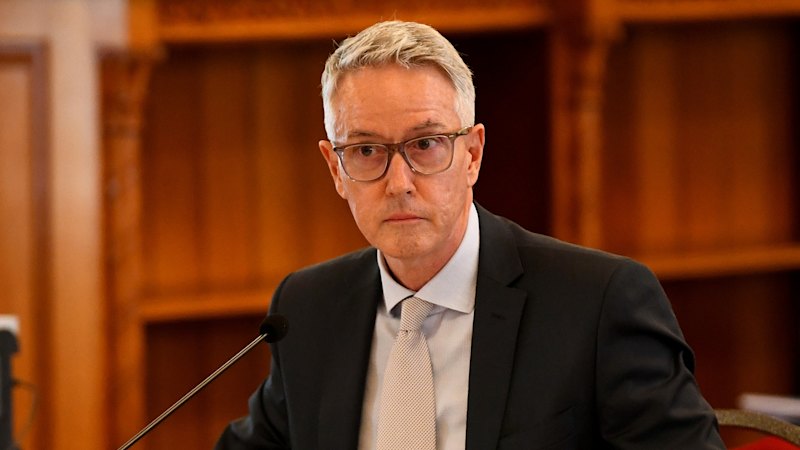
The head of Queensland’s anti-corruption agency has backed a near total ban on political donations, just months after a major relaxation of the state’s election funding.
Crime and Corruption Commission chair Bruce Barbour, appearing at a regular parliamentary hearing, made the comments amid MPs’ partisan questions about risks to the political process.
“I think the South Australian model, where elections are publicly funded and the system does not support donations for the purpose of elections … is something that is very interesting, and certainly worth consideration more broadly than South Australia,” Barbour said on Tuesday.
“I think whether it is unions, whether it is property developers, whether it is any other interest group or individual who has particular interests – paying substantial amounts of money automatically creates a perception that the purpose of those payments is to achieve some sort of access, which is not available to people who do not pay that money, and I think that’s a risk.”
The South Australian Labor government’s ban on electoral donations and gifts to registered political parties, MPs and candidates – passed two years ago and in place for the state’s election in March – also imposes election spending caps but allows limited donations for new candidates.
But some, including The Australia Institute, have criticised the public election funding push for being rushed and unfairly favouring the established major parties.
In February, Queensland’s Crisafulli LNP government unwound a ban on property developers donating to state politics – against the advice of the CCC – while also quadrupling the state’s cap on political donations to $48,000.
Barbour’s regular quarterly public meeting with the parliamentary crime and corruption committee saw him questioned by Labor MPs about last week’s $100,000 donation to the LNP by a family trust linked to the Lancini Property Group, revealed by this masthead.
The developer was recently selected by the government to develop prime state-owned waterfront land in Hamilton, which was previously earmarked for a 2032 Olympic athletes’ village, before the LNP accepted a call from the Games Independent Infrastructure and Coordination Authority – on whose board chairman Laurence Lancini sits – to explore alternatives.
The corruption watchdog boss declined to comment on the matter in case it ended up coming before his agency, but he reiterated general concerns about the risk of perceptions that people are “paying money for favours”.
“I anticipate there will be major issues raised at points of time with the CCC [around Olympic infrastructure, preparation and hosting matters], and so beyond talking about that in a general sense, that’s all I can really say,” Barbour said.
Government members of the committee then sought to draw Barbour on whether such risks extended to donations from unions like the CFMEU to the Labor Party, or more broadly around union roles in candidate selection.
“The moment there are meetings held in secret with significant players – whoever they are, whether they are property developers or whether they’re unions – and those are not adequately recorded, there is a perception in the community that they’re being done for some sort of nefarious process,” Barbour said.
“Now, that may not be the case, it may be entirely appropriate. But the perception is a very, very important indicator of community trust.”
After the Labor chair of the committee, Mark Furner, asked a further question about reports of the government cracking down on public criticism – drawing interjections by the government MPs – Barbour sought to steer things away from the “frustrating” behaviour.
“Frequently we come here to talk about our work, and what happens is we are asked questions which are clearly designed to cause political embarrassment from one side to the other, and that may well be the committee’s view that that’s a useful way for it to present its time,” he said.
“I won’t fall into that trap and answer questions which are designed to do that, and talk specifically about matters that may be before the committee and I have to make decisions on.”
Barbour declined to give specific responses to a range of other such questions throughout the public hearing, but also reiterated his agency’s “significant concern” about the government’s proposed removal of safeguards while expanding on-the-spot police domestic violence order powers.
“The concerns we’ve raised have not led to any proposed amendments or broad discussion,” Barbour said, also noting there had not been a meeting of relevant agencies to discuss the long-proposed independent police integrity unit since two were held in April.
Start the day with a summary of the day’s most important and interesting stories, analysis and insights. Sign up for our Morning Edition newsletter.
KioskNews shows a cleaned-up reading view extracted from the publisher’s page — the original always lives on their site, not ours.