Caryl Oliver obituary

My friend Caryl Oliver’s huge contribution to fencing spanned more than five decades, several continents and almost every aspect of the sport. Caryl, who has died aged 73 of cancer, believed passionately in the ability of fencing to bring people together.
She first picked up a foil at the age of 12 (women and girls were only allowed to wield the lightweight weapon in those days), having been told she was too old to train as an Olympic swimmer, and fencing instantly became her passion.
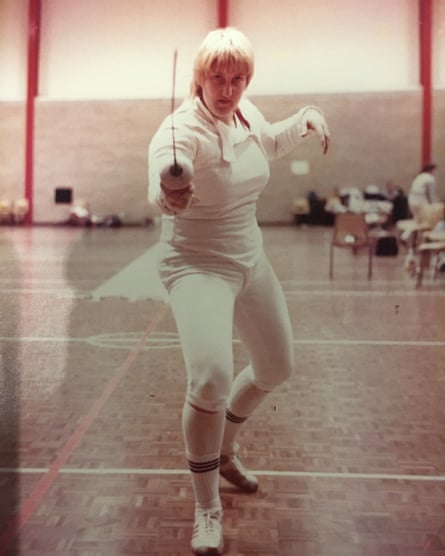
Caryl was born in Stockholm, to Paula and Raye Oliver, her father’s job as a marketing director for an international firm having taken the family to Sweden. Back in London she was educated at the Lycée Français Charles de Gaulle, where she became fluent in French.
By the early 1970s she was part of the Great Britain squad preparing for the 1976 Montreal Olympics, though eventually she missed out on selection by one place. Her reaction to this disappointment was typically radical: she left for Australia, initially thinking that fencing was no longer for her. That lasted just three months before she was asking for her kit to be sent to her new home in Sydney.
Her prowess as an organiser came to the fore there. She helped to run the successful 1979 world championships, served on the board of the Australian Fencing Federation and managed the first Australian team to tour China in 1981.
On the piste she switched to épée, a weapon much more suited to her physique and personality, and in 1988 she became Australian épée champion.
Her tourism business pushed fencing into the background for a few years until the Veterans World Championships arrived in Sydney in 2007. It did not take much to persuade Caryl to take up her weapons once more. She won the Australian and Oceania veterans épée championships in three successive years: 2008, 2009 and 2010.
At the 2009 Commonwealth Veterans Championships in Jersey, she won individual, age-group and team gold medals while representing Australia.
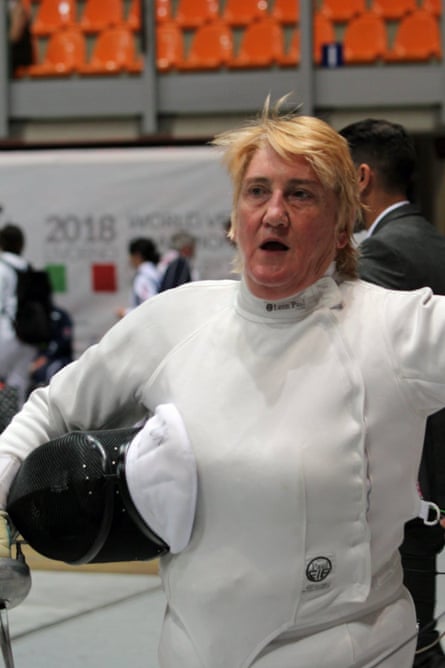
By this time, London was preparing for the Olympics, an opportunity that proved irresistible to Caryl. She whipped in an application to be fencing services manager and on hearing she was successful packed up 30 years of life in Australia and headed back to the UK. She set about recruiting an army of volunteers and sourcing equipment. The 2012 games fencing tournaments were a triumph of smooth organisation, with Caryl one of the linchpins.
As president of European Veterans Fencing (EVF) from 2016 she set up a packed circuit of competitions and created pathways for people to carry on fencing into their 70s and 80s.
She also stepped in to the breach when England Fencing faced an existential crisis, taking on the presidency in 2023 and securing its future, while nurturing stronger ties with British Fencing.
Caryl was a principled and often forceful woman, characteristics perfectly illustrated by her determination for EVF to retain the ban on Russians and Belarussians entering EVF competitions, even after the International Fencing Federation opened the door to them.
Her stoicism in the face of her long treatment for stage 4 breast cancer was another manifestation of that personal strength and resilience.
Caryl is survived by her long-term partner Anne Mills, whom she met at a fencing competition in Canberra in 1981, and by her older sister, Lizzie.
KioskNews shows a cleaned-up reading view extracted from the publisher’s page — the original always lives on their site, not ours.