In Pomuch, to honor the dead is to preen them
There are few places across the world where the dead are as ever-present as they are in Pomuch, a town in the municipality of Hecelchakán, in the southern state of Campeche.
Every Día de Muertos, the deceased are prepared for their return in a bittersweet process. While welcoming those who have left is cause for celebration, it is also a reminder that they cannot stay with us all year round.
In the words of Marisol Yam, the process is “very mystical, very intimate,” and “a way of loving the people who are no longer here.”
Marisol, or Mari for short, is a 29-year-old woman who has spent her entire life knowing this way of drawing close to the dead in Pomuch. For those unacquainted with this reality, the process might seem crazy. However, for Mari, it’s part of the commitments that exist with her family.
“For as long as I can remember, my grandparents always took us to the cemetery to visit our great-grandparents and a young cousin who passed away before his time,” Mari says. “To me, that was normal. Going to the cemetery to clean my great-grandparents, accompanying my grandmother to bring the candle, the flowers and the tablecloth, was normal.”
To be loved is to be taken care of
The people of Pomuch have a unique way of celebrating their ancestors.
With the utmost care and affection, families begin making preparations a few weeks before the Day of the Dead; they tell their deceased family members that it is time to start getting ready for the celebration, and an unexpected scene unfolds in Pomuch’s cemetery.
Under the loving hands of their families, the dead finally return to celebrate the union between both worlds. The bones that now rest in small carved wooden boxes — or ossuaries — acquire new life with each cleaning and feel that they have not been forgotten.
Preparing the bones for celebration
Among the graves, skulls and ribs begin to appear, delicately removed from their ossuaries so that the cloth in which they are wrapped — often decorated by a family member — can be changed.
From the archive: How Mexico’s Day of the Dead helps us remember the people we’ve lost
With the devotion of someone dressing a loved one, each household wraps the bones in lace and embroidered tablecloths, taking care not to seal the lids so the bones can catch a bit of air. In this revered tradition, death is merely another form of presence, and the bones, trapped between two worlds, still need the air to “breathe.”
“The family will decide what kind of tablecloth to put on (with little angels, flowers, their name, a character), whether they will sing to them, pray to them, if the whole family will go with the children or just mom and dad, if you want to tell them about your life and how you’ve been doing since they left. If you had them in life, you still have them in death. The only difference is that they can no longer see you, but they can hear you,” Mari explains.
She goes on to say, “Cleaning them before Oct. 30 is an absolute must, because Oct. 31 is the celebration for the children who are no longer with us, and Nov. 1 is for the adults. There is a belief that if you don’t go clean them, they become forgotten souls — souls whose families didn’t care or bother to prepare them for their celebration. On Nov. 1, they go out for a walk and are free to come visit us.”
When is the grave opened for the first time?
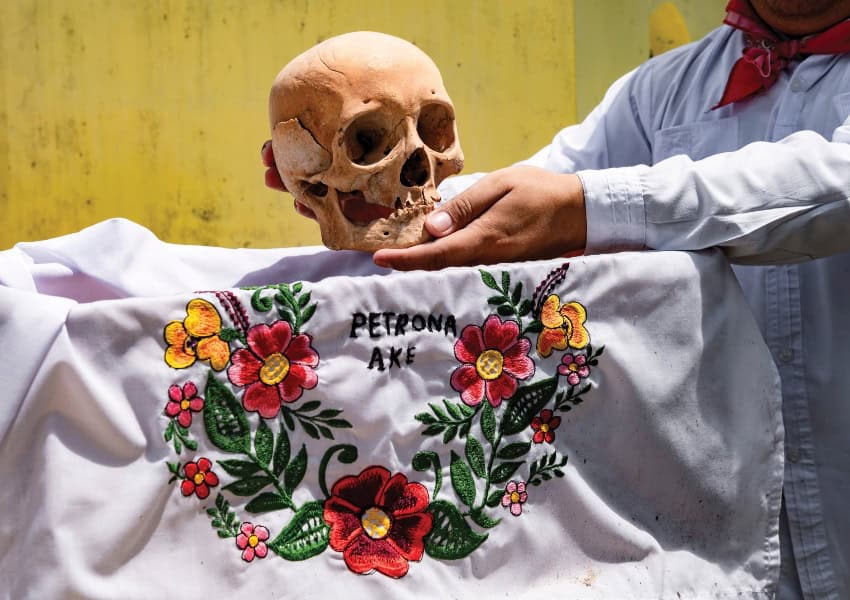
Although this ceremony takes place every year on the Day of the Dead, it does not happen immediately after a loved one passes away.
Mari says that “when a person dies, three years must pass before the family can exhume their remains.” She explains that for the cleaning process to be done properly, human remains must be reduced to bones, and the body must be completely decomposed.
“If after three years the body hasn’t decomposed,” Mari says, “they rebury it for as long as they deem necessary depending on its condition. There are families that sometimes take four or five years to exhume the remains. This can happen if the person who passed away took a lot of medication.”
The initial exhumation process
That first time they are taken out to transition from burial to ossuary is one of the most important moments for commemorating the family member’s life and cleaning their remains.
“The first turning point is when they come out. They open a wall of the vault to pull out the casket (some families pay the gravedigger or a mason to do it). Some people take them out at the exact time they passed away; others wait until the whole family is present,” Mari says. “And when they open the casket, if only bones remain, they begin cleaning them one by one — using a brush or a cloth — and place them one by one into a box similar to a shoebox, but slightly wider and taller.”
At that point, “They arrange the entire skeleton,” marking the “first moment of the tradition of cleaning them every year.”
Not only on the Day of the Dead
According to Mari, while the cleaning for the reception of the dead cannot be missed, it is not the only date when ancestors can be celebrated, spoken with and remembered. Throughout the year, each family decides how often they want to clean their loved one’s remains and on what dates to do so.
“The family decides when to go clean them: Do they visit for their birthday? They decide. Do they visit for a wedding anniversary? They might bring them flowers or candles. They can bring an object, a photo or introduce new members of the family to them.”
Celebrations outside the cemetery
As with all major celebrations, the commemoration is not confined to the cemetery. Just as altars are set up in other parts of Mexico, homes in Pomuch are filled with banquets for loved ones who are no longer here.
“My grandmother would always wake us up at 6 or 7 in the morning to set the table, buy ingredients and get ready.”
Mari recalls how she experienced the Day of the Dead as a child, and how it is lived in her home today: “In my house, when my little cousin is coming, we decorate with balloons and buy him a toy because that’s what he likes. We buy bread, fruit and set out water, hot chocolate, candied coconut, candied squash, candied plum and candied nance. It’s our little offering for him. He’s coming to eat.
“My dad puts food on the table for him at 11 in the morning, and when we are about to eat, he takes it away and says to him: ‘We are going to eat now; I hope you enjoyed the food we prepared for you today. You are welcome to come back whenever you like. Excuse us while we eat. If you’d like to join us, we left something on the table for you.’ My mom prepares food, making sure it’s yard chicken — the kind raised at home that you bought as a chick, and you decide if you’re going to slaughter it for those dates.”
A lifelong commitment of love
What might seem unsettling to an outsider is, for Marisol Yam and the families of Pomuch, the ultimate expression of love. It is a lifelong commitment that transforms a cold grave into a living, breathing dialogue.
Whether introducing a new baby to a great-grandparent’s bones or buying a toy for a cousin who left too soon, this tradition ensures that to be dead is still to be taken care of.
Lydia Leija is a linguist, journalist and visual storyteller. She has directed three feature films, and her audiovisual work has been featured in national and international media. She’s been part of National Geographic, Muy Interesante and Cosmopolitan.
KioskNews shows a cleaned-up reading view extracted from the publisher’s page — the original always lives on their site, not ours.