Singapore’s foreign policy based on realism, but it’s not just a passive observer: Tommy Koh
SINGAPORE – Just three years after Singapore gained independence, a young Tommy Koh learnt one of his most abiding lessons in international relations – might is right for powerful countries.
The law academic-turned-diplomat was barely a month into his posting as Singapore’s representative to the United Nations when the Soviet Union invaded Czechoslovakia.
Czechoslovakia was then aligned with the Soviet Union. But it was undergoing political and economic liberalisation, which Moscow was worried would lead to widespread rebellion in the Eastern bloc.
The invasion on Aug 20, 1968, took Czechoslovakia and the world by surprise.
“It was a shocking event that this superpower would send in its army to invade a smaller country and overthrow its government,” Koh said, recounting the episode in an interview with The Straits Times on Sept 15.
At the United Nations, he saw how efforts in the UN Security Council to pass a resolution condemning the attacks were repeatedly blocked by the Soviet Union and eventually quashed.
“You know, it makes you sit back and say, ‘Is there a role for law in a world governed by force and by power?’” Koh said.
Ultimately, it was a reality check for him.
“It made me aware that the world is not governed by law, but that powerful countries will use their power to assert their will, and that’s the reality,” he said.
But while such use of force might produce results in the short term, it rarely prevails in the long term, said Koh, 88, Singapore’s longest-serving diplomat who retired at the end of August after 55 years in the foreign service.
History has shown the limits of power, he added, citing America’s loss in the Vietnam War that lasted from 1954 to 1975, and the Soviet Union’s withdrawal from Afghanistan in 1989 after a decade-long invasion.
The Czechoslovakia invasion, coming early on in Koh’s career, solidified his resolve to defend international law and the rule of law.
This has become especially important in the current climate, as major global powers increasingly flout multilateral rules through the use of force, and undermine key international institutions.
For Singapore, it is about survival, as international law provides the legal framework for a small country to defend their sovereignty against arbitrary action by bigger countries.
“Of course, they will continue to do things like kidnapping (former president Nicolas) Maduro from Venezuela. I suppose when you are very powerful, you are tempted to use your force,” he said.
“(But) I’m clear in my mind. I don’t want to build a world governed by force. I want to build a different world… governed by the rule of law. I want to build a world in which countries cooperate with each other. I want to build a world in which we will protect the global commons.”
Koh, a principal architect behind major international agreements like the UN Convention on the Law of the Sea (UNCLOS) and founding chairman of the Centre for International Law, added that the world must not accept the flouting of international law by powerful countries as reality.
“Sure, you will do this, but I’m not accepting it. I’m telling you what you’ve done is wrong. I hold you to account,” he said.
Countries have agency. This is true even for a small country like Singapore, which hews to the principle of taking the world as it is, he said.
As examples of how Singapore has pushed back, Koh pointed to the Republic speaking out in August against Israel’s plans to build more residential settlements in the West Bank, which are illegal under international law.
It was important for Singapore to call out the illegal settlements and settler violence against Palestinians, he added.
“Israel is militarily very powerful… but it doesn’t mean that Israel can do whatever it wants. And it doesn’t mean that because we are a good friend of Israel, we must either support Israel no matter what it does, or keep silent,” he said.
In the past, Singapore had condemned Vietnam’s invasion and occupation of Cambodia in 1978 and led a concerted effort to table an annual resolution at the United Nations General Assembly to call for the withdrawal of the troops over 10 years.
Singapore had also condemned the Soviet Union’s invasion and occupation of Afghanistan in 1979 and the United States’ invasion of Grenada in 1983.
While Singapore’s foreign policy is based on realism, it does not mean that it is just a passive observer of reality, he said.
“Accepting the world as it is doesn’t mean that we have no agency… we will push back, and we will have the courage to hold the big countries to account,” said Koh, who had delivered Singapore’s statement about Grenada at the UN all those years ago.
As a diplomat, Koh said he has held the two principles in balance – recognising the reality of the world, while working hard to defend Singapore’s sovereign rights and principles so as to ensure its agency.
To this end, one of Singapore’s most important contributions to international relations is the Forum of Small States, said Koh.
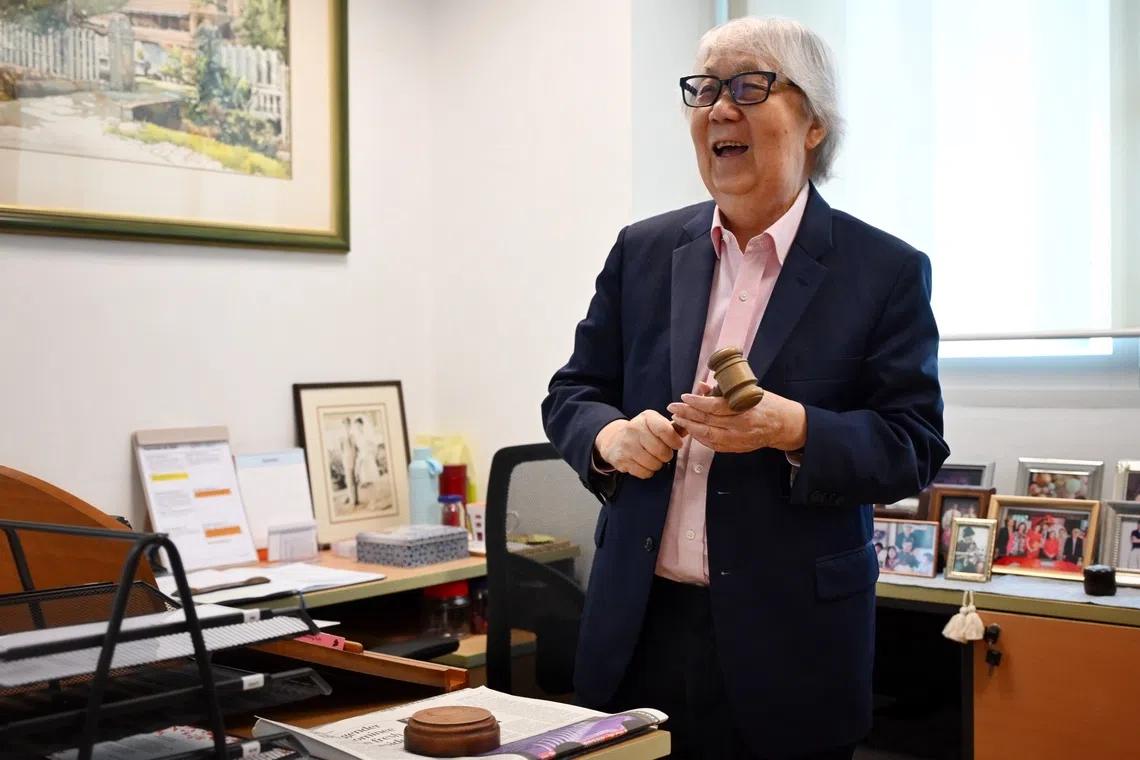
Koh, as a diplomat, has held the two principles in balance – recognising the reality of the world, while working hard to defend Singapore’s sovereign rights and principles so as to ensure its agency.
ST PHOTO: KUA CHEE SIONG
In 1992, Singapore co-founded the informal grouping of small states in New York, with an initial membership of 16 countries. Today, it comprises 108 countries which meet regularly to discuss issues of concerns to small states.
Before this, small countries had no platform of their own and were disadvantaged in a world that favours the big over the small and the strong over the weak, said Koh.
By bringing the countries together, the forum has allowed them to amplify their voice and increase their leverage, he added.
Things could well have worked out differently for Singapore in 1991.
When the Cold War ended with the formal dissolution of the Soviet Union, and the world was left with one superpower in the United States, the Ministry of Foreign Affairs held a major brainstorming exercise.
The question Singapore was grappling with then was whether it should become an ally of the remaining one superpower, or stay independent.
Recounting the brainstorming session, Koh said there were good arguments for both options, but the eventual consensus was for Singapore to be close to the US but not aligned with it.
Allies are obligated to defend each other, he explained, and this can constrain Singapore’s ability to speak out according to its own principles.
“We wanted to maintain our autonomy and our room for manoeuvre,” he said.
“Looking back on 1991, I think we made the right choice.”
As the global order moves towards more multi-polarity, this will be important for Singapore, he said.
Koh believes that China, now a prospective superpower, will become a complete superpower and a rival to the United States.
But the two countries will not be the only poles. There will also be other spheres of influence, such as the European Union, Tokyo, New Delhi, as well as the BRICS developing countries among others.
With autonomy, Singapore can better uphold its principles and act in its own interests even as the world gets more complicated, he added.
But Singapore’s external strength and sovereignty also depend on domestic unity.
Koh said the Government must be able to convince Singaporeans that its foreign policy is correct and serves the national interest.
For example, in the contest for influence between the US and China, Singapore has not chosen to take sides. Yet, there may be some Singaporeans who believe Singapore should support China.
In the same way, some Singaporeans may feel that Singapore should take a stronger position against Israel in the Gaza war that broke out in 2023.
“So it is the job of the Ministry of Foreign Affairs and the whole of government to convince our own people, that our policy is correct, that at the end of the day, we mustn’t allow our emotions to override our rationality,” he said.
Besides building consensus back home, Singapore has also continued to build bridges abroad, such as by continuing to champion multilateral organisations and cooperation.
The majority of the 193 member states of the UN still believe in the importance of the international organisation, said Koh.
While countries have violated the UN Charter and damaged the system – the Russians by invading Ukraine, the US by waging a war against Iran without just cause, and Israel by its excessive actions in Gaza – the treaty is still “standing tall”.
“They don’t represent the world,” said Koh of these countries. “It is true that a few member states have become disenchanted. They are important, but they are a minority. The rest of us will carry on without them.”
Koh added that the US is doing itself harm by withdrawing from so many multilateral platforms, such as the Trans Pacific Partnership, the Paris Agreement and the World Health Organization.
“My message to my American friends is: You are important, but you’re not indispensable, and the rest of us will carry on without you. The danger is that we will have a world without America. Not good for the world, and not good for America,” he said.
Closer to home, there is also ASEAN, which is another platform Koh has championed.
When the grouping was founded in 1967, South-east Asia was poor and unstable, with insurgencies in many of the countries.
Since then, the region has become stable and prosperous and has been transformed, he added.
“We have inculcated in us a culture of consulting each other, seeking to accommodate each other’s view, and we have an ability to, most of the time, find a consensus,” said Koh, noting that there is no such successful regional organisation for North-east Asia or South Asia.
“So we (ASEAN) are not perfect. But when I look at ourselves and look at other regions of the world, I’m just so glad that we (Singapore) are located here.”
He added that ASEAN is a force for peace, which has intervened when disputes arise between its members.
Most recently, when fighting erupted between Cambodia and Thailand on their border in 2025, ASEAN had stepped in to try to help defuse the tension.
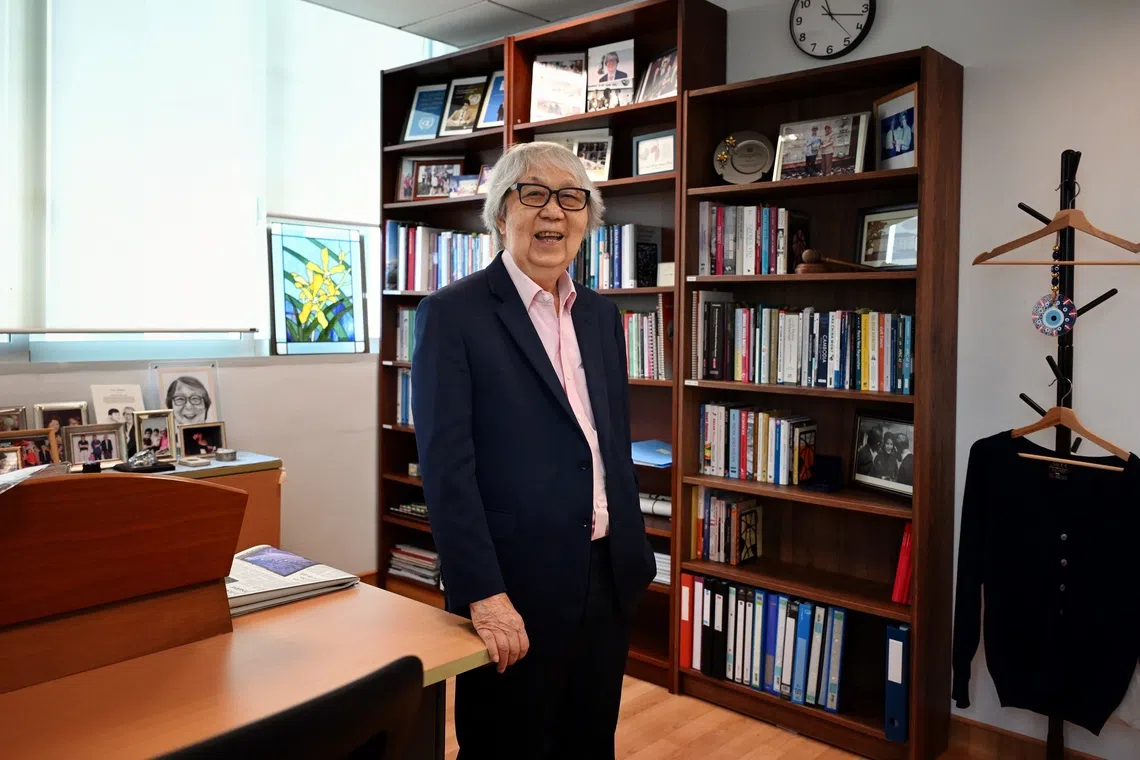
Koh said the government must be able to convince Singaporeans that its foreign policy is correct and serves the national interest.
ST PHOTO: KUA CHEE SIONG
The two countries also have a dispute at sea, and are engaged in conciliation talks under UNCLOS.
Even then, ASEAN has come under criticism in recent years, as the 11-member regional grouping deals with a deadlock caused by Myanmar’s military coup in 2021 and ongoing civil war.
An ASEAN-backed peace plan has failed to end the war, leading some critics to cast doubt about the grouping’s effectiveness.
Asked about this, Koh said the problem in Myanmar is not interstate, but intrastate, and the result of a military coup staged by the army against Myanmar’s elected government.
“We can’t solve the problem. The Myanmar people must solve their own problem. All we can do is encourage them,” he said.
But he admitted that ASEAN is divided on whether or not to recognise Myanmar junta chief-turned-president Min Aung Hlaing, who led the military coup and remains barred from the official ASEAN leaders’ summits.
Within ASEAN, Thailand, Vietnam, Cambodia and Laos have hosted him on bilateral and official visits, which critics warn runs the risk of providing legitimacy to his military-run government.
Myanmar will be on the agenda as Singapore takes over the ASEAN chairmanship in 2027, and unless the military is willing to have a fundamental rethink of the use of force, ASEAN is likely to be at an impasse, he said.
Still, Koh remains a supporter and believer of ASEAN’s consensus model, which is based on consultation and unanimity, rather than majority voting,
He said there was only one occasion in ASEAN’s history – the grouping marks its 60th year next year – that it had failed to adopt a joint communique.
That happened when Cambodia, on behalf of China, decided to block the adoption of a paragraph on the South China Sea in the official document released after the annual ASEAN Foreign Ministers’ Meeting that outlines the grouping’s consensus.
“But I think Cambodia learnt the lesson that it shouldn’t act as a proxy of China, and after that, we’ve never had problem adopting or joint communique. So consensus works,” he said.
Koh, who is known for his personal approach to foreign relations and often refers to his counterparts as friends, added: “We shouldn’t take decisions by vote because it will destroy the family.”
This non-confrontational approach is also favoured by Koh in the civic realm at home.
Widely seen as one of the Singapore government’s foremost “loving critics” – a term he coined in asking the Government not to reflexively dismiss those with dissenting views – he said being confrontational may work in other countries but not Singapore.
“Being adversarial is not our style. Confrontation is not a technique that works in Singapore. It’s better to be persuasive,” he said.
He cites AWARE and Nature Society Singapore, which he is a patron of, as non-governmental organisations that have been effective and successful in championing their cause by harnessing facts, rational arguments and persuasion.
On the health of Singapore’s civic space, he said while Singapore has many strengths, one of its weaknesses is the “relatively low tolerance for people with different views or dissenting views”.
While the space for intellectuals and artists have expanded over the past 61 years, Singapore could do better, he added.
“If you look at the trajectory, I think we are growing towards greater tolerance, more acceptance… the trajectory is in the right direction.”
KioskNews shows a cleaned-up reading view extracted from the publisher’s page — the original always lives on their site, not ours.