Study shows benefits of hospital mattress project
MOVING PATIENTS: The devices are not to replace manual repositioning, but they are a vital assistant to nurses, helping them save time, an NTUH official said
By Lee I-chia / Staff reporter


Automated repositioning air mattresses for critically ill patients can improve pressure injury prevention and reduce the physical burden on nurses who manually reposition patients every few hours, National Taiwan University Hospital (NTUH) told a news conference on Wednesday.
NTUH superintendent Yu Chung-jen (余忠仁) said that people in critical care or intensive care units (ICUs) are often severely ill, connected to medical devices and tubes, or are unconscious and unable to reposition on their own.
If they remain in the same position for too long, they become prone to pressure injuries that can lead to severe infections, Yu said.
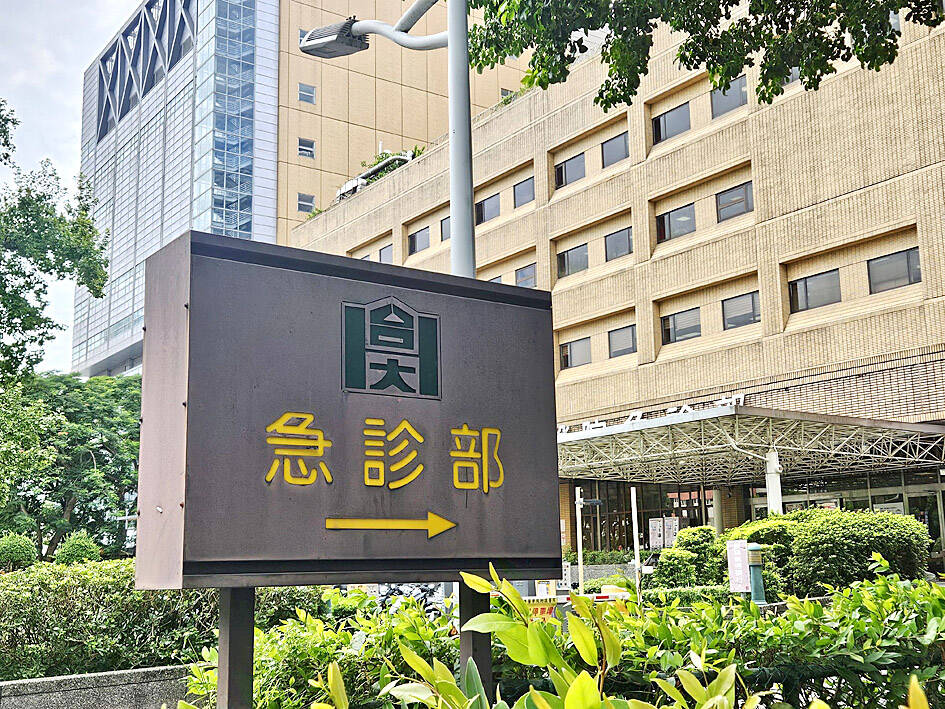
A sign for National Taiwan University Hospital’s emergency department is pictured in Taipei in an undated photograph.
Photo: CNA
ICU staff typically reposition patients every two hours, he said.
It is not an easy task, especially with tubes attached to patients’ bodies, he said, adding that it often requires two or three nurses to work together to complete the task.
To address the challenges, NTUH said that its nursing team launched a clinical research project on an automated repositioning air mattress.
The project involved codevelopment, clinical testing and improvements to the devices, it said.
A study conducted in the ICUs of the hospital’s internal medicine and neurosurgical departments garnered data from use of the devices with 424 critically ill patients, it said.
Following the introduction of automated repositioning air mattresses, reports of pressure injuries fell from 4.7 percent to 2.9 percent; nurses’ workload associated with repositioning patients was reduced by 69 percent; while time spent on repositioning was shortened by 53 percent, NTUH said.
The proportion of repositioning procedures that could be completed by a single nurse increased to 91.8 percent from 36.7 percent, it added.
NTUH nursing supervisor Hsiao Wei-ling (蕭偉伶) said that manually repositioning patients can sometimes cause occupational injuries, such as lower back, shoulder and neck strains.
It is essential that medical lines and tubes connected to patients remain unaffected during the process, Hsiao said.
Introduction of the mattresses, with collaborative feedback from the hospital based on clinical needs, has allowed low-risk patients to be automatically repositioned every two to three hours without requiring any human intervention, she said.
For patients with higher risk of pressure injuries, a nurse needs to first adjust the patient’s position before using the automated machine to help perform the turn, but it only requires one nurse to complete the task, she said.
NTUH’s Department of Nursing said the mattresses are not intended to replace professional nursing care or all manual repositioning, but rather serve as an important assistant to nurses, helping them reduce the time and physical effort required to reposition patients, which gives them more time to attend to other patient care needs.
The hospital thanked Wellell Inc for donating 20 automated repositioning air mattresses to the hospital’s 3C and 4A ICUs.
Minister Without Portfolio Chen Shih-chung (陳時中) told the news conference that compared with pharmaceutical clinical research, medical devices are often overlooked because Taiwan’s medical device market is smaller and has high entry barriers for implementation in clinical settings.
The collaboration between NTUH and Wellell Inc serves as a model for industry-academia cooperation, Chen said.
Clinical-based empirical studies are crucial for developing Taiwan’s smart medical devices and promoting them globally, so the government would help open hospital clinical settings to promising and innovative smart medical devices, he added.
KioskNews shows a cleaned-up reading view extracted from the publisher’s page — the original always lives on their site, not ours.