Weeping whales: why one humpback whale mother stayed beside her dead newborn
One day last July, a newborn humpback whale calf lay motionless on the seafloor, just a kilometre off Australia’s Gold Coast. The encounter was captured through underwater video.
For more than an hour, the mother repeatedly returned to the same spot, gently touching the calf with her head and pectoral fin and resting beside it eye-to-eye. Our new research suggests this is the first described case of a humpback whale mother caring for her deceased newborn calf.
The encounter offers a rare window into one of the least understood aspects of whale behaviour: how these highly social animals respond to death.
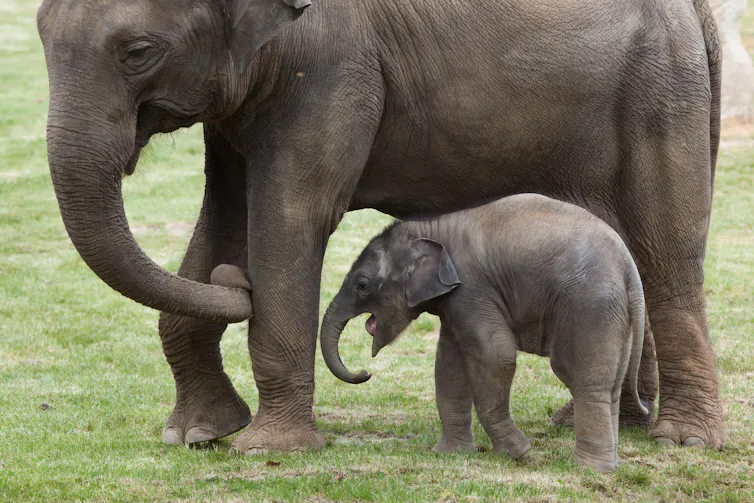
And it raises the question: do whales, and other highly social animals such as elephants, grieve?
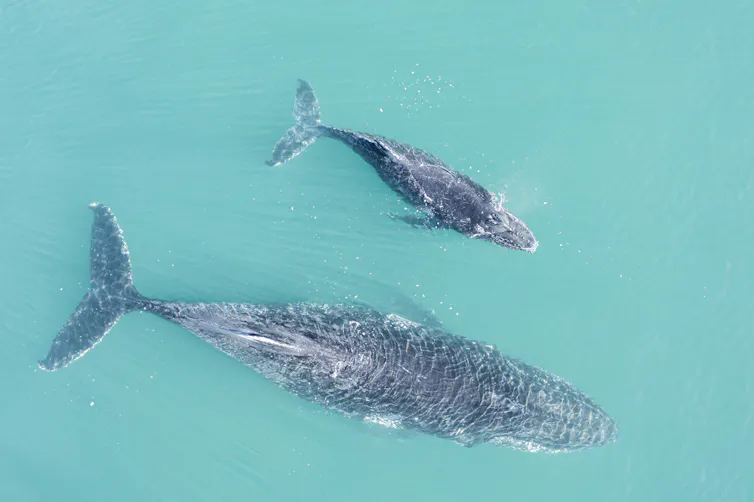
Caring creatures
Humpback whales are famous for their spectacular migrations and acrobatic breaches. However, they are equally remarkable for the way they respond to other animals in distress.
Humpback whales often defend their calves from killer whales. Researchers have also observed them remaining alongside whales that are injured or entangled in nets, circling them, resting nearby and attempting to assist. Humpback whales may even intervene when killer whales attack seals, sea lions and grey whale calves.
These responses of care and attention are known as epimeletic behaviour and are common among cetaceans, a group of marine mammals including whales, dolphins and porpoises. Dolphins and killer whales often remain close to distressed companions, evidence of their strong social bonds. These animals may even risk their own lives for others. This happened in April off Scotland’s northwest coast, when multiple pilot whales became stranded after following a birthing female.
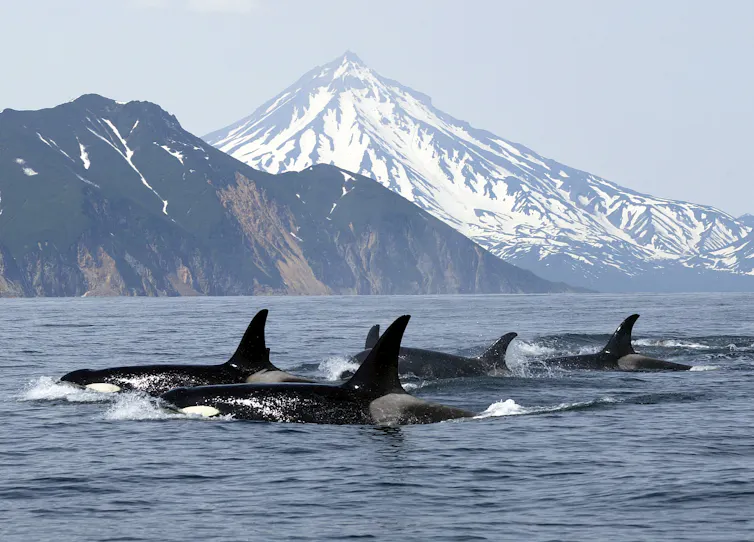
Read more: Whale of a problem: why do humpback whales protect other species from attack?
When a whale loses a calf
Killer whale mothers have repeatedly been observed carrying their dead calves for hours, days and, in exceptional cases, weeks. The most famous example is the killer whale Tahlequah, who in 2018 carried her dead calf for 17 days over more than 1,500 kilometres. Scientists have observed similar behaviour in pilot whales and dolphins.
Such prolonged responses illustrate the strength of the bond between mother and calf. Maternal instincts and hormonal changes after birth may contribute to mothers remaining with their deceased offspring. But exactly what the animals understand about death remains unknown.
Until now, scientists have almost exclusively documented these epilemetic behaviours towards deceased calves in toothed whales. The research on baleen whales, including humpback whales, is scarce. This is likely because dead newborn baleen whales often sink quickly, making it extremely difficult to observe such cases.
Humpback whale mothers give birth after almost a year of pregnancy and spend the next few months feeding their calf with nutrient-rich milk. Right after the delivery, mothers often lift their calf to the surface to help it take its first breath. During the first months of its life, a calf relies entirely on its mother for nourishment, protection and guidance during migration.
Tragically, some calves don’t survive. This may be due to disease, pollutants or a mother’s lack of fat reserves that help female whales cope better with pregnancy and better care for their calves.
Read more: What the grieving mother orca tells us about how animals experience death
A first for humpback whales
Our new study aimed to help fill this research gap.
We observed two adult whales off the Gold Coast of northeast Australia. The two whales stayed in the same area for several hours, after what appeared to have been a stillbirth. The female humpback whale released an ammoniac membrane shortly after the birth, but a placenta was not seen.
Underwater footage revealed the calf resting motionless on the seafloor while the presumed mother repeatedly approached it. She remained close to the calf, continuing to touch it with her head and pectoral fin. A second adult whale, likely an escort, also stayed nearby.
The humpback mother did not try to lift the calf to the ocean’s surface. This may indicate that she recognised the calf had died or was unable to carry it up from the seabed.
Members of the public reported two adult humpback whales remaining in the area over the next two days. However, our research team could not confirm they were the same animals.
Do whales grieve?
To our knowledge, this is the first detailed scientific study of a humpback whale mother attending her deceased newborn calf. It provides crucial insight into how baleen whales cope with death.
Many of the behaviours we observed – including remaining close to the calf and suspending normal behaviours such as travelling or socialising with other whales – resemble how other species respond to death. Elephants, great apes and some toothed whale species care for dead offspring in similar ways.
However, we can’t directly measure the emotional state of whales. The behaviours we observed could represent grief, but they could also reflect maternal attachment, confusion or instinctive caregiving. For this reason, researchers use broader terms – such as post-mortem attentive behaviour – rather than concluding that whales grieve in the human sense.
Nevertheless, these behaviours reveal that humpback whales maintain strong maternal bonds even after the death of a calf. Our study suggests similar cases may have gone unnoticed because scientists rarely observe whale births at sea.
In good news, researchers are increasingly able to observe these animals as whale populations recover and scientific equipment makes at-sea studies more feasible.
So while there’s much more to learn about whales, their emotional lives may be infinitely more complex than we once imagined.
Read more: Humpback whales may have bounced back from near-extinction, but it’s too soon to declare them safe
KioskNews shows a cleaned-up reading view extracted from the publisher’s page — the original always lives on their site, not ours.