Within minutes: How quickly a scam site can be taken down under newly formed Cyber Command
SINGAPORE – If a website, phone number or social media page is linked to a scam, Special Constable Sergeant Javier Lau of the police’s Cyber Command can take it down within minutes.
Previously, the process could take up to several hours, as Lau and his team would need to coordinate across multiple departments in the Singapore Police Force.
Lau, 22, a cybercrime operator and a full-time national serviceman, was among several officers from Cyber Command who spoke to the media on Sept 16, two months after it was launched on July 3.
He said when a site is reported, they would assess whether it is malicious.
He added: “We would document our findings, and support follow-up actions that are required to disrupt the websites. The tempo is quick, especially during an active scam campaign. In those moments, we must work fast yet make sure that every case is thoroughly assessed.”
Scam victims in Singapore lost $410.6 million in the first six months of 2026, with scam losses here hitting over $4 billion since 2019.
In the first half of 2026, the police disrupted over 47,000 scam-related mobile lines, 37,500 WhatsApp lines, 31,600 online monikers and 52,200 malicious websites.
When asked about common scam trends, Lau said scammers often impersonate news outlets, including The Straits Times and CNA, to promote investment schemes and cryptocurrency sites, to phish for contact information.
He said: “To the untrained eye, it can be quite convincing because it mirrors CNA and ST, but the content on the site is different.”
When the site is assessed to be a scam, Lau and his team will contact the relevant Internet service providers to take it down before more get duped.
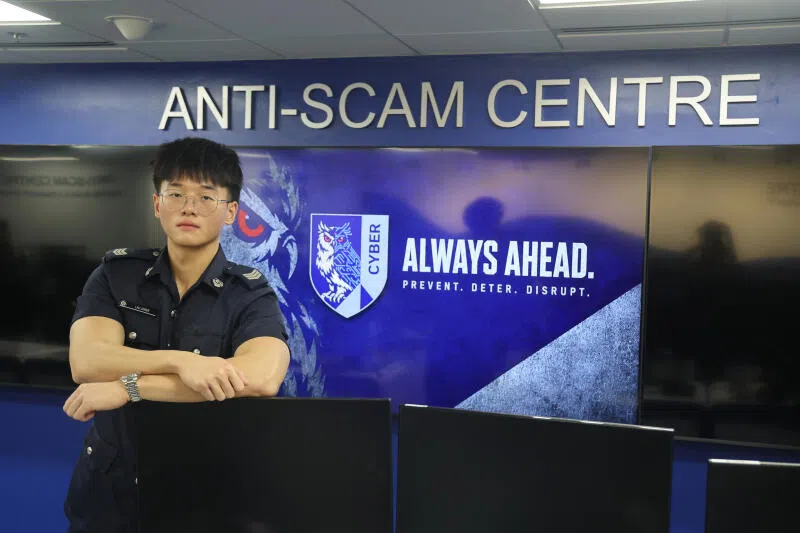
Special Constable Sergeant Javier Lau said once a site is reported, his team assesses if it is malicious.
PHOTO: LIANHE ZAOBAO
Said Lau: “This matters because scam websites can harvest victims’ details within minutes of going live.”
Another officer, Assistant Superintendent of Police Nicole Morgan, 30, works with foreign law enforcement agencies and internal partners to fight cybercrime and scams.
She said Cyber Command helps with quicker decision-making.
Referring to a case in July, Cyber Command and the Federal Bureau of Investigation prevented losses amounting to US$2.7 million (S$3.5 million) in the US and $388,000 in Singapore in a joint operation targeting transnational cryptocurrency scams.
The agencies identified 54 victims and potential victims of scams in both countries.
Morgan said: “Scam syndicates can move funds, change communications channels, replace infrastructure, and relocate their members very quickly. For intelligence to be operationally useful, it must reach the correct agency and operational team in time for action to be taken.”

ASP Nicole Morgan works with foreign law enforcement agencies and international partners to strengthen cooperation against cybercrime and scams.
PHOTO: LIANHE ZAOBAO
She added this can be challenging as every jurisdiction operates under its own legal and procedural framework.
On Sept 9, the Scams (Countermeasures) and Other Matters Bill was passed, making it an offence to provide one’s personal details to supply online accounts on Carousell, TikTok, Telegram and Meta’s platforms to criminals.
Senior Minister of State for Home Affairs Goh Pei Ming had said then the police receive on average 90 reports of scams involving $2 million lost daily.
He added: “Scammers will continue to adapt, and so must we. Our response must be sustained, coordinated and always forward-looking.”
Lau said his work is meaningful as it has a direct impact on scammers.
He added: “Much of it happens behind the scenes, but acting quickly can shrink a scammer’s window of opportunity and stop more people from becoming victims.”
KioskNews shows a cleaned-up reading view extracted from the publisher’s page — the original always lives on their site, not ours.