‘Cut the umbilical cord’: Bougainville’s bid to break away from Papua New Guinea faces reckoning
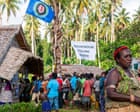
For decades, the distant island of Bougainville has fought for secession from Papua New Guinea, for a future as an independent nation of its own.
This week, that long-running aspiration faces further challenge, with PNG’s parliament slated to debate the ratification of Bougainville’s 2019 UN-sanctioned referendum, in which nearly 98% of Bougainvilleans voted for independence.
That referendum was a key element of the 2001 Bougainville Peace Agreement, which ended a 10-year long civil war estimated to have killed as many as 15,000 people.
Even as violence has reemerged around the controversial Panguna mine – a catalyst for the conflict, but now seen as critical to the island’s independent financial future – Bougainville’s government has insisted it will not be deterred from secession. It has committed to “self-government” from next year, and to breaking away from PNG, as a fully fledged independent nation, by 2030.
Sources in Port Moresby and Bougainville say they expect the independence referendum result to be rejected on the floor of the PNG parliament, given the threshold for ratification has been raised to three-quarters of all MPs, not the two-thirds usually required for constitutional amendments.
The autonomous island of Bougainville, PNG’s easternmost province and about 1,000km from the capital, is home to about 300,000 people, culturally and ethnically distinct from the rest of the PNG archipelago. It has for decades, sought to break free of rule by Port Moresby.
Divided opinion
Port Moresby has long resisted acting on Bougainville’s post-conflict independence, anxious not to establish a precedent for the break-up of PNG’s vast and culturally diverse archipelago, or to lose a resource-rich and potentially lucrative province.
Bougainville’s attorney-general and vice-president, Ezekiel Masatt, said that the MP vote threshold was “crafted” by the PNG government to defeat the vote.“There is a national government strategy to poison the waters and make it impossible to come close to reach the voting threshold,” he said in a June statement.
Opinions in PNG’s parliament were divided ahead of the referendum vote.
Dr Allan Marat, chair of a bipartisan committee on Bougainville matters, told parliament last month that the island had met all the conditions outlined in the 2001 peace agreement and deserved its independence.
“It seems there is only one humane option for us members of this honourable house to do … to cut the umbilical cord connecting baby ‘Bougainville Independence’ to PNG,” he said.
Others are fiercely opposed. Former deputy prime minister Belden Namah, who served in the PNG army during the Bougainville conflict, said the question went beyond a political debate.
“It is an issue of national sovereignty, it is an issue of constitutional integrity, it is an issue of peace, unity, sacrifice and the future survival of Papua New Guinea as one nation,” he told the same parliamentary sitting.
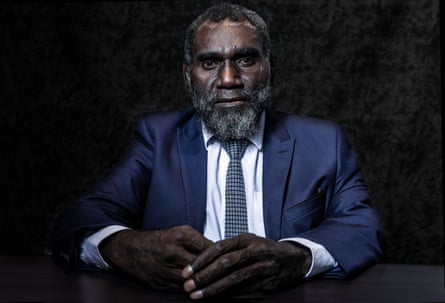
In June this year, Bougainville’s president Ishmael Toroama presented his government’s “final position” on the island’s political future.
He said Bougainville would enter a stage of “self-government” from 1 September 2027, before declaring itself independent “separate from the state of PNG” in 2030.
Toroama said he did not want a return to violence or conflict with Port Moresby. “Our objective has never been confrontation,” he said. “Our objective has always been reconciliation, partnership and a peaceful transition founded on law and mutual respect.”
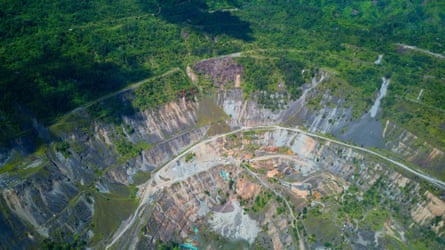
The Bougainville government hopes the controversial Panguna gold and copper mine will fund independence. Carved from a mountain in the centre of the island, it was once one of the largest gold and copper mines in the world, and still has an estimated $60bn in unrealised reserves.
“We closed the mine because of oppression,” Toroama told the Guardian in an interview last year. “Today the mine is the key to our economic growth and settling all unresolved issues from the war.”
Q&AWhat caused the Bougainville civil war?
Show
Bougainville, a group of islands off Papua New Guinea to the north of Australia, has been variously controlled by Britain, Germany, Japan, Australia and PNG.
It declared independence in 1975 as the Republic of North Solomons, but was absorbed into the newly independent PNG weeks later.
Its close ethnic ties and proximity to the Solomons archipelago means it has always sat uneasily with Port Moresby’s rule.
That discontent came to a violent head in 1988 after a long-running dispute over the lucrative Panguna copper and gold mine.
The mine, carved from a mountain in central Bougainville, was critically important to PNG, at one point generating more than 45% of the country's national export revenue.
Multinational Rio Tinto and other international investors earned nearly US$2bn from the mine over 17 years of operation. But less than 1% of the mine’s profits went to Bougainvilleans, whose homes and lands had been destroyed by it.
Under the leadership of a former mine worker, Francis Ona, disaffected Bougainvilleans ran a sabotage campaign which forced the mine’s closure in 1989.
The PNG Government responded by sending in police, then soldiers, to restore law and order. Bougainville was blockaded and the island descended into a brutal civil war that ran for a decade, and saw as many as 20,000 people die.
PNG later hired international mercenaries to end the conflict (the notorious Sandline affair), before a peace agreement was signed in 2001.
In a 2019 referendum, 97.7% of Bougainvilleans voted in favour of independence. Many argue that reopening Panguna mine will be key to the island’s economic future as an independent nation.
Multinational Rio Tinto and other international investors earned nearly $2bn from Panguna over 17 years of operation from 1972. But less than 1% of the mine’s profits went to Bougainvilleans, whose homes and lands were destroyed by it. The mine and surrounding river deltas remain dangerously polluted. Rio Tinto has signed an MOU with the Bougainville government to address the ongoing environmental and human rights impacts of the dormant mine.
Disaffected landowners ran a sabotage campaign that forced Panguna’s closure in 1989. The PNG government responded by sending in police, then soldiers, to restore law and order. Bougainville was blockaded and the island descended into a brutal civil war – known as ‘the crisis’ – that ran for a decade.
Violence returned to the mine last month, when up to 30 men carrying high-powered rifles drove into the sprawling Panguna pit site and set fire to nearly 40 heavy haulage trucks, excavators and water tanks owned by the newly appointed contractor, India’s Lloyds Metals and Energy.
Photograph: Awol Imagery/Alamy
Toroama said violence would not intimidate his government from redeveloping the mine.
“We will not cower to terroristic acts of violence designed to cause disunity and distract us from our agenda of creating a socio-politically and economically viable Bougainville,” he said after the incident.
Oliver Nobetau, Pacific islands program director at the Lowy Institute, an Australian thinktank, said it was well known across the island that “not everyone is on-side to reopen the mine”.
He said the incident, while relatively minor, had damaged the independence cause by affirming Port Moresby’s often-overstated concerns that Bougainville was not ready for independence, including that the island had not fully disarmed.
Nobetau said a “no” vote was looking increasingly likely in PNG’s parliament.
“My assessment is that it’s not going to spill over into actual conflict and fighting the way that people fear,” he said. “I think there’s going to be a lot of social tensions, a lot of political tensions, but I think eventually they’ll come back to the table to discuss how to move forward.”
Nobetau said the independence movement on Bougainville would not be deterred by resistance from Port Moresby.
“I think most likely they will try to go at it alone through the self-government model and then rolling out a three-year plan towards independence by 2030.”
KioskNews shows a cleaned-up reading view extracted from the publisher’s page — the original always lives on their site, not ours.