‘Jelliness is my life motto’: jackpot theatre prize winner Jaha Koo on kimchi, K-pop and his robotic eel
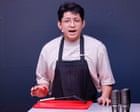
When I meet Jaha Koo in Oslo, where he has just been honoured with the prestigious International Ibsen award, I hand him a congratulatory packet of Haribo. The alternative would be a jar of kimchi but one of the many things you learn from Koo’s captivating theatre shows is that air travel and fermented vegetables can be a disastrous combo. When he moved to Berlin from South Korea with 10kg of his grandma’s finest kimchi, it became “bloated like a dead whale” and exploded on his balcony. His new neighbours were unimpressed.
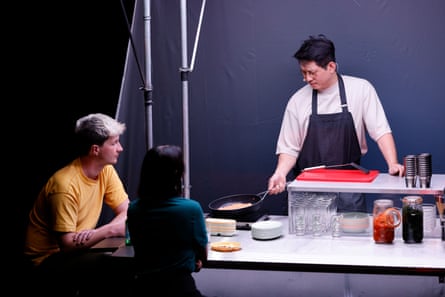
In Koo’s current touring production, Haribo Kimchi, he examines how this unlikely fusion of two foods represents his cultural identity. He does so while preparing an onstage banquet for two lucky audience members. Despite spending many years in Europe, where Haribo gummies originated around a century ago, Koo still finds himself considered foremost as Korean by Europeans. But when he returns to his original homeland he is not always seen as Korean either.
We meet the day after the ceremony for the Ibsen award, founded by the Norwegian government and rewarding the winner with a huge 2.5m kroner (£200,000). Its past recipients include Lola Arias, Taylor Mac and Forced Entertainment. Koo cheerfully packs away my sweets for the next day’s flight to Belgium, where he is now based, and outlines his life motto of “jelliness”. It was only when he arrived in Europe that he started to eat gummy bears. “When you push jelly, it can shrink and change form but after a few seconds, it recovers its shape,” he says. “That is the same resilience I need to improve when I live outside Korea.” In the show, he explains how the bears’ smiley faces cheer him up when he’s feeling down.
If Haribo was a new discovery, kimchi “was there before I was born and it was waiting for me”. As a Korean, he says, it is impossible to think about food without this quintessential side dish and he is part of “a kimchi diaspora”. The exact ingredients may differ around the world, depending on what’s available, but that doesn’t make any recipe inauthentic, he says: “Kimchi can be very diverse.” When he prepares the dish in Belgium, it sums up how he is true to his roots yet adapting to a new environment – “a kind of cultural assimilation”.
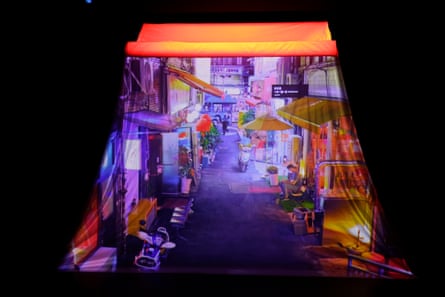
Koo is an artist adept at setting out his stall – literally so in the case of Haribo Kimchi, where the set is a Korean snack cart called a pojangmacha. It’s a movable feast, typically frequented by hungry customers of all backgrounds and generations – “kind of like a soul place,” he says. “They want to find comfort, eat quite humble food.” The roof of Koo’s bar has a Haribo-red glow that is translucent – a signifier, he suggests, of in-between states, much as the pojangmachas suggest lives in transit. “They are movable. There is no address. They appear in the evening and then disappear.” He draws a parallel with the country’s pop-up shop culture, which can transform a street over night, and Korea’s rapid pace of change which, viewed from Europe, makes him feel far behind as well as far away.
A simple kimchi pancake is on the menu for Haribo Kimchi, its aroma filling the room in a show where Koo’s narrative is often sensory – such as the persimmon fruit trees he remembers from his youth. The theatregoers who take a seat at his bar are first given a somaek, a cocktail made with soju and beer, then several dishes including cold seaweed soup. As you’d expect from the theatrical cookery genre, which has included productions as different as Travis Alabanza’s Burgerz and Hannah Khalil’s My English Persian Kitchen, each item on the menu has a different emotional resonance – Koo likens it to a score of carefully chosen compositions. Seaweed, for example, has links with birthday traditions in Korea and with ocean myths.
That brings us to Koo’s unusual co-star: a robotic eel who slithers around the stage and even delivers a ballad. (A giant gummy bear and a snail break out in song too.) It’s not as random as it sounds – Koo says he was drawn to the way eels leave their birth home, journey afar, but “then go back to their home before they die”.
Haribo Kimchi, designed by Eunkyung Jeong (who is married to Koo) and with dramaturgy by their regular collaborator Dries Douibi, had its UK premiere at this summer’s Edinburgh international festival, where the audience invaded the stage for his end-of-show buffet. It’s not the first time Koo has found that mealtimes can make perfect metaphors for a show. In Korea, he says, “When we say hello, we always ask: ‘Did you have a good meal?’ Korean people call family sikku, which means ‘people who eat together’.” His earlier production Cuckoo, which he revived in Oslo, uses rice cookers as a symbol of both “economic imperialism and the pressure upon society”.
Cuckoo delves into the longterm impact of Korea’s late 90s financial crisis and its neoliberal shift after the International Monetary Fund intervened with a $58bn rescue package. The part played by US treasury secretary Robert Rubin in what Koo calls “economic imperialism” is given a catchy electro-pop tune to rival Bo Burnham’s Jeff Bezos takedown. Koo describes, in a show as angry and raw as Haribo Kimchi is gentle and warm, a severe spike in unemployment, inequality and isolation – “a generation without a future”, including an account of his close friend’s suicide.
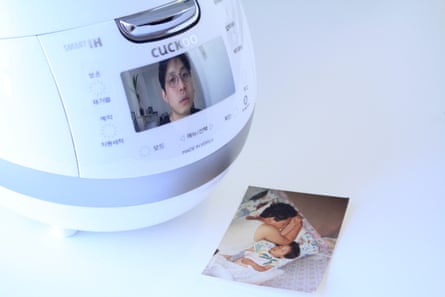
Cuckoo is the name of Korea’s brand of ubiquitous talking rice cookers – Koo appears on stage with three of them which have been hacked so that they gripe at each other and even sing. Listening to an answerphone message from his father, Koo cradles one cooker as if it’s his own child. The show also has much of the poppy melancholy of Haribo Kimchi and blurs with performance art: in the climax, he tips a mound of rice from the cooker, steam rises, and he feverishly prepares it in portions – an act of control and division as much as cheffing.
His other shows take in linguistic colonisation: Lolling and Rolling is about the tongue surgery some South Koreans pursue in order to pronounce the English “R”. The History of Korean Western Theatre examines what you could call theatrical imperialism. “I studied at university in Korea and it was quite a conservative environment in terms of what theatre can be,” he says. In this classical western definition of drama, there was no room for a robotic eel or a chatty rice cooker and Koo is intent on putting tech on stage. “When we think about our contemporary world, it’s impossible to think and understand only with a human perspective. If we want to understand our time, then we have to think about different perspectives – nature, animals – and also technology like robotics.”
In his Oslo ceremony speech, Koo duly reflected on the irony of receiving an award named after a canonical figure such as Ibsen: “But he was also an artist who questioned the theatre and society of his own time.” His next project will grapple with another artform that has become “a force for change”: K-pop, whose fans have wielded the genre’s bangers and glow sticks as a form of political protest, notably against former President Yoon’s martial law attempt in 2024. It will be the first of Koo’s shows where he will not perform; the cast will comprise singers. “I want to examine our global society through the lens of K-pop,” he says. “It has strong power as a new form of pop culture … On the other hand, the industry has a really dark side.”
Theatre, for Koo, is an arena for us “to think together” he says. “This kind of solidarity is very important,” he adds. It’s drama as an act of breaking bread with the audience – or slurping cold seaweed soup.
KioskNews shows a cleaned-up reading view extracted from the publisher’s page — the original always lives on their site, not ours.