10 Best Peanuts Comic Strips of All Time, Ranked

Michael Block is a 14 time GLAM Award nominated writer, producer, and host of the podcast Block Talk. Throughout his time in the entertainment industry, he has worked on and off Broadway as a stage manager, written several produced plays, critiqued hundreds of theatrical performances, drag and cabaret shows, and has produced events randing from drag competitoons to variety concerts!
On Block Talk, he interviews nightlife personalities, covers the wide world of entertainment through features, ranking episodes, and recaps ALL of Drag Race, as well as Dragula and Survivor. He has interviewed hundreds of RuGirls that span the globe at DragCon NYC, DragCon LA, and DragCon UK.
In his free time, he makes one-of-a-kind jewelry and gift baskets with his mom. He is a proud member of the LGBTQ+ community.
Sign in to your Collider account
When we think of the most timeless characters in pop culture, we often think about the Peanuts gang. They have been part of our lives since 1950. Created by Charles M. Schulz, the famous comic strip follows Charlie Brown, Snoopy, and the gang as they navigate everyday life, new philosophies and discoveries, and what it's like to grow up. With a media empire that has expanded over the decades, Peanuts is beloved for its emotional honesty, universal relatability, and sense of nostalgia.
The comics have showcased a plethora of characters, stories, and moments that have resonated with us because the themes are transcendent. With thousands upon thousands of strips during Schulz's 50-year run, it's a difficult task to determine which are the best. We are here to discuss 10 of the ultimate strips. The process to determine the entries included storytelling, timelessness, and their impact beyond their initial release. While we may exclude many favorites, they'll always be in our hearts.
10 The Great Pumpkin

Several Peanuts comic strips have transitioned to television specials. One of the most beloved is The Great Pumpkin. While the original animated special debuted in 1966 as It's the Great Pumpkin, Charlie Brown, the story first debuted on October 26, 1959. According to Linus van Pelt, the Great Pumpkin rises from the "most sincere" pumpkin patch on Halloween night. It is believed that the Great Pumpkin carries a large bag of toys to distribute to all the children who believe in him.
The Great Pumpkin serves as a metaphor for unwavering faith. Despite constant ribbing, disbelief, and mockery from his friends, Linus maintains his belief in the unseen pumpkin without any proof. It's a masterpiece series, as it brilliantly blends childhood innocence with the joys of the little things in life. The Great Pumpkin strips represent hope for those who desperately seek it, even as they understand disappointment may arrive instead. The Great Pumpkin has cemented itself as a major part of the Peanuts lore, expanding beyond a single strip.
9 The Kite-Eating Tree

Schulz introduced many characters into the Peanuts world, but every so often, the elements become part of the narrative. Case in point: the Kite-Eating Tree. The ravenous plant served as a nemesis for Charlie Brown's kites. The Kite-Eating Tree made its first appearance in April 1956, only to earn its infamous moniker in 1965. Also adapted for animation, including The Peanuts Movie, the tree is occasionally depicted with a sly grin that munches on Charlie Brown's aspirations.
Unlike a human nemesis, the Kite-Eating Tree represents a silent, unmoving force of nature that Charlie Brown and friends must overcome. But Charlie Brown's enduring spirit doesn't deter him, making him the personification of perseverance. Over time, the Kite-Eating Tree devoured Schroeder's piano, as well as smaller kite-eating trees popping up and menacing characters like Woodstock. The Kite-Eating Tree became a brilliant teaching tool over time.
8 Future Marriage

Fifteen years into the stories, one of the most iconic strips shows Lucy pondering her future marriage to Schroeder. The deeper she goes into her fantasy, the more it rattles Schroeder until he simply walks away when she asks, "Wouldn't that be romantic?" In the October 1965 panel, the story reminds us that Lucy doesn't realize she went too far, blaming him for not being romantic enough.
The Lucy and Schroeder relationship remains one of the most iconic duos in the bunch. After many conversations at the piano, their relationship reflects unrequited love at a young age. It's aggressive and bold on Lucy's part, yet calm and unbothered on Schroeder's. He simply wants alone time to stay in the zone. Whether we want to admit it or not, we certainly relate to one, if not both.
Collider Exclusive · Universe Personality Quiz Which Iconic Universe Do You Belong in the Most? Star Wars · Lord of the Rings · Harry Potter · Game of Thrones · Star Trek
Five legendary universes. Five completely different visions of what the world could be — or already was. One of them is the world your instincts, your values, and your particular way of existing were built for. Eight questions will tell you which one.
🚀Star Wars
💍Lord of the Rings
🧙Harry Potter
👑Game of Thrones
🖖Star Trek
01
What gives your life its deepest sense of meaning? Every universe is built around a different answer to this question.
02
Which kind of world do you most want to inhabit? The environment shapes who you become. Choose carefully.
03
How do you prefer your conflicts resolved? The shape of a world's conflicts tells you everything about its soul.
04
Who do you want beside you when things get difficult? Your ideal companions reveal the world you were made for.
05
What is your relationship with power? How you seek, wield, or resist power is the map of who you are.
06
How does your universe treat good and evil? A world's moral architecture tells you more about it than any map.
07
What role would you naturally fall into? Every universe has archetypes. Which one fits you without trying?
08
What do you ultimately believe about the future? The answer to this is the clearest window into which universe already lives inside you.
Your Universe Has Been Chosen You Belong In…
Your answers point to the iconic universe your values, your instincts, and your particular way of seeing the world were built for. This is where you would find your people — and your purpose.
Star Wars
You believe in the cause — in the idea that freedom is worth fighting for even when the odds are impossible and the empire is vast.
- You are drawn to the moral clarity of a universe where hope itself is a form of resistance.
- You'd find your people in the Rebellion — a ragtag coalition of true believers held together by conviction more than resources.
- Star Wars is fundamentally a story about ordinary people choosing to matter in an extraordinary conflict — and that is exactly your kind of story.
- The Force may or may not be with you. But the will to use it for something larger than yourself certainly is.
Lord of the Rings
You understand, in the deepest part of yourself, that the journey matters as much as the destination — and that the world's beauty is worth protecting even at great cost.
- Middle-earth is a world of ancient wonder, deep friendship, and a darkness that only retreats when enough small acts of courage accumulate.
- You would thrive here because you value the fellowship more than the glory — the road more than the arrival.
- Tolkien's universe rewards patience, loyalty, and the willingness to carry something heavy across a very long distance.
- Those are not burdens to you. They are simply how you move through the world.
Harry Potter
You believe that love, loyalty, and doing what's right are not naive sentiments — they are the most powerful forces in any world, magical or otherwise.
- The Wizarding World is a place of wonder hidden in plain sight, where learning is transformative and the bonds you form at school follow you into every battle.
- You would flourish here because you take both the magic and the friendships seriously — and you understand that one without the other is incomplete.
- Harry Potter's universe ultimately rewards those who choose to stand for something even when standing is terrifying.
- That choice — made quietly, without guarantee — is something you understand completely.
Game of Thrones
You see the world clearly — its power structures, its hypocrisies, its brutal arithmetic — and you are not paralysed by that clarity. You use it.
- Westeros is a world that rewards intelligence, adaptability, and the willingness to understand that every alliance is also a negotiation.
- You would survive here — possibly thrive here — because you don't confuse the world as it is with the world as you'd like it to be.
- Game of Thrones is a story about what happens when the idealists and the realists collide. You are sharp enough to know which one lasts longer.
- Winter always comes. You are already prepared.
Star Trek
You believe the future is worth building — that curiosity, cooperation, and the expansion of understanding are not just ideals but the most practical path forward for any civilisation.
- Star Trek is a universe where the questions matter as much as the answers, and where encountering something utterly alien is cause for wonder rather than fear.
- You would belong here because you are fundamentally optimistic about what intelligence and decency can achieve — while being honest about how hard that achievement is.
- The Federation is the universe's most ambitious thought experiment: what if we actually got better?
- You don't just hope that's possible. You think it's the only thing worth working toward.
7 Endless Space

Out of the mouths of babes do we hear the most innocently profound comments. Such is the case in the June 9, 1963, strip known as "Endless Space." A truly brilliant narrative about an overwhelming existential truth, "Endless Space" bridges the gap between youthful innocence and the burdens you face. The panel features Charlie Brown and his sister Sally standing in a field, looking out at the stars. Upon Charlie Brown telling Sally that one day the Big Dipper would be gone, she wallows in dread.
Rather than typical small talk, the discussion becomes casually philosophical. No matter what, a time will come when "we" simply will not exist anymore. It's a deep concept young children may not understand, which makes the strip so brilliant. Schulz takes the terrifying concept of stellar mortality and drops it into the lap of an innocent child. Her sudden meltdown is brutally honest and sincere. Often filled with melancholy, this strip was a rare occurrence where existentialism became the focus.
6 Lucy's Feelings

For long-running series, the brilliance of non-aging characters is the potential for character development. Or, at the very least, moments of vulnerability that might be rare for their normal appearances. Such was the case for Lucy in the June 30, 1963, strip. After pining that her "life is a drag," it's Linus who is there to serve up some sound advice. Lucy feels that life cuts her no breaks like others, and she can count her blessings on one finger. Linus tells her to be grateful for what she does have — "a little brother who loves you." After a moment of silence, she hugs him and cries.
Lucy has feelings! She's not a one-dimensional character. In a rare moment of vulnerability, the crabby facade is whisked away to reveal that she is deeply emotional. It's one of the most accessible comics because we feel what Lucy feels. We may feel as if we have nothing and that it might not get better, when all it takes is an outsider to put it all into perspective. It's a genuinely raw narrative that shows Lucy's sensitivity. It also gives a beautiful glimpse of unconditional love. This strip is a true breakthrough for the character and reader alike.
5 Snoopy Eats in the Rain

Many of us treat our pets like humans. That unconditional love we have for our pets plays a major role in why we adore the bond between Charlie Brown and Snoopy so much. In this strip, Snoopy opines about the difficulties of being a dog, especially when it's raining, and you're anticipating breakfast. Unfortunately, Snoopy's desired pancakes float away when the water rises. From joy to sadness, Snoopy has a revelation about what it means to be an animal.
Schulz quite often showcases Snoopy's simple pleasures in life through the reality of being a dog. While Charlie Brown doesn't necessarily know what happens when he's gone, the action matters most. His deep, gentle care for his pet is special because Snoopy is special. It's why he relishes being treated like royalty. Rather than barking for help, he relents to fate. It's a bit sad, but it serves as a reminder of exactly what a dog's life is.
4 Snoopy vs. the Red Baron

One of the most iconic recurring storylines in Peanuts' history is Snoopy versus the Red Baron. First introduced in October 1965 as the World War I Flying Ace, the strip watches as Snoopy, wearing a leather helmet and goggles, sits atop his doghouse. As the doghouse transforms into a Sopwith Camel biplane, he faces off against his arch-nemesis, the German fighter pilot, the Red Barron. The strip was so iconic that it not only made its way onto the page and screen multiple times, but it inspired a novelty song by The Royal Guardsmen and became its own video game in 2006.
The original strip was regarded as one of Schulz's most creative achievements. Snoopy vs. the Red Baron merged vivid childhood imagination with topical humor. As children, we all imagine the mundane things around us as bigger set pieces. And even though he's a dog, it doesn't stop Snoopy from dreaming that his doghouse is bigger than it is. The Red Baron is never seen, following Schulz's rule of keeping adult elements out of the physical frame. No matter how many times Snoopy was shot down by the Red Barron, he continued to pursue him during his next mission. Snoopy vs. the Red Baron represented the most imaginative and joyful eras.
3 Lucy's Booth

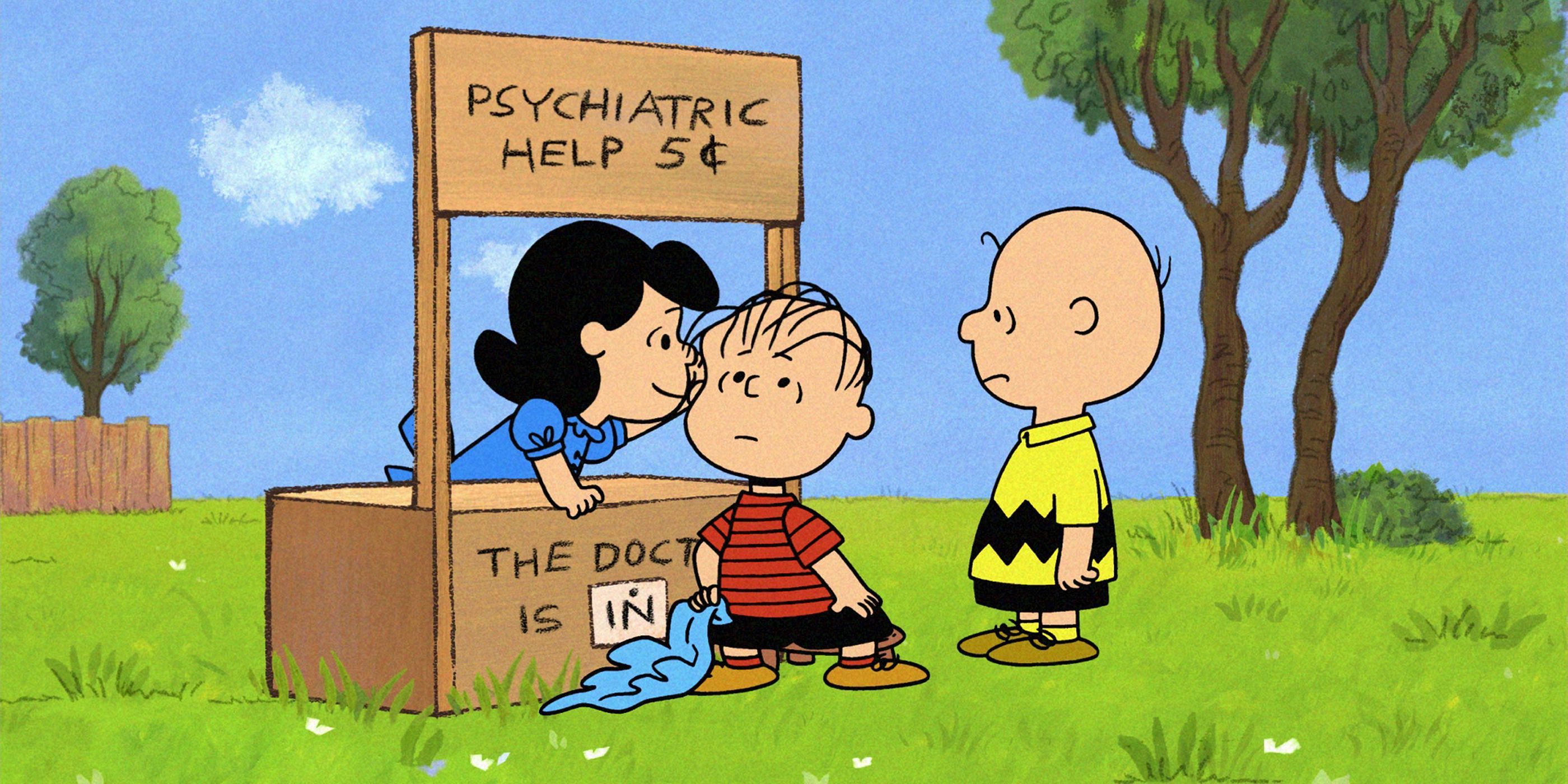
The Peanuts often mixed their childhood innocence with adult-oriented philosophical satire. Perhaps the best example is Lucy's psychiatric booth. A running gag in the series, the first strip was released on March 27, 1959. Here, we see Charlie Brown sharing with Lucy that he has feelings of depression. Seeking advice, Lucy, with her infinite wisdom, retorts, "Snap out of it!" She then immediately requests her five cents. A quick and silly story, this first iteration established adult humor for all ages.
Schulz used Lucy's booth as a brilliant parody, transforming a classic lemonade stand into a single-coin psychiatric practice. From first appearance to last, Lucy offers blunt, often horrible advice. Yet, in doing so, she cuts through Charlie Brown's self-deprecation to find something deeper inside. Over the course of the run, Charlie Brown visited Lucy 115 times. Though it meant he had such woes to share, his willingness to reach out to Lucy, despite her words, means he trusts her.
2 The Football

Easily the most famous running gag in Peanuts' history is Charlie Brown and the football. It originated on November 14, 1951, and the first time it appeared featured Charlie Brown and a character named Violet. Yes, that's right, Lucy came later. With Violet, her reason for pulling away was out of fear that he would kick her fingers. A year later, Lucy held the football for the first time, and it quickly became a regular, cunning trick. Charlie Brown never learned, as he attempted to kick the football 36 times.
The recurring strip represents life's ongoing struggle and the inevitable disappointment that comes with failure. Yet the moral of the recurring bit also represents persistence. Schulz often used jokes to mirror real life, with adversity being a major theme. Charlie Brown's repeated failure is funny yet heartbreaking, but at the end of the day, it's relatable. We all face setbacks in life, and the football represents a plethora of things. But like Charlie Brown, we don't give up. Ironically, in the final appearance, we never learn if he ever succeeded, as Schulz never showed it. How's that for a brilliant conclusion?
1 Happiness Is a Warm Puppy

It may not be the most famous strip, but if there ever was a Peanuts comic that represented the brand, it's "Happiness Is a Warm Puppy." Debuting on April 25, 1960, the four-panel strip is simple. It features Snoopy and Lucy as she pets his head, hugs him, and realizes that "happiness is a warm puppy." Inspiring a 1962 gift book of the same name, the original is a beautifully charming narrative that depicts a simple definition of what happiness is.
It's a standout entry, capturing a universal truth while showcasing a raw moment of tenderness from Lucy. Seeing her let her guard down to hug Snoopy showcases that there is a lot of depth to these characters. She is highly relatable and sweet despite the exterior and facade. While those of us dog lovers know this sentiment to be true, it extends beyond that to prove the importance and impact of physical comfort.

Peanuts
- Release Date
- 1965 - 2005
- Directors
- Phil Roman
-

Ann Altieri
Violet (voice)
-
Cathy Steinberg
Sally Brown (voice)
-
Christopher DeFaria
Peppermint Patty (voice)
-
Christopher Shea
Linus van Pelt (voice)
KioskNews shows a cleaned-up reading view extracted from the publisher’s page — the original always lives on their site, not ours.