Average wage rises, but 70% still making less
By Crystal Hsu / Staff reporter


Taiwan’s average regular monthly wage rose 2.81 percent year-on-year to NT$49,477 (US$1,506) in September, while total wage, including bonuses, overtime pay and other irregular compensation, increased 4.83 percent to NT$60,297, the Directorate-General of Budget, Accounting and Statistics (DGBAS) said yesterday.
The gains came as strong global demand for artificial intelligence (AI) hardware continued to support production at Taiwan’s technology manufacturers.
“The latest figures suggest a stable job market that has benefited from global AI deployment,” DGBAS Census Department Deputy Director Tan Wen-ling (譚文玲) said.
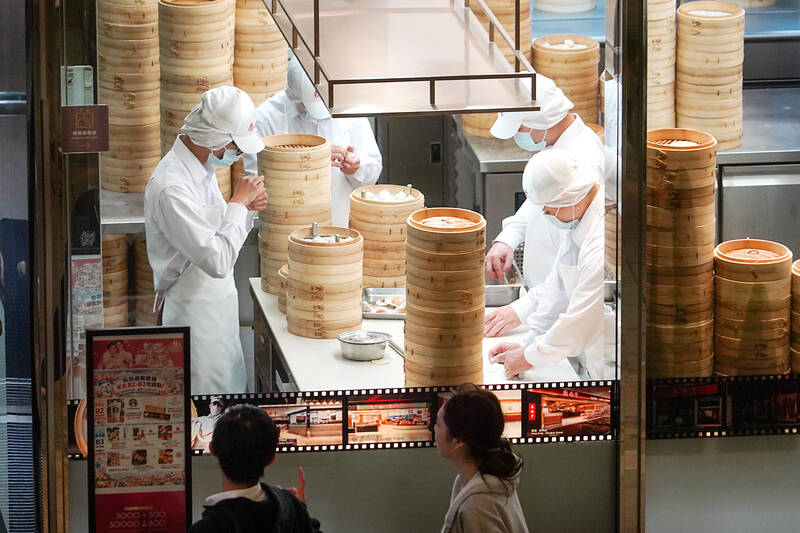
Din Tai Fung staff make Xiaolongbao, also known as steamed soup dumpling, at a branch of the restaurant chain in Taipei’s Xinyi District yesterday.
Photo: CNA
The strength of manufacturing activity was reflected in record overtime hours, particularly among workers producing electronic components and other technology products.
Manufacturing employees worked an average of 17.9 hours of overtime in September, the highest for the month since records began in 1979, and 1.1 hours more than a year earlier, Tan said.
Electronic components industry workers logged an average of 28.3 overtime hours, the highest level for September in 47 years, up 0.4 hours from a year earlier.
In the computer, electronic and optical products industry, average overtime hours reached 17.5, the highest level for September in 23 years and an annual increase of 1.1 hours.
For the first nine months of this year, the average regular monthly wage rose 2.93 percent from a year earlier to NT$49,152, while total wage increased 4.59 percent to NT$60,498, the strongest growth for that period in 16 years.
After adjusting for inflation, real regular monthly wage grew 0.98 percent, indicating that wage gains continued to outpace consumer price increases, although the improvement was less pronounced, Tan said.
However, rising average wages did not translate into comparable gains for all employees, as almost 70 percent earned less than the overall average during the first nine months, she said.
The proportion stood at 69.97 percent in September, slightly below the 70.03 percent recorded in the first half of the year.
DGBAS data showed that the share of employees earning below the average has increased every year since 2020.
Tan attributed the trend mainly to changes in the composition of the workforce, saying that the number of migrant workers and part-time employees has grown faster than that of full-time Taiwanese workers, raising the proportion of relatively lower-paid employees.
Meanwhile, stronger wage increases among higher-paid employees have lifted the overall average, she said.
The median monthly wage, which provides a better indication of what a typical employee earns, increased 2.93 percent year-on-year to NT$39,793 in September and rose 3.04 percent year-on-year to NT$39,429 in the first nine months, DGBAS data showed.
KioskNews shows a cleaned-up reading view extracted from the publisher’s page — the original always lives on their site, not ours.