Op Sindoor showed how fast IAF can move into combat: Air chief
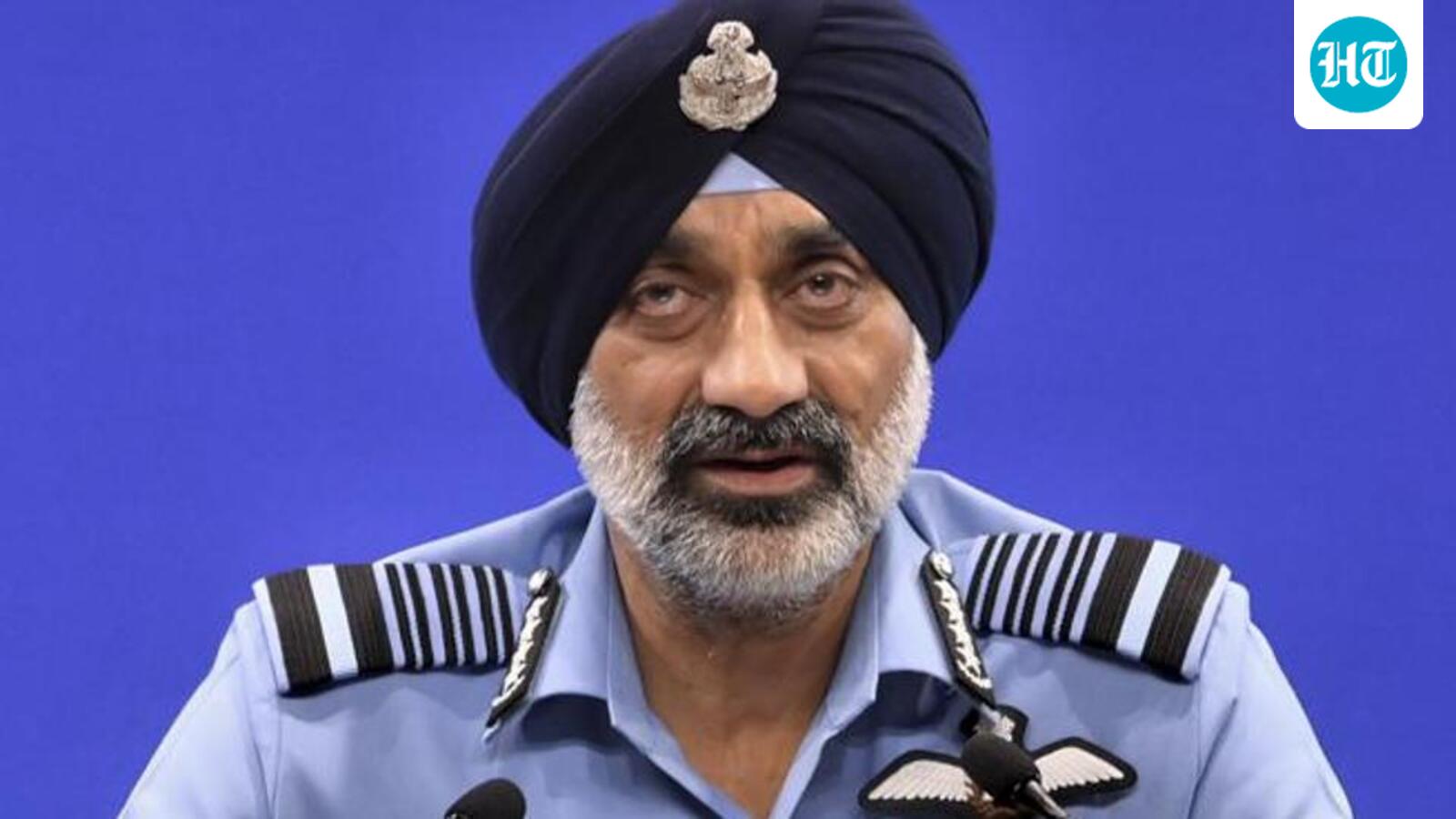
Air Chief Marshal AP Singh on Thursday said that last year’s four-day military confrontation with Pakistan under Operation Sindoor showed the world how swiftly the Indian Air Force (IAF) can move into combat, even as he underscored the central role of air power in safeguarding national interests.
“Last year, the whole world witnessed the speed with which the IAF moved into combat operations. We saw first-hand the destructive power as well as the effective air defence operations of the IAF during Operation Sindoor,” the Chief of Air Staff said in his IAF Day address at the Hindan air force station.
In the early hours of May 7, 2025, the IAF struck two terror sites at Markaz Subhanallah in Bahawalpur and Markaz Taiba near Muridke, both in Pakistan’s Punjab province, while the army hit targets at seven places, including Mehmoona Joya in Sialkot, Sawai Nala and Syed Na Bilal in Muzaffarabad, Gulpur and Abbas in Kotli, Barnala in Bhimber, and Sarjal. On May 9-10, 2025, the IAF struck military targets in Rafiqui, Murid, Chaklala, Rahim Yar Khan, Sukkur, Chunian, Pasrur, Sialkot, Skardu, Sargodha, Jacobabad, Bholari and Malir Cantt in Karachi.
Also Read:LCA Mk-1A, LCA Mk-2, MRFA: Key projects new IAF chief is expected to push
The world is going through rapid changes, leading to uncertainty and intricate geopolitical challenges, Singh said. “New conflicts are emerging across different parts of the world. These events have clearly demonstrated that air power is the primary means of protecting the national interest. The IAF, being the custodian of the air power, understands its role and responsibilities and is always alert, committed, and ready to meet any contingency,” said Singh, who retires on October 31.
The men and women behind the machine matter most, he said.
“We believe that any air force can have the most advanced aircraft or systems in the world, but its true strength is measured by its operational preparedness...how quickly and confidently it can act whenever the call comes,” he said, drawing attention to the IAF’s tagline “Infallible, Impervious, and Precise.”
Also Read: UP-made BrahMos missiles forced Pakistan to cry for help during Operation Sindoor: Yogi
The IAF understands that operational capability rides on the back of professional training, he said. “Our aircrew and ground crew are trained to such a high degree that their skill becomes their second nature. And whether the task is defending our skies, or delivering aid in a disaster, or carrying out punitive strikes, we are constantly preparing for the mission. This year, we have continued to build on that foundation through significant initiatives such as Vayu Shakti, Dronathon, and the ongoing multilateral air exercise Tarang Shakti. These efforts are focused on actively validating our combat readiness while swiftly integrating niche technologies into our operational frameworks.”
More than 80 Indian and foreign aircraft, including fighters ranging from the F-35 to the locally produced Tejas light combat aircraft, are participating in Tarang Shakti. Eight air forces are participating with their air assets, including the US, France, Germany, the United Arab Emirates, Australia, Bangladesh and Sri Lanka. The 32 observers include Brazil, Egypt, Italy, Japan, Malaysia, Oman, Singapore, South Africa, Thailand and Vietnam.
Also Read: Amar Chitra Katha’s next comic to celebrate Hindustan Aeronautics Limited’s aviation milestones
“We have continuously embraced new technologies. We are entering an era shaped by artificial intelligence, autonomy, and digital innovation. The IAF is using AI to help commanders make informed decisions after analysing enormous amounts of data. Autonomous systems are being developed with “man-in-the-loop,” aligning with our goal to create an AI-augmented force enhanced by technology while keeping human authority at the centre,” Singh said.
He also highlighted efforts to bolster self-reliance.
“While enhancing the capability of the IAF, atmanirbharta is our guiding principle. Indigenous systems such as the Tejas light combat aircraft, advanced medium combat aircraft, HTT-40 trainer, Dhruv and Prachand helicopters, Astra missiles, Akash air defence systems, and BrahMos missiles are results of this very resolve. On this same foundation of self-reliance, rapid adoption of emerging technologies has become the IAF’s top priority,” the IAF chief added.
KioskNews shows a cleaned-up reading view extracted from the publisher’s page — the original always lives on their site, not ours.