Netanyahu is not Thatcher, but both faced the same problem: When to leave - opinion
While the United Kingdom has become known as the "cradle of democracy" via which candidates are elected to the "mother of parliaments," the Israeli system, by contrast, as we are witnessing, is best described as a Balagan, a Yiddish word to describe a state of chaos, disarray, and confusion.
The two electoral systems have their differences.
The UK electorate goes to the polls (at most) every five years and elects 650 members of parliament, one for each seat, geographically designated. Each member represents a party. A minority are independents.
The leader of the party with the most seats will be asked by the monarch to see if he or she can form a majority government either with their own party or, if not, in coalition with another party or parties. The system is first-past-the-post. Parliament is bicameral, two houses, one elected, the other selected by appointment or accident of birth.
The Israeli system is a form of proportional representation. As you know only too well, elections are by votes for a party whose number of seats out of the 120 is determined by their proportion of the public vote.

But while the systems have fundamental differences, each from time to time finds itself with the same issue that arises with leadership, namely, how to get rid of them when they have outstayed their welcome. This is now the Israeli conundrum.
The starkest similarity of that problem is between Netanyahu and Thatcher. Both are and were known as the strongman and woman of their respective parties in their respective eras. Both engendered a feeling of security in their people, and each became a thorn in the side of their citizens.
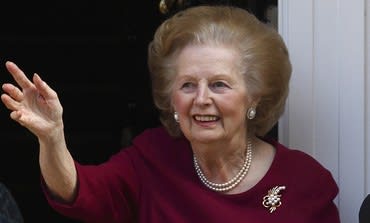
Margaret Hilda Thatcher, baroness Thatcher, served as prime minister of the United Kingdom from 1979 to 1990, the longest-serving British prime minister of the 20th century.
As prime minister, she implemented policies that came to be known as "Thatcherism." A Soviet journalist dubbed her the "Iron Lady," a nickname that became associated with her uncompromising politics and leadership style.
Similarly, Benjamin "Bibi" Netanyahu is Israel’s longest-serving prime minister of the 20th Century.
He has held office from 1996 to 1999, from 2009 to 2021, and since 2022.
Maggie took “her” country to war over the Falkland Islands against Argentina and, while she did not welcome the start of the war, she famously announced “Rejoice, rejoice” when victory was assured.
Bibi took “his” country to war after the October 7 massacre in 2023, and more recently against Iran. Many believe he is poised to take the country back to war against Iran as the outcome of the elections remains in balance.
Was Maggie pleased to go to war with Argentina? And how. In October 1981, her conference revealed her ministers conspiring against her, and she was behind in the polls. She was against membership in the European Union. Everything changed in March 1982 as she launched the response attack on Argentina. The result was her victory in the General Election of 1983.
War has often been used as a politician’s device – either to distract from internal issues or to hope the public will not want to change leaders at a time of uncertainty, and the worst cynics accuse Bibi of this behavior.
I said Maggie took her country and Bibi took his country to war, and therein lies part of the problem. Neither Thatcher nor Netanyahu realized that they have no feudal right to govern their respective countries forever.
Shakespeare says in Hamlet: “There is a special providence in the fall of a sparrow. If it be now, 'tis not to come; if it be not to come, it will be now; if it be not now, yet it will come.”
But leaders such as them believe the end of their “reigns” will never come, and so ultimately and inevitably the problem becomes how to get rid of them.
Three things brought Thatcher down: The poll tax, a flat-rate local tax regardless of income, leading to riots. Division over membership of Europe and, thirdly, her cabinet colleagues’ knives in her back. (Sir Geoffrey Howe’s resignation speech was lethal, even though listening to his speeches was once likened to being savaged by a dead sheep).
In her 11 years in office, I never met one person who admitted voting for her.
We have yet to see whether Netanyahu will fall this time round.
So why else do leaders cling onto power long after change is due?
The short distance you walk to the polling booth and the privacy it affords the voter seems to be a problem.
For as the pen is raised or the envelope is about to be sealed to cast your vote, a moment’s weakness overcomes many, and their resolve to vote for change disappears and is replaced by a yearning for the same old, same old. After all, they haven’t done such a bad job, have they? They will keep us safe, won’t they?
Challenges in Israel's political system
In fact, Israel’s whole electoral process in some respects is weaker than Britain’s.
We have noticed, as new olim (immigrants to Israel), the fact that while there are a few core issues: wider conscription of the haredim (ultra-Orthodox), a Zionist party precluding having members of Arab parties in government, what is missing are the sort of issues the UK regards as bread and butter:
Immigration; welfare; taxation; these are spelt out in a way that doesn't happen in Israel. Why not? You deserve a proper look at all important policies.
What does this all teach us? It is perhaps as important that not only do our leaders stay resolved, but so should the voters. If you want to change your leader, it is in your hands.
Change takes resolve and risks to be taken if progress is to be made.
Nigel Lithman is a retired criminal Judge and author. He lives between London and Zichron Ya’akov.
KioskNews shows a cleaned-up reading view extracted from the publisher’s page — the original always lives on their site, not ours.