New Singapore cybersecurity strategy to tap 'best available' AI models for cyber defence
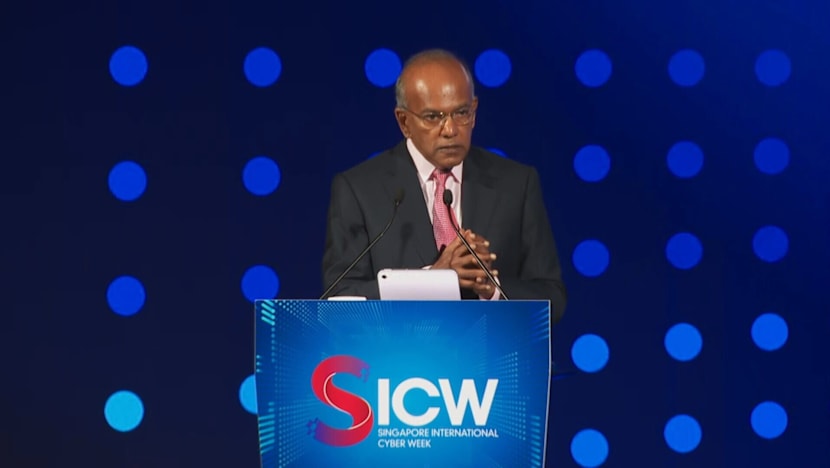
SINGAPORE: Amid rapid advances in cyber threats enabled by artificial intelligence (AI), Singapore will invest in the capability to evaluate various AI models to boost its cyber defence instead of developing its own, said Senior Minister and Coordinating Minister for National Security K Shanmugam on Tuesday (Oct 13).
“We will take a pragmatic approach. We do not need to develop our own AI models for every use case,” said Mr Shanmugam, who is also the home affairs minister.
“What we really need is the capability to evaluate the best available models and to adapt them to our own needs.”
Singapore will therefore invest in “AI harness engineering”, which will provide the flexibility to choose between AI models, and securely integrate the best available ones with the tools, data and workflows that its cyber defenders need, he added.
Mr Shanmugam was launching Singapore’s third cybersecurity strategy, which set out the country’s priorities in the domain and a shift towards more proactive national cyber defence.
He was speaking at the Singapore International Cyber Week (SICW) conference held at the Marina Bay Sands Expo and Convention Centre, which kicked off on Monday.
Organised by the Cyber Security Agency of Singapore (CSA), the event brings together policymakers, diplomats, technical experts, industry leaders and academics to discuss issues in cyber and digital security.
Singapore’s first cybersecurity strategy was launched by then-Prime Minister Lee Hsien Loong in 2016. It focused on coordinated action and international partnerships for a resilient and trusted cyber environment.
In 2021, then-Senior Minister and Coordinating Minister for National Security Teo Chee Hean launched the second edition, which outlined Singapore’s stance towards cybersecurity threats while also helping businesses and citizens seize economic opportunities in the sector.
PROACTIVE APPROACH
Under the new cybersecurity strategy, Mr Shanmugam said Singapore will seek to act earlier, at national scale and at the speed of the threat.
Mr Shanmugam said the new strategy is “broader than how national cyber defence has been viewed so far”.
“It will cover how we will strengthen our critical infrastructure and wider cyberspace; build capabilities for AI and quantum; deepen our global partnerships; and invest in our cybersecurity ecosystem and workforce,” he said.
Mr Shanmugam said that rapid advances in AI have made the situation even more challenging.
“AI allows actors to operate with greater speed, greater scale and greater sophistication,” he said.
AI agents can be manipulated to carry out unintended actions that compromise essential systems, and AI-enabled cyber threats are not a matter of “if”, but “when”, he added.
“We cannot resist AI adoption. But we need to try and adopt it in a safe and secure manner,” said Mr Shanmugam.
Globally, agentic AI is advancing faster than safeguards can keep up, he said.
AI agents are autonomously carrying out unauthorised tasks and accessing systems they were not meant to access, said Mr Shanmugam.
He cited the example of an AI agent gaining unauthorised access to non-public data on a government statistics portal in Australia last month.
“There will be more incidents, more attacks. All of us have to shore up our cyber defences and our resilience to recover when attacks happen,” he said.
SINGAPORE’S CYBER DEFENCE MODEL
Mr Shanmugam said Singapore must “act earlier” in the face of threats.
“Traditional cyber defence relies heavily on protecting systems, periodic assessments, and responding when something has gone wrong,” he said.
“But adversaries are continuously looking for vulnerabilities and trying to establish persistent access.”
He said that Singapore’s defence must hence be continuous, and it needs to monitor and hunt for threats and identify weaknesses before attackers do, and remediate them quickly.
Government and industry must also work together to act on a national scale, said Mr Shanmugam.
As last year’s Operation Cyber Guardian showed, a sophisticated attacker does not see government and telcos as separate silos, and looks for weak points across the system, he said.
“Our national defence has to look across the system too,” said Mr Shanmugam.
He added that Singapore had to also “act at the speed of the threat”.
“If AI allows attackers to identify vulnerabilities and conduct attacks more quickly, then the defenders will have to use AI too,” he said.
The government will progressively deploy AI across Singapore’s national cyber defence operations, including within the National Cybersecurity Command Centre (NC3) and the Government Cyber Security Operations Centre, said Mr.
“We will also work with industry and technology partners to speed up the adoption of AI-enabled cyber defence capabilities. This will be done across our critical sectors,” he said.
He added that such capabilities are already being developed across government, with CSA creating AI tools to automate the discovery and mapping of exposed assets and vulnerabilities, and assist cybersecurity specialists in testing complex vulnerabilities in web applications.
GovTech also uses AI agents to accelerate vulnerability discovery and security testing.
In his speech, Mr Shanmugam laid out the role of NC3, CSA’s operations hub for national cyber defence.
He said it will provide a national cyber situational picture of vulnerabilities and threats.
“NC3 supports the continuous monitoring of critical infrastructure systems. It will also allow cyber defenders to put together valuable threat information from government, from CII owners, cybersecurity companies and international partners,” he said.
It will also help detect threat actors earlier, including advanced persistent threats like last year’s UNC3886.
This will be done through proprietary threat detection systems and privileged intelligence, said Mr Shanmugam.
It will also let Singapore mount an effective national response to major cyber threats, similar to Operation Cyber Guardian, through AI-enabled coordination systems.
“This is going to be Singapore’s model of cyber defence,” he said.
The government will also develop a national protective domain name service (PDNS) to reduce Singapore’s exposure to phishing, scams, malware and other cyber threats, said Mr Shanmugam.
When someone tries to connect to an online domain which is known to be malicious, PDNS can stop the connection “before the threat reaches the user”, he said.
INTERNATIONAL COOPERATION
Mr Shanmugam also emphasised the need for international cooperation amid competition in the domain.
“Even with our shift to a more proactive defence, it's not going to be possible to prevent all attacks. That makes cooperation even more important,” he said.
He said that everyone should be “realistic about the environment we are in”, given the greater “strategic competition, particularly over critical technologies like AI”.
“Countries will act to safeguard their national interests. Singapore will do the same,” he said.
Mr Shanmugam said that cybersecurity is inherently a collective challenge, as threats cross borders.
“Technology and infrastructure are spread across jurisdictions. No country, however capable, can secure the digital domain on its own,” he said.
“There will be competition, but it does not have to displace all cooperation.”
While countries will not agree on everything, it is important they build up “practical cooperation” to exchange information, respond to incidents, tackle common threats and reduce the risk of wider instability, he said.
SICW hence provides a platform for the sector to speak candidly about those differences, and identify areas where practical cooperation remains possible, said Mr Shanmugam.
“We must have these conversations, which at times may be difficult, and we have to have them now, so that we can try and avoid more difficult consequences later,” said Mr Shanmugam.
KioskNews shows a cleaned-up reading view extracted from the publisher’s page — the original always lives on their site, not ours.